
Notary for a Property Purchase in Geneva: Role, Obligations and Process

In Geneva, buying real estate must necessarily go through a notary: the law requires a notarial deed to carry out the transfer of ownership. As a public officer, the notary secures the transaction, ensures its legality and records the transfer in the land register.
This article explains the notary's role, why it is mandatory, how to choose a notary and how the purchase unfolds at the notary's office. It lists the documents to provide, clarifies the notary's role in mortgage financing and covers the cost of their services.
What is the notary's role in a property purchase in Geneva?
The notary receives the notarial deed of sale and legally secures the transfer of ownership. As a public officer, their role is not to advise one party to the deed, but to make it an impartial document, for the benefit of both the buyer and the seller.
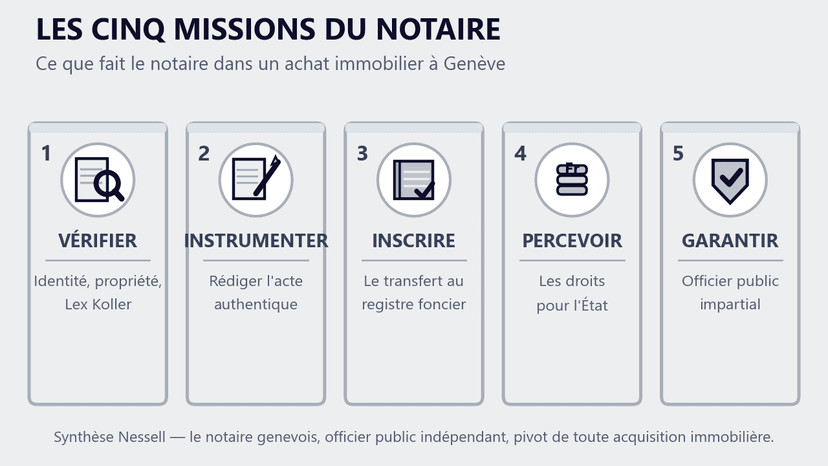
The notary verifies the identity and legal capacity of the parties, checks the property's status in the land register (owner, easements, liens) and ensures compliance with the applicable rules, including liability to the Lex Koller where relevant. They draft the deed, read it aloud, collect the signatures, then apply for the transfer to be recorded in the land register. On behalf of the State, they collect the duties and taxes related to the sale, and manage the payment of the price through a dedicated account.
In Geneva, notaries operate as independent professionals: appointed by the Council of State, a notary practices without dependency but under supervision, and under their own responsibility. This status places them at the center of every real estate transaction.
This diagram summarizes the notary's five duties in a property purchase in Geneva.
Is a notary mandatory to buy in Geneva?
Yes, in Geneva going through a notary is necessary to buy. A property sale is only valid in notarial form (Art. 216 para. 1 of the Code of Obligations): without a deed received by a notary, it is void and the transfer cannot be recorded in the land register. A simple written agreement between the parties, even if signed, is not sufficient. In Geneva, only an independent notary is competent to draw up this deed.
Who chooses the notary for a purchase in Geneva?
Under Geneva practice, the choice of notary in principle belongs to the buyer (the party bearing the costs designates the public officer). This choice is free: the buyer is not bound to their bank, the broker or the seller.
Since the notary is impartial, a single notary may draw up the deed for both parties (which is common in Geneva), but nothing prevents each party from being assisted by their own notary. In practice, the buyer often uses a notary who has been recommended to them or with whom their bank is used to working.
How does the purchase unfold at the notary's office in Geneva?
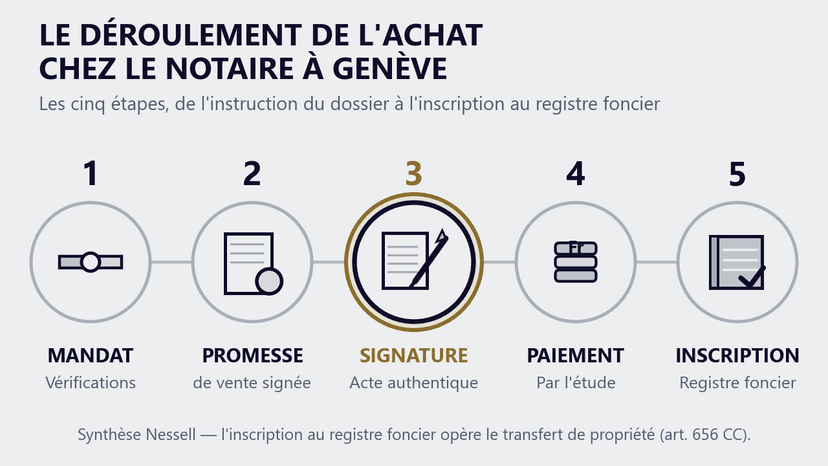
The purchase at the notary's office comprises several steps, from reviewing the file to recording it in the land register.
Once an agreement is reached, a notary is engaged, who carries out the usual checks: land register extract, identity and legal capacity of the parties, mortgage status, and possible liability to the Lex Koller. A preliminary sale agreement is often signed, with conditions precedent such as obtaining financing. The notary then draws up the draft deed of sale and sends it to the parties.
On signing day, the notary reads the notarial deed aloud, collects the signatures and ensures payment of the price, often into an account held by the notary's office. They apply for the transfer to be recorded in the land register: it is this registration that confers ownership on the buyer. The notary finally draws up the final statement and remits the collected duties to the State.
This timeline presents the five steps of the purchase process at the notary's office in Geneva.
What documents does the notary request for a purchase?
The notary gathers the documents that establish the identity of the parties, the status of the property and the financing of the transaction.
- The parties: an identity document, civil status and, where applicable, the marital property regime or marriage contract, which determines the power to dispose of the property.
- The property: the land register extract and, for a condominium (PPE) unit, the co-ownership regulations and the minutes of meetings.
- The financing: the bank's loan confirmation and information on the mortgage note to be created or taken over.
- Lex Koller authorization: required when the buyer is a person abroad subject to this regime.
What is the notary's role in mortgage financing?
For financing, the notary creates the mortgage collateral required by the bank and has it recorded in the land register. The mortgage note is the security instrument drawn up by a notarial deed separate from the sale (it is a lien instrument).
After verifying the status of any existing liens, the notary creates the mortgage note or has it assigned to the lender, and applies for its registration. They ensure that the bank releases the funds on the signing date, so that the price is paid to the seller on that date. The mortgage note incurs its own costs, in addition to those of the deed of sale, borne by the buyer.
How much does the notary's involvement cost in Geneva?
The cost of the notary's involvement combines their fee, disbursements and the duties and taxes they collect on behalf of the State. The fee remunerates their work according to a regulated cantonal schedule, not to be confused with the registration duties, which are much higher and go to the canton. The calculation of the fee and the order of magnitude of the total are detailed item by item, with a reference to the notary fees section and the notary's place in the purchase process.
How are notary fees calculated in Geneva?
Notary fees in Geneva comprise several items:
- the notary's fee (degressive with the value of the deed)
- the registration duties collected by the canton
- the land register fees
- disbursements
In addition to the costs of the deed of sale, those of the mortgage note are added in the case of a loan. The dedicated article on notary fees in Geneva sets out the detailed rates and a figure for the order of magnitude.
How does the notary fit into the purchase process in Geneva?
The notary always comes in downstream of the purchase. Once the property has been found and the conditions for its financing have been secured, the notary takes over from the buyer's preparatory steps to formalize the sale and legally secure its transfer. Their involvement forms the final, yet structuring, step of the process: the main steps to buy in Geneva, from the property search to financing, all lead to signing the notarial deed at the notary's office.
Can you buy without a notary in Geneva?
No, buying without a notary in Geneva is not possible. Since a property sale is subject to the notarial form (Article 216 of the Code of Obligations), no sale, even between relatives or within the same family, can be exempted from it. A private agreement would be void and could not be recorded in the land register.
Can you choose the same notary as the seller?
Yes, the buyer can choose the same notary as the seller. As an impartial public officer, the notary draws up the deed for both parties at once; they do not represent the interest of one party against the other. This is the solution adopted in practice, particularly in Geneva, for the sake of simplifying and speeding up the transaction. Each party retains the option of using their own notary if they wish.