
Notary Fees in Geneva: Composition, Calculation and Amount

In Geneva, a property purchase has so-called "notary" fees added to the purchase price. Despite this common name, only a tiny fraction of the fees collected actually goes to the notary; the majority are taxes and duties collected for the State and the land register.
This article details what these fees consist of, how the notary's fee is set, how to calculate them to know what amount to expect, who must pay them and when, and how to partially reduce part of them. It is based on the cantonal notary fee schedule and Geneva legislation.
What do notary fees in Geneva consist of?
In Geneva, notary fees are broken down into four components:
- transfer duty
- land register fees
- the notary's fee
- disbursements
Three of these components are public levies; only the fee remunerates the notary.
- Transfer duty is the cantonal tax levied on the sale, payable to the State of Geneva.
- Land register fees are the charge for registering the transfer of ownership and the mortgage note, payable to the land registry office.
- The notary's fee corresponds to the fees of the notary handling the drafting of the deed, set by a cantonal schedule.
- Disbursements cover all the costs advanced by the notary (extracts, certificates) that are recovered from the buyer.
This chart quantifies the composition of notary fees for a purchase at CHF 1'000'000 financed by a mortgage note of CHF 800'000: the two tax components (transfer duty and the duty on the mortgage note, totaling CHF 40'920) far outweigh the notary's fee (CHF 8'300).
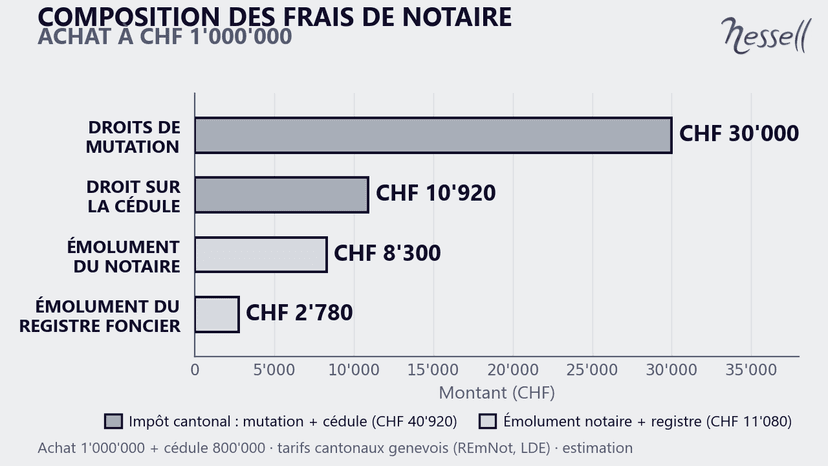
The Geneva Chamber of Notaries considers the term "notary fees" misleading, since the tax portion dominates the total.
How is the notary's fee set in Geneva?
The notary's fee in Geneva is set by a regulated cantonal schedule, which decreases according to the value of the deed. It applies in brackets: each value bracket is taxed at its own rate, expressed per mille.
The scale decreases as the price rises. The first bracket, up to CHF 200'000, is taxed at 7‰; the bracket from CHF 200'000 to 400'000 at 6‰; the one from CHF 400'000 to 800'000 at 4.5‰; beyond that, the rates continue to decrease. For a property at CHF 800'000, the fee comes to CHF 4'400; at CHF 1'000'000, CHF 5'200; the effective average rate drops to around 0.5% for a one-million purchase. According to the cantonal regulation on notary fees, this scale is the same for every notary in the canton.
| Value bracket (deed of sale) | Fee rate |
|---|---|
| Up to CHF 200'000 | 7‰ |
| CHF 200'001 to 400'000 | 6‰ |
| CHF 400'001 to 800'000 | 4.5‰ |
| CHF 800'001 to 1'000'000 | 4‰ |
| CHF 1'000'001 to 1'500'000 | 3.5‰ |
How do you calculate notary fees in Geneva?
To calculate notary fees in Geneva, you can add up these four components applied to the property price and, where applicable (in the case of financing), to the amount of the mortgage note.
The calculator below will give you an estimate of this breakdown based on the property price and the amount borrowed.
Notary fees calculator — Geneva
Indicative estimate. Notary's fee according to the degressive cantonal scale (REmNot, art. E 6 05.03), excluding disbursements. Transfer duty 3% and land register fees capped. Sources: Geneva cantonal tariffs.
The total consists of the transfer duty (3% of the price), the land register fee (0.21% of the price, capped), the notary's fee (degressive scale) and, for the loan, the duty on the mortgage note (1.365% of the amount borrowed) and its own fee.
Three examples for the deed of sale are provided: at CHF 800'000 the fees are around CHF 31'800; at CHF 1'000'000 about CHF 38'000; and at CHF 1'500'000 close to CHF 57'000, each time between 3.8% and 4% of the price. Under the Geneva cantonal fee schedules, transfer duty makes up the predominant share of the total.
Deed-of-sale fees or mortgage note fees: what is the difference?
Fees on the deed of sale and fees on the mortgage note relate to two different deeds (two tax bases, two fees). The deed of sale, which transfers ownership, bears the transfer duty; the mortgage note, which constitutes the collateral securing the loan, bears the duty on the mortgage note.
When a purchase is financed by a loan, both must be added together: sale fees of around 4% of the price, and mortgage note fees close to 2.5% of the amount borrowed. For a purchase at CHF 1'000'000 financed by a mortgage note of CHF 800'000, the fees on the sale come to around CHF 38'000 and those on the mortgage note to CHF 20'000, two separate invoices settled at the same signing. The mortgage note remains the sole responsibility of the buyer.
How much should you budget for notary fees in Geneva?
In Geneva, you should budget about 4% of the purchase price for notary fees on the deed of sale, plus close to 2.5% of the amount borrowed for the mortgage note. This share changes little, as the 3% transfer duty forms its base.
The total percentage decreases slightly as the price rises, since the notary's fee is degressive. For a property at CHF 800'000, budget around CHF 31'800; at CHF 1'000'000, around CHF 38'000; at CHF 1'500'000, close to CHF 57'000. Financing with a mortgage note of CHF 800'000 adds around CHF 20'000 in fees. According to calculations by the Geneva Chamber of Notaries, the total is between 3.8% and 4% of the price for the deed of sale.
Who pays notary fees in Geneva?
The buyer pays the entirety of the notary fees in Geneva, unless otherwise agreed with the seller. The mortgage note remains, in all cases, their responsibility.
This rule stems from cantonal practice: the notary bills the buyer, then personally forwards the transfer duty to the State and the registration fee to the land register, for which they are personally responsible. The buyer must have these funds available in cash, in addition to their own equity, since they are not covered by the mortgage loan; for a purchase at CHF 1'000'000, this represents around CHF 38'000 to budget for beyond the price. The seller may agree to bear a share by mutual agreement, but this remains rare in the Geneva market. According to the Geneva Chamber of Notaries, the buyer bears the entirety of these fees.
When are notary fees paid?
Notary fees are paid at the time of the notarial deed, in practice before or at the signing of the deed of sale. The notary collects the full amount, then forwards the duties and fees to the relevant authorities.
Payment precedes registration with the land register, which carries out the transfer of ownership. The notary only proceeds with registration once the fees have been collected; insufficient funds prevent the signing. Before the signing, the notary draws up a detailed statement summarizing each item and the total to be paid. For a purchase at CHF 1'000'000, the buyer should have around CHF 38'000 available on the day of the deed, separate from the price paid to the seller. No transfer takes place until the fees are paid and the deed is registered.
How can you reduce the costs of a property purchase in Geneva?
Several levers can reduce the costs of a property purchase in Geneva, even though the notary's fee follows a fixed schedule. The main one is a cantonal tax scheme that reduces the transfer duty, the heaviest item among the fees.
The Casatax scheme and factoring all of these fees into the purchase budget are the two levers.
How does Casatax reduce transfer duty in Geneva?
Casatax reduces the transfer duty for the purchase of a primary residence in Geneva. The scheme deducts a flat-rate allowance from the transfer duty on the sale and halves the duty on the mortgage note.
In 2026 the Casatax allowance amounts to CHF 20'924 on the transfer duty, for a maximum purchase price of CHF 1'394'928. Casatax reduces the main tax component of notary fees without affecting the notary's own fee.
How do you factor these fees into the budget for a purchase in Geneva?
Notary fees are factored into the budget for a purchase in Geneva as an item to set aside in addition to the price and the buyer's own equity. These fees are settled outside the transaction financed by the mortgage, and must therefore be available in cash at the time of signing.
To carry out a successful property purchase in Geneva, the future owner adds about 4% of the price to the financing plan, on top of the 20% minimum down payment. Anticipating these fees avoids an unpleasant surprise at the time of the deed.
Are notary fees negotiable in Geneva?
No, notary fees are not negotiable in Geneva. The notary's fee follows a regulated cantonal schedule, identical for every notary in the canton.
Room for negotiation exists only for any fees related to specific services and for disbursements. The regulation allows for a possible reduction of the fee in certain circumstances, at the notary's discretion.
Is a notary mandatory to buy property in Geneva?
Yes, the involvement of a notary is mandatory to buy property in Geneva. The transfer of property ownership requires a notarial deed drawn up by a notary, failing which it is void.
A contract exchanged between private individuals is not sufficient to transfer ownership, any more than payment of the price or the handover of the keys. Under the Swiss Civil Code, only the notarial deed registered with the land register effects the transfer.