
Casatax in Geneva: Transfer Duty Reduction, Conditions and Amounts
Casatax reduces the tax bill on the purchase of a primary residence in the canton of Geneva, by lowering the acquisition duties, subject to eligibility for its criteria and to a capped price.
This article sets out the definition of Casatax and the buyers it targets, its 2026 amounts and the savings achieved, the procedure for obtaining it from the tax authority and the commitments it entails, then places Casatax within the overall cost of buying in Geneva. It draws on the cantonal legal basis and data from the canton's tax authority.
What is Casatax?
Casatax is a cantonal tax provision specific to the canton of Geneva, which reduces the duties owed on the purchase of one's primary residence. When buying property in Geneva, the buyer is subject to two levies: transfer duty on the sale, at a rate of 3% of the price in the canton, and the duty on the mortgage note, at a rate of 1.365% on the amount borrowed.
Casatax combines two tax reductions. On the transfer duty, Casatax deducts a flat-rate allowance; on the duty on the mortgage note, it halves the duty payable. For a purchase at CHF 600'000, the 3% transfer duty is reduced, from CHF 18'000 to zero; for a mortgage note of CHF 800'000, the 1.365% duty decreases, from CHF 10'920 to CHF 5'460. A buyer who benefits from both components lightens the whole of their deed-related costs.
The scheme followed a 2002 initiative by the Geneva Real Estate Chamber and came into force in 2004 to promote homeownership. The Geneva law on transfer duties, in article 8A, sets its scope, and the cantonal tax authority ensures its application. The benefit is reserved for occupying private individuals, below a periodically revalued price cap.
Who can benefit from Casatax?
Casatax is intended for people who purchase a home as their primary residence in the canton of Geneva. The scheme sets four cumulative conditions.
- Private individual: the buyer is a private individual. Companies, foundations and other legal entities are excluded.
- Property located in Geneva: the home is located in the canton of Geneva, whether an apartment held in condominium (PPE) or a single-family house.
- Primary residence: the buyer occupies the property as their primary residence. Secondary residences do not satisfy the condition, nor does buy-to-let investment.
- Price under the cap: the purchase price does not exceed the legal cap (CHF 1'394'928 in 2026).
These criteria are illustrated by three cases. A couple who buy an apartment at CHF 900'000 to live in it meets the conditions. A real estate company that buys the same property for the same purpose is not eligible. A private individual who buys a secondary residence in the Geneva countryside does not meet the conditions.
Paragraph 2 of article 8A of the cantonal law on transfer duties provides that eligibility conditions are assessed at the time of purchase. The buyer must not only purchase the property, but also confirm the declaration of use within two years.
What are the Casatax amounts in 2026?
The 2026 Casatax amounts are a maximum allowance of CHF 20'924 on transfer duty, a 50% reduction of the duty on the mortgage note, and a price cap of CHF 1'394'928. These amounts apply to deeds registered from 1 March 2026.
The allowance works as a flat-rate deduction. The transfer duty amounts to 3% of the price; Casatax deducts up to CHF 20'924 from it, which cancels out the duty below around CHF 697'000 and reduces it above that. The second component halves the 1.365% duty charged on the mortgage note taken out to finance the purchase.
Three examples show the effect of the allowance on the transfer duty. At CHF 600'000, the duty of CHF 18'000 falls to zero; at CHF 1'000'000, it drops from CHF 30'000 to CHF 9'076; at CHF 1'200'000, from CHF 36'000 to CHF 15'076. Beyond the CHF 1'394'928 cap, the purchase loses the entire benefit.
According to the Geneva cantonal tax authority, these two amounts are set by the law on transfer duties and reassessed each year.
| Component | Calculation base | 2026 Casatax allowance |
|---|---|---|
| Transfer duty (duty on the sale) | 3% of the purchase price | up to CHF 20'924 deducted |
| Duty on the mortgage note | 1.365% of the amount borrowed | 50% reduction |
| Eligible price cap | purchase price of the property | CHF 1'394'928 |
How do the amounts change each year?
The Casatax amounts are adjusted each year through indexation, effective 1 March. The maximum allowance and the price cap are indexed to the Geneva construction price index, aligning the scheme with the real cost of cantonal real estate rather than adjusting it on a flat-rate basis.
The adjustment is relatively steady. Between 2025 and 2026, in particular, the allowance on transfer duty rose from CHF 20'616 to CHF 20'924, while the cap increased from CHF 1'374'396 to CHF 1'394'928, an increase of around 1.5%. This same mechanism has raised the cap year after year since the scheme was introduced, in order to keep pace with Geneva price inflation.
According to the Geneva cantonal tax authority, these indexed values are published annually, and apply to deeds registered from 1 March onward.
How much can Casatax save?
Casatax can save up to several tens of thousands of francs on acquisition costs, depending on the price of the property and the amount borrowed. The savings combine the allowance on transfer duty and the 50% reduction of the duty on the mortgage note.
The calculator below estimates the savings achievable based on the price of the property and the amount borrowed.
Casatax savings calculator (2026)
Transfer duty 3%, maximum allowance CHF 20'924, mortgage note 1.365% reduced by 50%, cap CHF 1'394'928. Indicative result, source: cantonal tax authority (ge.ch).
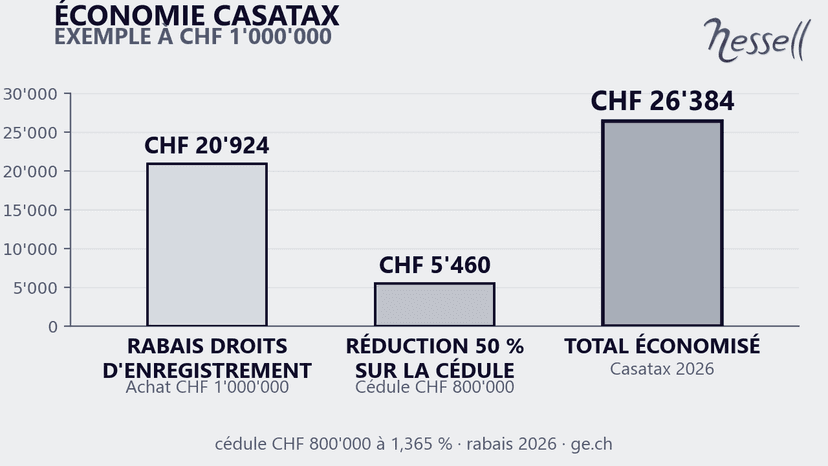
The first component reaches a maximum of CHF 20'924 in 2026, from the point at which the 3% transfer duty exceeds this threshold. For example, for a property at CHF 1'200'000, the transfer duty dropping from CHF 36'000 to CHF 15'076 saves CHF 20'924. The second component, meanwhile, depends on the amount financed: for a mortgage note of CHF 800'000, bearing a 1.365% duty, i.e. CHF 10'920, Casatax brings this figure down to CHF 5'460.
The total benefit is calculated for three profiles. For a buyer at CHF 600'000 financing CHF 480'000, Casatax saves CHF 18'000 in transfer duty and CHF 3'276 on the mortgage note, for a total of CHF 21'276. At CHF 1'000'000, with a mortgage note of CHF 800'000, the total comes to CHF 20'924 plus CHF 5'460, i.e. CHF 26'384. At CHF 1'200'000, with a mortgage note of CHF 960'000, the total exceeds CHF 27'000.
The two variables remain the price of the property and the amount borrowed. According to the Geneva cantonal tax authority, the annual schedule makes it possible to know the maximum allowance applicable to each purchase.
This chart quantifies the total savings made possible by Casatax for a purchase at CHF 1'000'000, by adding together the allowance on transfer duty and the 50% reduction on the mortgage note.
How to obtain Casatax?
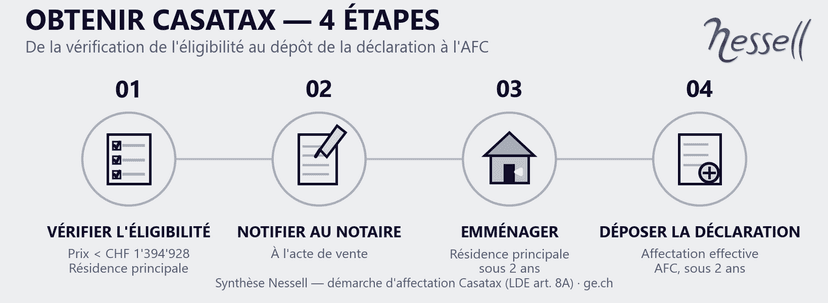
To obtain Casatax, the buyer notifies the notary of the allowance when the deed is registered, then confirms it with the tax authority. The procedure takes place in four steps.
- Check eligibility before buying: the property, its price under CHF 1'394'928, and its use as a primary residence must meet the requirements.
- Notify the notary of the intended use: state the use as a primary residence, which the notary uses to calculate the duties when registering the deed.
- Move into the home: occupy the property as a primary residence within two years of the deed.
- File the declaration of actual use: submit the signed form to the tax authority, along with a certificate of residence from the Cantonal Population Office and proof of the move.
This timeline summarises the four steps for obtaining Casatax in Geneva, from checking eligibility to filing the declaration of use.
The allowance is applied by the notary at the deed, and the declaration then confirms it. According to the Geneva cantonal tax authority, each buyer files a form separately, within two years of the signing of the notarial deed.
What obligations follow after benefiting from Casatax?
There are three obligations after Casatax: actual occupation, filing a declaration, and repayment of the duties in case of non-compliance.
- Actual occupation: use the property as one's primary residence, for at least three years from the move-in date.
- Declaration of use: declare this use to the tax authority by filing the declaration of actual use, within two years of the deed, attaching the supporting documents for residence and the move.
- Repayment in case of non-compliance: repay the duties wrongly benefited from by the buyer, for failing to comply with the use as a primary residence and the minimum commitment period.
These commitments are only checked after the fact. A buyer who resells the property before three years, who lets it out, or who omits the declaration is exposed to a reassessment of the duties. In accordance with article 8A of the cantonal law on transfer duties, the tax authority issues a reassessment notice in case of non-compliance, along with the amount the taxpayer would have had to pay had no declaration been filed.
How does Casatax fit into the cost of a purchase in Geneva?
Casatax reduces one of the main costs when buying property in Geneva: the transfer duty levied on the sale. Commonly referred to as "notary fees", these costs include transfer duty, land register fees, the notary's fee and financing-related costs. Casatax concerns only transfer duty and the mortgage note. The other items remain unchanged. The notary's fee, land register fees and mortgage note costs complete this cost, on which Casatax has an effect at the time of registration.
What other costs accompany a purchase in Geneva?
These other costs of a purchase in Geneva are independent of transfer duty and come on top of the property's price at the time of purchase.
- The notary's fee remunerates the drafting of the deed of sale and its registration.
- Land register fees cover the registration of the transfer of ownership.
- Mortgage note costs constitute the collateral securing the loan.
Among these notary fees, only the fee represents a variable share depending on the value of the property, following its own schedule.
At what point in the purchase does Casatax take effect?
Casatax takes effect not at the signing of the deed of sale but at its registration, when the notary settles the duties. The reduction is applied when the notarial deed is filed for registration with the tax authority and before payment of the transfer duty.
Within the process of buying in Geneva, this happens after the signing of the deed at the notary's office and before the declaration of use of the property. The declaration of actual use takes place within two years of the deed.
Can Casatax be combined with other assistance schemes?
Yes, Casatax can be combined with other schemes supporting homeownership in Geneva. The tax allowance adds to financing solutions without excluding them.
Casatax remains compatible with the bank mortgage, the buyer's own equity contribution, the use of pension assets (occupational pension/LPP and 3rd pillar), and cantonal schemes such as the State loan or the State guarantee. The State guarantee applies the same price cap as Casatax.
Does Casatax exist outside Geneva?
No, Casatax is specific to the canton of Geneva. The cantonal law on transfer duties applicable in Geneva governs Casatax. The scheme does not apply to purchases outside Geneva.
In Switzerland, each canton sets its own transfer duties and any reductions relating to homeownership. A purchase in another canton falls under the tax regime of the canton concerned, entirely distinct from Casatax.