
Real Estate in Geneva: What You Need to Know Before Buying, Selling or Renting
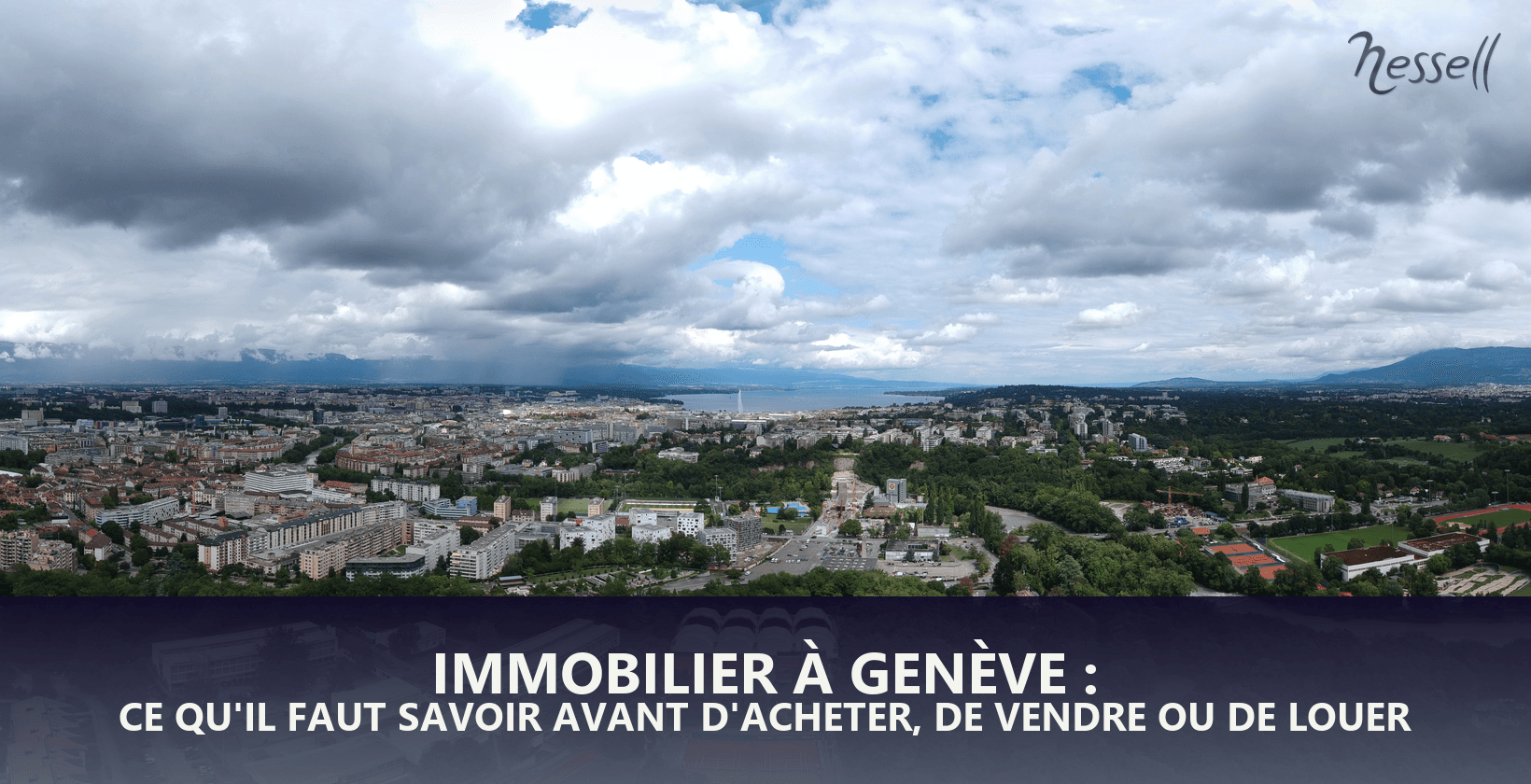
In Geneva, there are only three ways to approach real estate: buying, selling or renting a property, in the most constrained canton in Switzerland. This guide brings together everything you need to know before getting started, whether you are planning a first purchase, a sale, or a search for a rental home.
It first looks at the Geneva territory and its market, then examines price per square metre and property typologies. It details the three transactions of buying, selling and renting before covering taxation, law, condominium ownership (PPE) and rental investment. The figures and legal rules cited are drawn from official Geneva and federal bodies.
Where is the canton of Geneva located, and how is its territory organised?
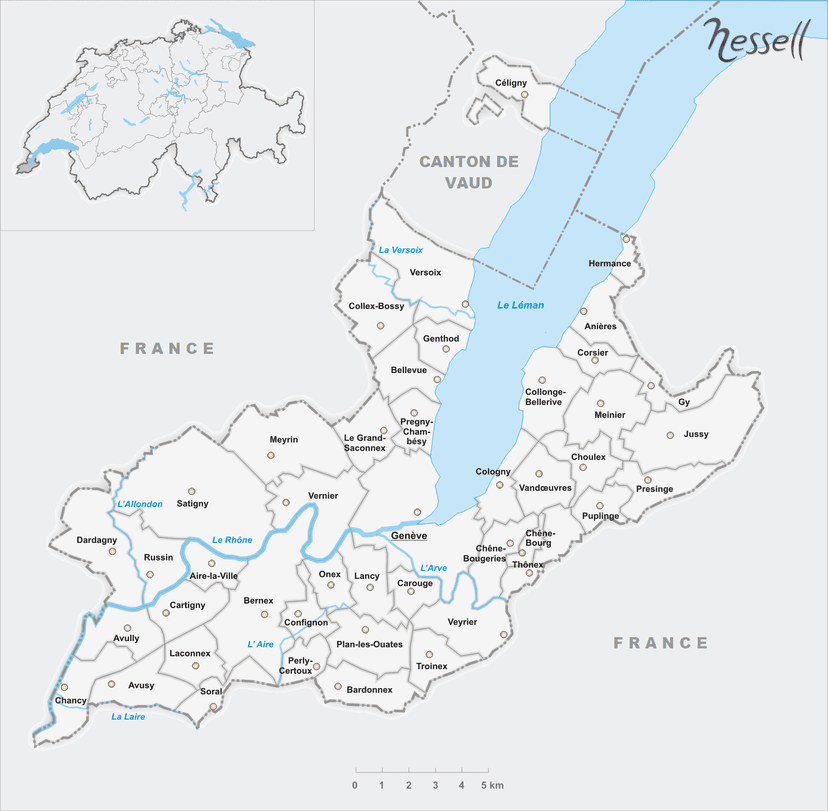
Geneva is a Swiss canton at the western tip of Lake Geneva, bordered by France along most of its frontiers. Covering an area of 282 square kilometres, the canton of Geneva is one of the smallest territories in Switzerland. It is crossed by the Rhône, which marks the separation between the left bank and the right bank.
The canton is divided into 45 municipalities and is not split into districts, its capital being the city of Geneva. Four levels shape any real estate project.
The canton sets the legal and tax framework. The municipalities apply local planning and their own taxation.
The city of Geneva is divided into districts. Greater Geneva (Grand Genève), a cross-border urban area, extends the housing catchment area beyond the cantonal boundaries. Each of these levels affects the price, availability, or rules applicable to a property.
This map presents the canton of Geneva, its 45 municipalities and the Lake Geneva basin bordering France.
What are the districts of the city of Geneva?
The city of Geneva is officially divided into eight districts, which group together the areas familiar to residents.
- Eaux-Vives and Cité
- Pâquis and Sécheron
- Grottes and Saint-Gervais
- Servette and Petit-Saconnex
- Saint-Jean and Charmilles
- Plainpalais and Jonction
- Champel
- Acacias and Bâtie
A district is not a municipality: the municipality is a local authority with its own taxation and its own administration, whereas the district is an internal subdivision of the city of Geneva, with no legal personality of its own.
For a real estate project, the district indicates the immediate surroundings: proximity to the lake, transport links, presence of schools, residential or central character. The districts of Geneva show marked price gaps, from the historic centre to the more peripheral areas of the city.
What characterises real estate in Geneva?
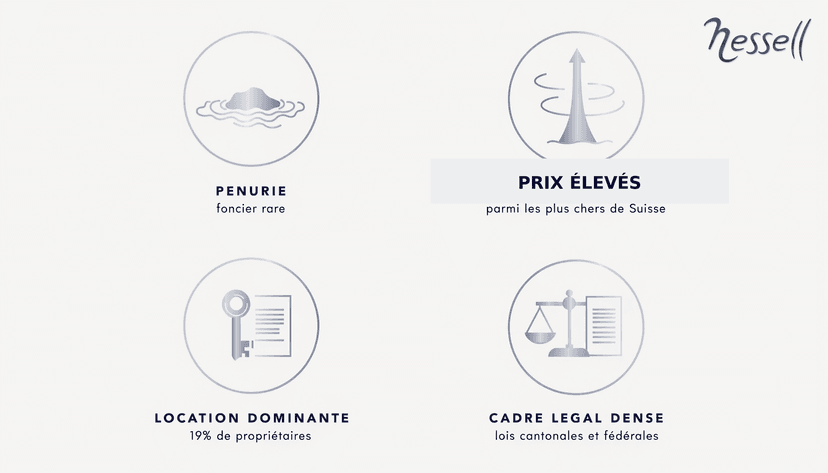
Real estate in Geneva is marked by a shortage-driven market, prices among the highest in Switzerland, and a very clear dominance of renting over ownership. Four traits characterise it.
The first is the scarcity of land: a canton of 282 square kilometres, bordered by France, with no room for expansion. The second is the imbalance between sustained demand and insufficient supply, which keeps prices under pressure.
The third is a low homeownership rate: according to the Federal Statistical Office, close to 19% of Geneva households own their home, the lowest rate in Switzerland, compared with around 36% nationally. The fourth is a dense regulatory framework, which governs purchases by persons domiciled abroad as well as the conversion of existing housing. These four traits mean that a real estate project in Geneva is prepared differently than in the rest of Switzerland.
This diagram summarises the four traits that distinguish the Geneva real estate market: land scarcity, high prices, dominant rental market, dense legal framework.
Why is the Geneva real estate market so tight?
The Geneva real estate market is tight because housing supply does not keep pace with demand. As of 1 June 2025, the canton's vacancy rate fell to 0,34%, its lowest level since 2012, according to the Cantonal Statistics Office. A rate below 1% already reflects a shortage situation.
Three factors sustain this imbalance: unrelenting demographic and economic growth, a pace of housing construction insufficient to meet needs, and a housing stock locked in place by the low mobility of existing tenants. This scarcity pushes both sale prices and rents upward.
How is the real estate market in Geneva performing?
The Geneva real estate market remains tilted in favour of sellers and landlords, under strong pressure. Demand persistently outstrips supply: the canton's population grew by 6 945 residents in 2025 (+1,3 %), according to the Cantonal Statistics Office, while new housing construction, around 2 900 units for the year, fails to keep pace with demand. The vacancy rate, which fell to 0,34% as of 1 June 2025, confirms a market close to saturation.
This pressure sets the recent trends: moderately rising sale prices, short transaction times for well-positioned properties, and continuous pressure on rents. The tracking of supply, demand and cycles of the Geneva real estate market is covered in a dedicated analysis.
How much does real estate cost in Geneva?
Real estate in Geneva is among the most expensive in the country, with a median of 11'349 francs per square metre across the canton and 14'530 francs in the city of Geneva (August 2026), depending on the property type, area and period. The canton regularly ranks at the top of the national housing price rankings.
The cost varies along two axes. Property type first: per square metre, apartments are on average priced above houses.
Location second, with considerable gaps from one municipality to another. These orders of magnitude change quickly: the updated detail of real estate prices, by property type and by area, is tracked on a dedicated page. These reference values are computed on sales actually signed and published in the land register (official gazette), cross-checked with the cantonal OCSTAT statistics.
How do prices per m² vary by district and municipality?
The price per square metre roughly doubles depending on the municipality: from around 9'026 francs in Dardagny or Avusy, on the outskirts of the canton, up to a median of 15'044 francs in Cologny, the most expensive municipality in Switzerland, where exceptional lakefront properties exceed 35 000 francs. These medians are based on sales signed in the land register (August 2026).
Within the city of Geneva itself, the disparity between districts follows the same logic: the centre and the areas close to the lake far exceed the more outlying districts. The view, proximity to the lake, transport links and the standing of the property explain most of these disparities.
The municipality-by-municipality detail is covered in the article dedicated to the municipalities of the canton.
This chart compares the price per square metre of the canton's main municipalities, from the canton's most affordable commune to Cologny, the highest.
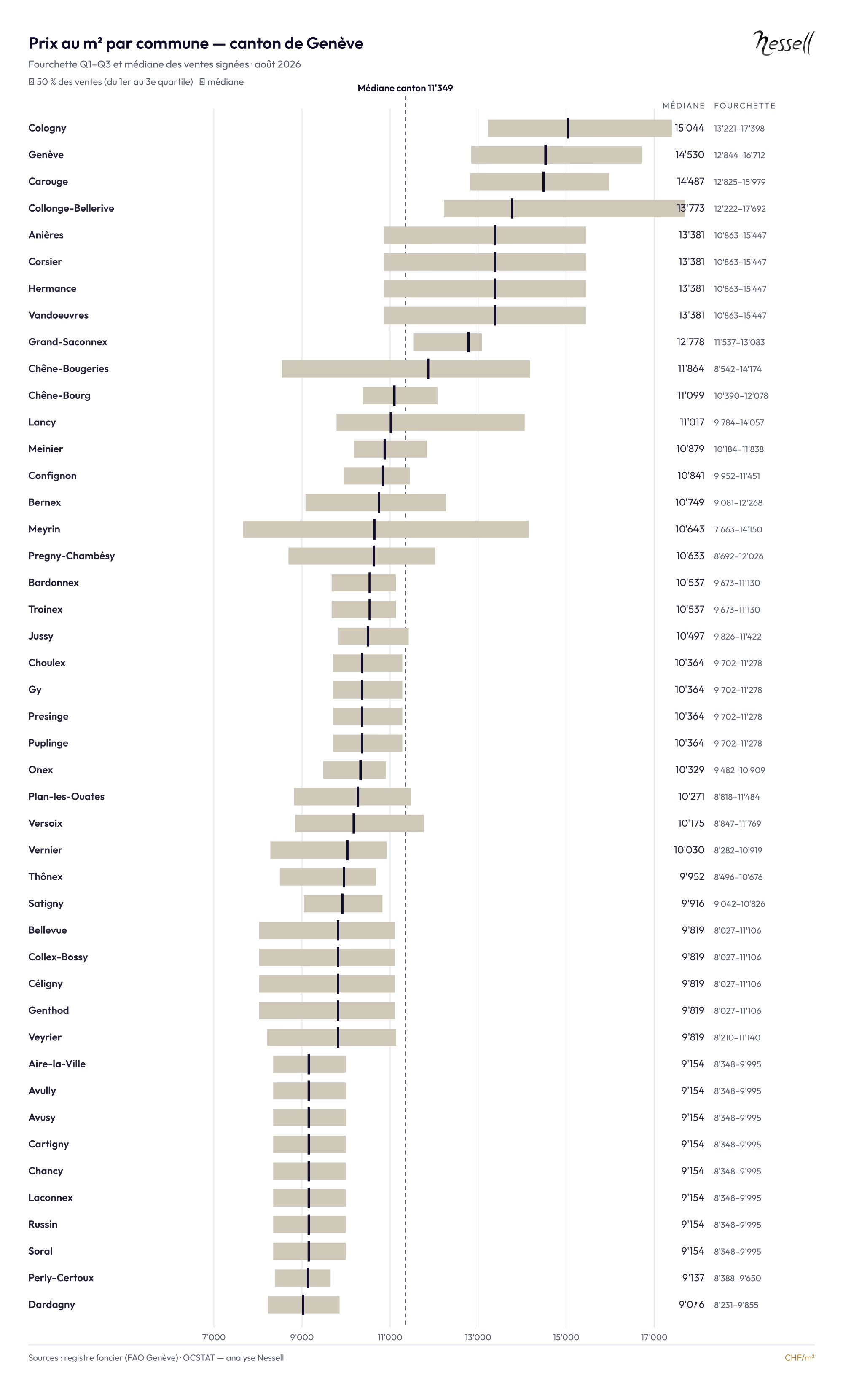
How to read it: the bar covers the middle half of each commune’s sales, the tick marks the median. Prices roughly double between the most affordable communes and Cologny at the top; the cantonal median is CHF 11'349/m² and the city of Geneva CHF 14'530/m² (August 2026).
What types of real estate can be found in Geneva?
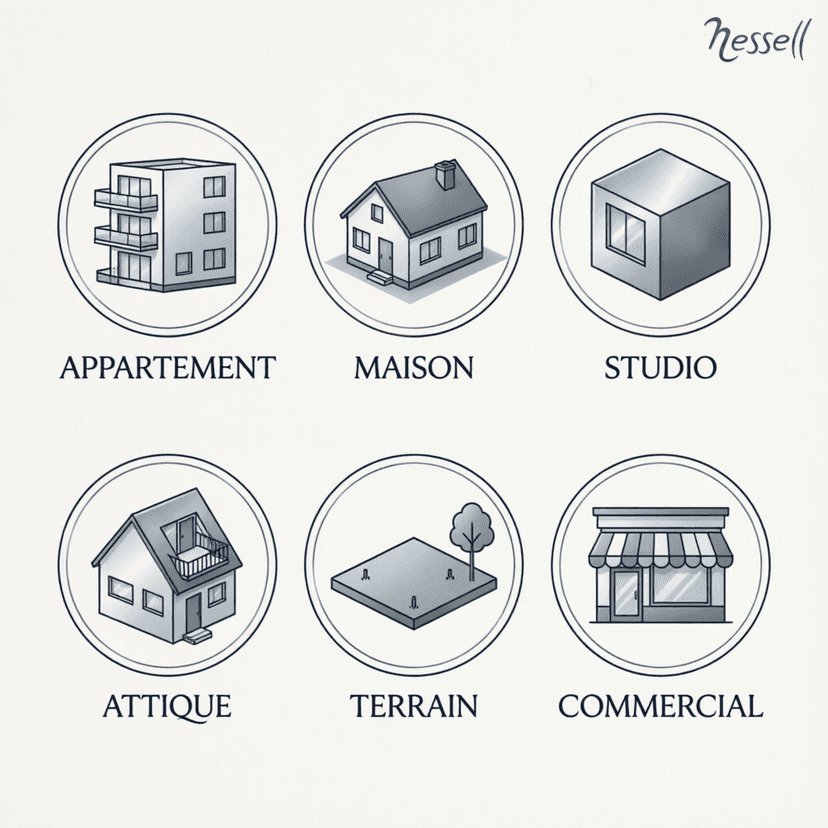
Several major categories of property coexist on the Geneva market, from the studio to the rental apartment building. The main types break down as follows.
- Apartment: the most common property type in the canton, most often held as condominium (PPE),
- House and villa: a standalone property, rarer, concentrated in peri-urban and residential municipalities,
- Studio and small unit: compact housing, favoured for renting and first-time purchases,
- Penthouse (attique), duplex and loft: atypical layouts, sought after in the high-end segment,
- Land: buildable or non-buildable land, subject to strict planning constraints,
- Commercial real estate: offices, retail arcades and business premises
The type of property shapes the price, taxation and procedures of the project.
This catalogue presents the six major categories of property on the Geneva market.
How to buy a property in Geneva?
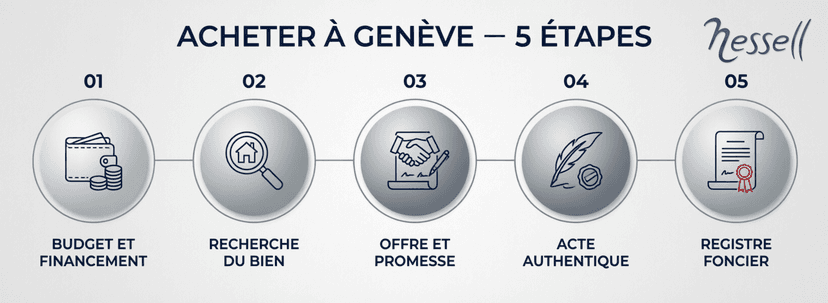
Buying a property in Geneva follows, under the notary's oversight, a 5-step process. The purchase proceeds in the following order.
- Establish your budget and obtain financing approval from your bank before starting your search
- Search for the property, visit it and check its condition and compliance
- Submit a purchase offer, then set the conditions in a preliminary sale agreement
- Sign the authentic deed of sale before a notary, whose involvement is mandatory in Geneva
- Have the transfer of ownership registered in the land register
Each of these steps to buy a property in Geneva has its own rules, procedures and timeframes, which we detail in the relevant section.
This timeline details the five steps of a real estate purchase in Geneva, from budget to registration in the land register.
What budget and financing are needed to buy in Geneva?
Under the standards of the Swiss Bankers Association and FINMA, the purchase budget is built around two banking rules: at least 20% in equity and costs capped at one third of income. Of the 20% equity, half must come from so-called hard equity, meaning excluding 2nd pillar pension assets: savings, pillar 3a, liquid funds.
The second rule, known as the one-third rule, caps the theoretical housing costs, meaning interest, amortisation and maintenance, at 33% of gross income. Beyond this, the bank refuses the loan or requires more equity. The various solutions for financing your purchase, from the mortgage loan to pension assets, are covered in detail in the financing section.
What costs should you plan for when buying in Geneva?
In Geneva in particular, acquisition costs represent about 4 to 5% of the property price and must be paid on top of it. They comprise three main items.
- First, transfer duty, a cantonal tax of 3% of the sale price due upon transfer of ownership.
- Then land register registration fees, around 0,3% of the price.
- Notary fees, generally between 0,5 and 0,7% of the price.
The cantonal Casatax scheme (art. 8A of the Geneva law on registration duties, in force since 2004) nonetheless allows these duties to be reduced when an individual buys their primary residence. The full breakdown of real estate purchase costs, item by item and including exemptions, is set out in the dedicated section.
How to buy a new-build home in Geneva?
To buy a new-build home in Geneva, it is most often a sale in a future state of completion, meaning an off-plan purchase. The buyer commits before or during construction and pays the price in instalments, as the works progress.
Part of the new-build supply is located in development zones, where sale prices are regulated by the State for a set period. The specifics of buying a new-build home, from warranties to delivery timeframes and defect handling, are presented in the related section.
Can a foreigner or a cross-border commuter buy in Geneva?
Yes, a foreigner residing in Switzerland can buy their primary residence in Geneva, subject to conditions. Depending on the buyer's status, they may or may not be authorised to do so. The applicable framework is the federal law on the acquisition of real estate by persons abroad.
- A holder of a C permit can buy without restriction, on the same footing as a Swiss national.
- A holder of a B permit can acquire without authorisation the home intended to be their primary residence.
- A national of a European Union member state domiciled in Switzerland is likewise not subject to this law.
- A person domiciled abroad, including a cross-border commuter, remains subject to authorisation and restrictions, with the competent cantonal authority granting the authorisation.
How to sell a property in Geneva?
Selling a property in Geneva rests on three decisions that determine its outcome: the listing price, the sales method and the support chosen. An accurate valuation makes it possible to set a price that is neither off-putting to buyers nor undervalued. The choice of sales method, through an agency or directly, commits the seller on marketing, viewings and negotiation.
In all cases, the transaction is concluded by an authentic deed signed before a notary (art. 657 of the Civil Code), then by registering the new owner in the land register. The full set of procedures for selling a property in Geneva, from the listing agreement to the handover of keys, is described in the dedicated section.
How to estimate the value of your property in Geneva?
As a reminder, estimating the value of a property in Geneva rests on three complementary methods. With the comparative method, the property is compared to recent transactions on similar properties.
With the hedonic method, online tools and banks model the value based on the property's characteristics. With an on-site expert appraisal, a professional adjusts the result to the particularities that models fail to capture.
Combining these approaches nonetheless makes it possible to arrive at a reliable range. The property valuation method used depends on the property and the intended purpose. This subject is covered in our dedicated article.
How to enhance your property's appeal before selling?
Enhancing a property before selling primarily means presenting the home in its best light, which shortens the selling time while preserving the price. The most effective levers are a matter of common sense: fixing visible defects, decluttering and depersonalising rooms, taking care of lighting and cleanliness, and having professional photographs taken.
Home staging takes this logic to its fullest extent, rearranging furniture to reveal the potential of the spaces. You will find all the techniques for enhancing a property before putting it on the market in the dedicated section.
What are the steps of a real estate sale in Geneva?
A real estate sale in Geneva unfolds in seven ordered steps.
- Estimate the value of the property.
- Choose the sales method and, if applicable, sign a listing agreement with an agency.
- Gather the sale documents and the property's diagnostic reports.
- Publish the listing and organise viewings.
- Receive offers and negotiate the price.
- Sign the preliminary sale agreement, then the authentic deed before a notary.
- Hand over the keys and register the transfer in the land register.
Each step involves timeframes and supporting documents specific to the canton.
How to rent a home in Geneva?
The rental market in Geneva is built around two parties: the tenant looking for housing, and the landlord offering their property. The tenant must first gain access to a rental through a complete application file (ID document, employment contract, payslips, extract from the debt enforcement office) then sign a lease agreement and pay a rental deposit capped at three months' rent.
On the landlord's side, renting out a property involves setting the rent, selecting the tenant, and drawing up a move-in condition report … Find in this section all the rules applicable for renting a home in Geneva, from the tenant's or the landlord's side.
Is it better to buy or rent in Geneva?
The choice between buying or renting in Geneva depends on the holding horizon, the equity available and the stability of the situation. Buying becomes worthwhile over a long horizon, when the buyer has the 20% equity and sufficient financing capacity. Renting retains the advantage of flexibility and remains the only option for most households, in a canton where only around 19% are homeowners.
The comparison plays out on total cost, mobility and wealth building. The trade-off between buying or renting is developed in the dedicated section.
What taxation applies to a property in Geneva?
Three moments of taxation can be distinguished for a property located in Geneva: at purchase, during ownership and upon resale. At purchase, the transfer of ownership is subject to transfer duty.
During ownership, the property enters the wealth tax through its taxable value, taxable income is generated (rent collected or the imputed rental value for an owner-occupier), and the supplementary property tax applies. Upon resale, the profit realised is subject to the tax on real estate profits and gains, whose rate decreases with the length of ownership.
The rates, allowances and deductions of Geneva real estate taxation are detailed in the following section.
What legal rules govern real estate in Geneva?
In Geneva, real estate is governed by several distinct bodies of rules at the federal and cantonal levels. Property law governs ownership, the land register and easements.
Tenancy law governs the relationship between landlords and tenants. Construction law sets the rules for building permits and land-use planning. In addition, there are cantonal laws on the protection of the rental housing stock and on acquisition by persons domiciled abroad.
The scope of each of these real estate legal rules is explained in the relevant section.
How does condominium ownership (PPE) work in Geneva?
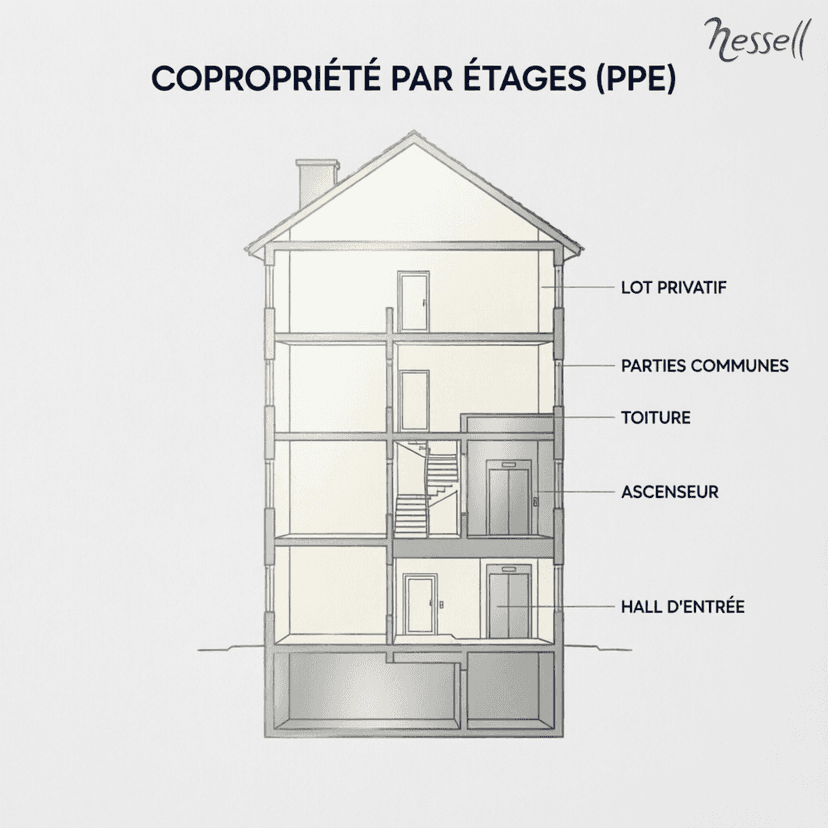
Condominium ownership (PPE) is a type of co-ownership that assigns each owner a private unit and a share of the common areas. The owner may freely dispose of their apartment but must share the building, the roof, the corridors and the facilities with the other co-owners.
Joint decisions are taken at the co-owners' assembly, by majorities predefined by law and by the regulations. Charges and the renovation fund are allocated according to each owner's share. You will find a detailed explanation of how PPE condominium ownership works in the dedicated section.
This diagram illustrates condominium ownership (PPE): private units and common areas of a co-owned building.
How to build or renovate a property in Geneva?
Building or renovating in Geneva requires a building permit issued by the canton before work begins. All work altering the appearance, structure or use of a building is subject to this authorisation procedure. Only routine maintenance work is exempt.
Renovation is subject to increasingly strict energy standards, which make certain works mandatory. Find in this section all the procedures for building or renovating a property in Geneva, including permits and standards.
What energy obligations apply to a property in Geneva?
In Geneva, the energy obligations applying to a property revolve around the heat expenditure index (IDC). Every owner is required to calculate and declare it, an annual obligation that from 2026 will extend to single-family homes.
An excessively high IDC triggers an audit, then, if necessary, energy renovation works. Unlike other cantons, Geneva does not require an energy certificate (CECB) upon sale, but a home's energy performance will increasingly weigh on its value and appeal, both for purchase and for rental.
The details of thresholds, renovation obligations and cantonal subsidies can be found in the article dedicated to energy renovation in Geneva.
How to pass on or share a property in Geneva?
There are mainly three ways to pass on a property in Geneva: inheritance, gifting and the life annuity sale (viager). While inheritance transfers the property to the heirs upon the owner's death, gifting achieves the same thing "in advance," meaning during the donor's lifetime.
The life annuity sale (viager) combines the sale of the property with the payment of an annuity until the seller's death. Each of these three routes is governed by its own civil and tax rules. We cover in a dedicated section the arrangements for passing on a property between generations.
What happens to a property in the event of divorce in Geneva?
In the event of divorce, the fate of a property depends on the spouses' matrimonial property regime and how the purchase was originally financed. Jointly owned property is shared during the liquidation of the regime; property owned individually by one spouse remains theirs, subject to compensation owed to the other.
Three outcomes are possible: selling the property and splitting the proceeds, one spouse buying out the other's share, or awarding the home to the spouse who keeps it. The handling of divorce and real estate is set out in the dedicated section.
Investing in real estate in Geneva: is it profitable?
Investing in real estate in Geneva remains sought after for the security of the investment more than for current yield. The persistent housing shortage limits vacancy risk and supports property values over the long term.
The high level of acquisition prices, however, compresses gross rental yield. The profitability of a Geneva real estate investment is therefore measured as much by capital appreciation as by annual income, a point developed in the dedicated section.
What distinguishes luxury real estate in Geneva?
In Geneva's luxury real estate market, location, the property's rarity and the confidentiality of the transaction take precedence. These properties are concentrated on the left bank of the lake, in Cologny and in the most sought-after municipalities, where the price per square metre far exceeds the cantonal average.
Part of this segment sells off-market, without a public listing. The criteria specific to Geneva's luxury real estate are set out in the dedicated section.
Which professionals for a real estate project in Geneva?
As part of a real estate project in Geneva, several professionals are involved, each with a complementary role.
- the agency or real estate broker supports you in your purchase or sale;
- the property management firm handles the management and rental of your properties;
- the notary draws up the authentic deed that guarantees the legal security of your transfer;
- the appraiser provides an independent valuation of its worth.
The choice and role of each of these real estate professionals are detailed in the dedicated section.
Should you go through a real estate agency in Geneva?
No, going through a real estate agency is not mandatory in Geneva: an owner can sell, and an individual can buy or rent, on their own. But in a market as tight and technical as Geneva's, working with a professional remains, in most cases, the safer choice.
An agency handles the most time-consuming and technical steps of a project:
- a reliable valuation, aligned with actual market prices;
- wide distribution of the listing and access to its network of buyers;
- screening candidates and conducting viewings;
- negotiation and the legal security of the transaction.
Doing without an agency saves the commission, provided you have the time, knowledge of the local market and command of the legal aspects. For a first project, a complex property or a seller with little availability, the support of a Geneva agency generally makes the difference, both in the price obtained and in peace of mind.
Where to find Geneva real estate vocabulary?
Find all the vocabulary specific to Geneva real estate in our dedicated glossary.
Condominium (PPE), mortgage note, transfer duty, imputed rental value or easement: every transaction draws on technical terms specific to Swiss law and the Swiss market.
Classified and defined, these terms are gathered in our reference real estate glossary, and will support you at every stage of your project in Geneva.
What do you need to know to settle in Geneva?
Settling in Geneva therefore is not limited to housing: the cost of living, taxation, transport and schooling carry equal weight in the final decision. It is by considering this living environment that a real estate project can come together — from the chosen district to the daily commute.
The territory, the market, the prices, the three transactions of buying, selling and renting, taxation, law and the canton's professionals: the guide has covered the topic. Every project comes back to the same starting question: where, and under what conditions, to settle in Geneva.