
Real Estate Inheritance Tax in Geneva: Valuation, Taxation and Division
In Geneva, inheriting a property can raise two questions: the inheritance tax due, and the transfer of the property to the heirs. Good news for families: the canton exempts inheritance in the direct line.
Inheritance tax on a property raises several questions: how it is calculated, the valuation of the property, its transfer and division among heirs, the taxation of a resale, the difference with a gift, and the management of an inherited property.
What is inheritance tax on a property in Geneva?
Inheritance tax is the cantonal tax levied on the share received by each heir upon the death of its owner. In Geneva, the law on inheritance tax (LDS) governs it.
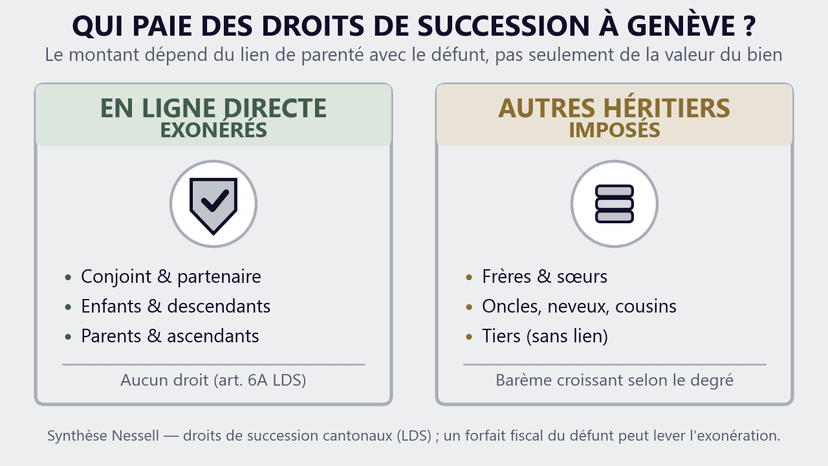
This tax is linked to the degree of kinship with the deceased, not solely to the value of the property. There is a progressive scale by category: heirs in the direct line and the spouse are exempt, collateral relatives and third parties bear it at increasing rates, and unrelated persons at maximum rates (article 6A et seq. LDS).
For a property, the tax is calculated on its market value as of the date of death, its fair market value (article 10 LDS). This tax on transmission upon death is to be distinguished from notary fees and land register registration fees which, while adding to it, remain due even in the direct line. An estate opens two separate matters: the transfer of ownership and its possible taxation.
This diagram summarizes who pays inheritance tax in Geneva depending on the degree of kinship.
How is a property valued in an estate?
In an estate, it is the property's market value as of the date of death that is used: its fair market value, not its usually recorded tax value (art. 10 LDS). For certain properties, such as agricultural buildings, the law allows a yield value rather than a market value (art. 10A LDS).
This value is the basis for inheritance tax when it is due, and the reference for division among heirs. It is assessed by the cantonal tax administration; it is often essential to use a real estate appraisal to establish it, especially when there are several heirs or an upcoming resale. An independent valuation guards against both undervaluation and overvaluation, both of which carry heavy tax and financial consequences.
How is the property transferred to the heirs?
Heirs become full owners of the property upon death but may only dispose of it once it is registered in the land register. The transfer of ownership takes place without formality; registration is merely the starting point for the power to sell or mortgage.
Federal law leaves no room for doubt: as soon as the estate is opened, the heirs acquire it (article 560 of the Civil Code), and whoever inherits a building becomes its owner before registration, but may not dispose of it in the land register until this formality has been completed (article 656 of the Civil Code).
In practice, the notary draws up the certificate of heirship, which designates the rightful claimants under the will or the statutory order of succession. This document is required in order to register the transfer in the land register; until it is produced, the heir may neither sell nor mortgage the property.
How do heirs divide a property among themselves?
When there are several heirs, they find themselves in undivided co-ownership of the property, within the community of heirs, until division takes place; no one may dispose of the building alone: decisions must be taken unanimously. Undivided co-ownership of the estate (article 602 of the Civil Code) continues as long as the estate has not been divided.
Division brings it to an end: the property is allocated to one heir, who must then buy out the other heirs' shares by means of a balancing payment, or it is sold and its price shared out. Any heir may request division at any time; failing agreement on the allocation, the judge orders the sale of the property. Buying out the shares requires agreement on the value, hence the need for a valuation. Often indivisible, the property is the central object of these arbitrations.
What taxation applies when reselling an inherited property in Geneva?
The resale of an inherited property is subject to the tax on real estate profits and capital gains (IBGI). The holding period, however, is not counted from the heir's acquisition: the inheritance itself is not taxed under the IBGI, and the holding period runs from the original purchase, not from the inheritance.
The scale is regressive: the longer the property is held, the lower the rate, down to a floor rate of 2% beyond twenty-five years of ownership. Conversely, a property recently acquired by the deceased and then quickly resold remains heavily taxed. The tax applies only to the capital gain, that is, the difference between the sale price and the purchase value; it is only triggered upon the actual resale.
The simulator below estimates the IBGI due upon resale, based on the holding period counted from the date of acquisition by the deceased.
Indicative estimate — LCP scale, art. 84 (as of 01.01.2025). Excluding improvement costs, acquisition expenses and deductions; the cantonal tax administration determines the final calculation.
Gift or inheritance: what are the differences for a property?
Gift and inheritance share the same exemptions in the direct line, but fall under two different laws: an estate transfers upon death, a gift between living persons.
Gift tax is governed by the law on registration duties, not by the law on inheritance tax. Gifts between spouses and in the direct line are, like estates, exempt; for other degrees of kinship a comparable scale by category applies.
Two practical differences follow from this: a gift made between living persons by a Geneva resident must be declared, even if exempt; and any gift of real property must be executed by notarial deed. Planning ahead through a gift makes it possible to organize the transfer during one's lifetime and to set its conditions; transferring in this way or upon death is a matter of estate planning choice, with similar taxation in the direct line.
How to manage a property received through inheritance in Geneva?
Managing a property received through inheritance in Geneva involves settling the transfer, then choosing between keeping it, sharing it or selling it. Once equipped with the certificate of heirship and after the transfer has been registered, the heirs decide on the future of the property: keep it, buy out the other heirs' shares, or sell it.
Depending on the family's composition and the value of the property, keeping it in undivided co-ownership, allocating the building to one of the heirs, or selling it do not carry the same tax and financial consequences. Having the property valued and selling it then require specific formalities.
How to have an inherited property valued?
Having an inherited property valued means determining its market value, which is necessary for any division or in view of a resale. Through an independent professional property valuation, the heirs agree on an impartial market value, binding among themselves and useful in support of a possible resale.
It is authoritative in the event of disagreement between co-heirs or a review by the tax administration, and sets the starting point for calculating the capital gains tax upon resale. This step, sometimes put off while grief is still recent, nonetheless prevents many disputes between heirs and with the tax authorities.
How to sell a property received through inheritance in Geneva?
To sell a property one has inherited, division or the agreement of all co-heirs must first take place since the property belongs to the community of heirs. Once unanimity has been reached and the transfer registered, the sale follows its usual course, and the real estate capital gains tax is paid on the gain. The price is shared among the co-heirs in proportion to their respective shares after payment of any debts.
Once these formalities have been completed, the various steps for selling in Geneva, from the valuation to the signing before the notary, apply in the same way as for any owner.
Do heirs in the direct line pay inheritance tax in Geneva?
No, heirs in the direct line do not pay inheritance tax in Geneva. Direct descendants and ascendants, the spouse and the registered partner are exempt (art. 6A LDS). The only situation in which this exemption is removed is one where the deceased was taxed under the expenditure-based method (lump-sum taxation): the tax is then calculated at the rate of the first category. Outside this case, no tax is due when transferring a property to one's children or spouse.
Must an inherited property be sold to pay the inheritance tax?
It depends on the heirs' situation. In the direct line, since the estate is exempt, no tax needs to be funded: there is no requirement to sell the property. For taxable heirs, such as collateral relatives or third parties, the tax must be settled in cash; an estate consisting mainly of a property may force a sale or a loan to pay it. In all cases, notary fees and registration fees remain payable, independently of the tax.