
Selling a Property in Geneva: Complete Guide from Valuation to Handover of the Keys

Selling a property in Geneva follows seven steps, from price valuation to the handover of the keys, each of which is covered in this guide: valuing the sale price, signing a listing agreement with a broker or selling without an agency, putting together the file and carrying out the diagnostics, showcasing the property and publishing the listing, organizing viewings and qualifying buyers, receiving offers and signing the preliminary sale agreement, signing the notarial deed before the notary and handing over the keys.
The guide then covers the timeframes to expect, the documents to gather, the choice between a non-exclusive and an exclusive listing agreement, and the diagnostics to provide. It explains notary fees, the canton's property gains tax (IBGI), and the notary's role in the transaction. Special situations are covered (selling during a divorce, life-annuity sales, weighing whether to sell before or after a new purchase), as well as the best time to sell and how the Geneva market influences the transaction.
What are the steps to sell a property in Geneva?
The seven steps to sell your property in Geneva are as follows.
- Value the sale price of your property.
- Sign a listing agreement with a broker or sell without an agency.
- Put together the sale file and carry out the diagnostics.
- Showcase the property (virtual tour, home staging) and publish the listing.
- Organize viewings and qualify your buyers.
- Receive offers and sign the preliminary sale agreement.
- Sign the deed of sale at the notary's office and hand over the keys.
This timeline summarizes the complete chronology of the seven steps of a property sale in Geneva.
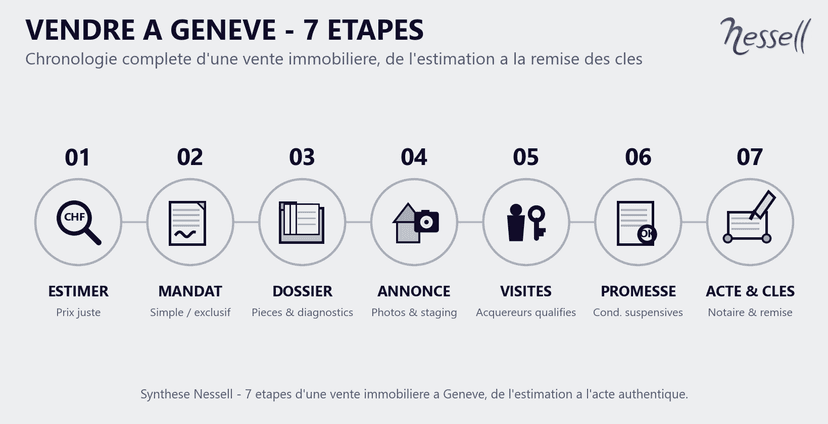
The first step lays the foundation for the entire transaction: the right price, the factor that will determine the pace and outcome of the sale.
1. Valuing the property's sale price
Valuing the sale price means determining the property's market value, the step that most influences the speed and outcome of the transaction. There are three methods in Switzerland:
- The comparative approach: it aligns the price with recent transactions of similar properties in the neighborhood.
- The hedonic approach: used by listing portals and banks (Wüest Partner and IAZI models), based on the property's characteristics.
- The on-site appraisal: carried out by a broker or an independent expert, it takes the property's specific features into account.
With an overvalued price, the listing stagnates and only finds a buyer after successive price cuts; with an undervalued price, the seller loses part of their capital gain.
A benchmark specific to Geneva: a price set just below the Casatax threshold (1 394 928 CHF in 2026) keeps the buyer eligible for the transfer duty relief, which widens the pool of potential buyers.
2. Signing a listing agreement with a broker or selling without an agency
At this stage, the seller chooses between appointing a broker or handling the sale themselves.
Appointing a broker means delegating the valuation, marketing, viewings and negotiation in exchange for a commission payable only upon signing the notarial deed; the listing agreement takes the form of a non-exclusive mandate, given to several brokers, or an exclusive one, given to a single broker.
Selling without an agency saves this commission but places the entire burden of the process on the seller. The listing agreement sets out the duration, the amount of the commission, the scope of services and the termination terms.
3. Putting together the sale file and carrying out the diagnostics
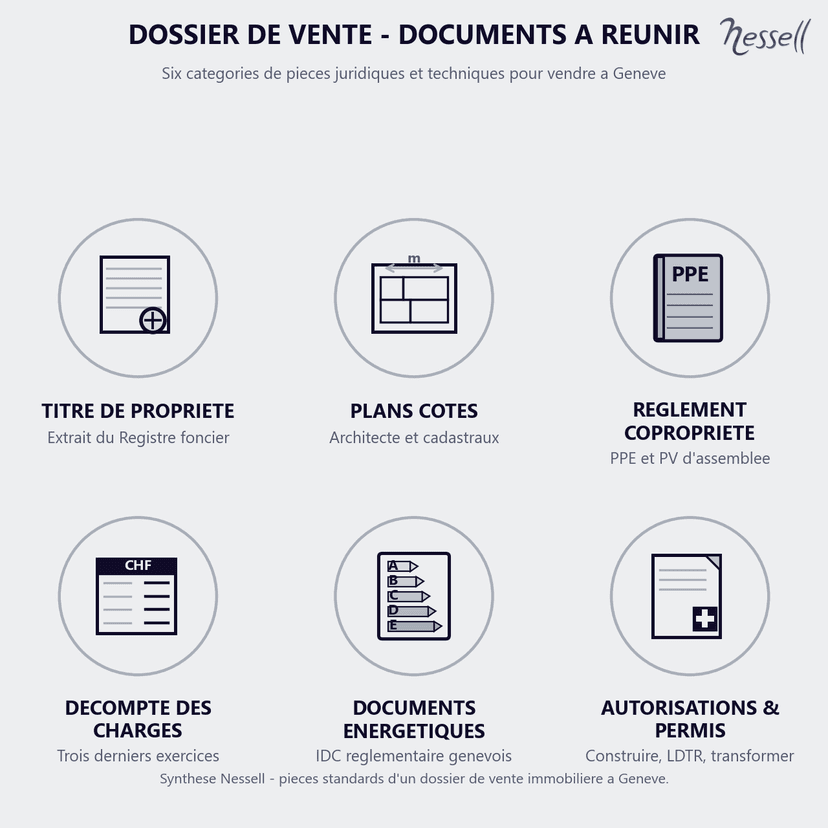
Putting together the sale file means gathering the legal and technical documents that the buyer, their bank and the notary will require. The main documents to gather are as follows.
- Title deed: an extract from the land register confirming the seller's status as owner.
- Dimensioned plans: the architect's plans and the property's cadastral plans.
- Condominium regulations and meeting minutes: for apartments held under condominium (PPE) ownership.
- Statement of charges: the last three financial years.
- Energy documents: the heating expenditure index (IDC), calculated in accordance with Geneva cantonal regulations.
- Authorizations and permits: building permits, renovation authorizations, and LDTR compliance.
This illustration summarizes the six categories of documents to gather for a sale file in Geneva.
In Geneva, the CECB energy certificate is not mandatory for a sale in the private sector: the IDC remains the canton's regulatory energy indicator.
Two points of caution specific to the canton. First, timing: obtaining the IDC from the property management firm can take several weeks, so it is best to request it as soon as the project begins. Second, the LDTR: work carried out without authorization, or the sale of an apartment that was previously rented out, can lead the State to block the transaction.
4. Showcasing the property and publishing the listing
Showcasing the property and publishing the listing launch the marketing phase and determine the number of viewings.
On the presentation side, four levers are combined: light home staging to neutralize the decor and open up the spaces, professional photography, a Matterport-style virtual tour that filters out serious buyers, and a drone video for properties with outdoor space.
On the marketing side, the listing is published on Swiss property portals, the broker's internal client file, the specialized French-speaking Switzerland press and social media. The number of inquiries received depends directly on the quality of the visuals.
5. Organizing viewings and qualifying buyers
Viewings are organized to convert inquiries into offers while ensuring the financial soundness of the candidates.
Before or during the viewing, the seller or their representative checks three points: the buyer's financing capacity (bank certificate or mortgage agreement in principle), the genuineness of their motivation, and their decision timeline.
Viewings are held in individual time slots for high-end properties or in groups to create competition among buyers. Disclosing any visible defects and the amount of charges upfront helps avoid disputes and ensures a quick signing.
6. Receiving offers and signing the preliminary sale agreement
As soon as an offer is accepted, the preliminary sale agreement legally binds both parties pending the final deed.
It sets out the price, the conditions precedent (obtaining financing, Lex Koller authorization for a foreign buyer, the prior sale of the buyer's own property), the deadlines and the date the deed will be signed. The condition precedent of obtaining the loan is decisive here: the bank's final refusal to finance, despite an agreement in principle, remains a classic cause of failure at this stage.
In Geneva, the preliminary sale agreement must be executed in notarial form before a notary (article 216 paragraph 2 of the Code of Obligations (CO)): a private preliminary sale agreement signed without a notary would be void. The notary executes it, just as they do the final deed.
7. Signing the deed of sale at the notary's office and handing over the keys
It is only when the deed of sale is signed at the notary's office and the keys are handed over that the transfer of ownership is finalized.
The notarial signing then follows a very precise sequence: the notary reads the notarial deed in full to the parties, checks that the parties agree on each clause, the seller and buyer sign simultaneously, the price is paid into the notary's escrow account before being transferred to the seller, and an application for registration is filed with the land register.
The keys are handed over on the day of signing or on the date agreed by the parties in the contract. The buyer becomes the owner, enforceable against third parties, as of the date of registration with the land register.
What timeframe should you expect to sell a property in Geneva?
In Geneva, the average time to sell, from listing the property to handing over the keys, is between four and six months.
Indeed, it takes on average between 90 and 100 days to find a serious buyer (marketing period, source: RealAdvisor data on the Swiss market) and 1 to 2 months for the notarial process between the preliminary agreement and the final deed: the Geneva notary must then gather the documents, draft the deed, obtain the bank certificates and process the registration with the land register.
Three criteria affect this timeframe: how well the asking price is positioned; the type and location of the property; and the market segment (entry-level, mid-range, high-end).
How do you value a property in Geneva?
In Geneva, property valuation is based on three complementary methods: comparative, hedonic and on-site appraisal. The Wüest Partner and IAZI hedonic models refine the value based on recent transactions of similar properties, using a very large number of variables (surface area, condition, location, charges).
To have a reliable starting point before setting a price, it is possible to request a free valuation of your property in Geneva.
Which listing agreement should you choose: non-exclusive or exclusive?
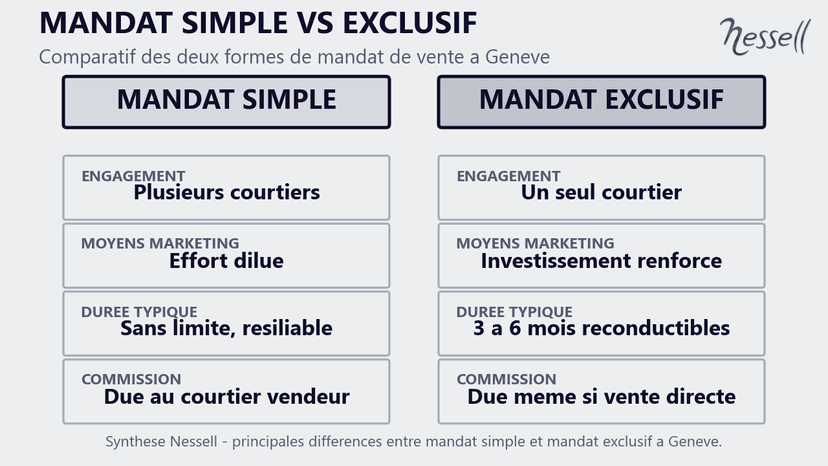
Non-exclusive or exclusive listing agreement: the choice is above all a trade-off between putting brokers in competition and committing to a single partner. With an exclusive property sale mandate, the broker will commit more marketing resources, whereas with a non-exclusive mandate, the property's exposure will be multiplied but with diluted marketing effort.
This comparison summarizes the differences between a non-exclusive and an exclusive listing agreement.
What property diagnostics must be provided before the sale?
The property diagnostic in Geneva refers to the mandatory technical documents that the buyer and the bank will request from you. The heating expenditure index (IDC) is only mandatory for buildings with five or more heat off-takers, in accordance with the cantonal energy regulation; it does not apply to individual houses. The CECB energy certificate, meanwhile, is not mandatory for a sale in the canton of Geneva (but remains necessary to qualify for certain cantonal energy subsidies).
Selling without an agency in Geneva: advantages and limits?
Selling without an agency in Geneva is perfectly legal and avoids the broker's commission.
On the other hand, the seller alone handles the valuation, putting together the file, publishing the listing, the viewings and the negotiation, which represents real work in terms of time and expertise in a technical market. In all cases, the sale must go through a notary for the notarial deed.
What deed of sale must be signed to transfer ownership?
The deed of sale is the notarial deed signed at the Geneva notary's office that carries out the transfer of ownership. The signing session follows the full reading of the deed, the simultaneous signing by the parties, payment via notarial escrow, and the filing of the registration application with the land register.
What role does the notary play in a sale in Geneva?
The notary in Geneva, by virtue of the public authority vested in them, is the neutral third party between seller and buyer. Their four main duties are drafting the notarial deed, holding the funds in escrow, filing the application with the land register, and providing legal advice to both parties.
What notary fees should you expect for a sale in Geneva?
In Geneva, notary fees (payable by the buyer) represent, in practice, around 4% of the purchase price, according to information published by the Geneva Chamber of Notaries. They include: cantonal transfer duty (around 3%), the land register fee (0.3%) and the notary's fee (0.5 to 0.7%, a rate that decreases according to the value).
How is the capital gain on a sale taxed in Geneva?
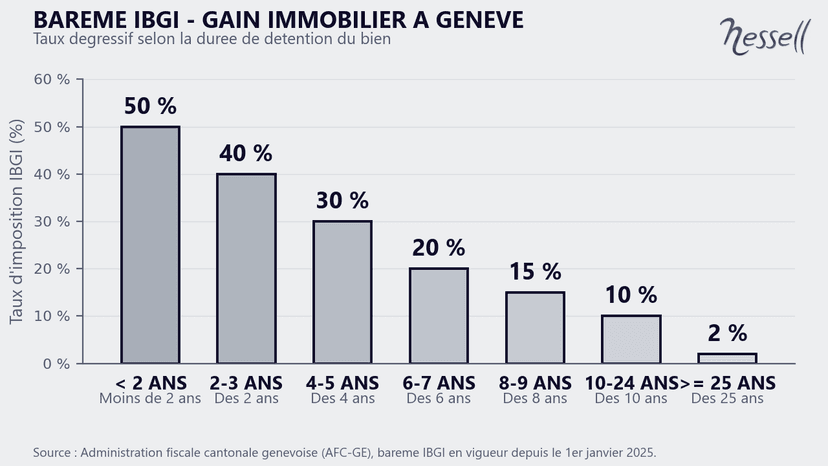
In the canton of Geneva, the property gains tax (IBGI) is a tax owed on the profit made from a property sale. According to the cantonal tax administration, the rate follows a strict degressive scale: 50% if held for less than 2 years, 40% from 2 years, 30% from 4 years, 20% from 6 years, 15% from 8 years, 10% from 10 years, and 2% from 25 years, effective since January 1, 2025. Thanks to the reinvestment mechanism, when the proceeds are fully reinvested in acquiring a new primary residence located in Switzerland within the required timeframe, taxation is deferred.
This chart presents the IBGI's degressive scale based on the holding period.
How do you sell a property during a divorce in Geneva?
A sale during a divorce in Geneva takes place as part of the liquidation of the matrimonial property regime and the division of joint ownership. The notary executes the deed of sale, while the lawyer oversees the follow-up under the divorce agreement and the division of the net price between the former spouses.
What is the best time to sell a property in Geneva?
Swiss brokers confirm that spring and the autumn back-to-school period are ideal for selling, as buyers are more numerous and the light shows properties off to better advantage. Seasonality remains of secondary importance: the economic climate and mortgage rates weigh far more heavily on the final price than the month the property is listed.
How does the Geneva property market influence a sale?
It depends directly on the supply-demand balance, which closely tracks mortgage rate trends and determines how easily and at what price a sale takes place. The Office cantonal de la statistique (OCSTAT) publishes transaction price indices and sales volumes by segment for this market.
Should you sell before or after buying your next property?
It depends, but in Geneva, selling before buying is the majority position among Geneva brokers, as it avoids double mortgage debt. Buying first requires financing two properties at the same time and carries the risk of a pressured sale.
Can you sell a property as a life annuity (viager) in Geneva?
Yes, a life-annuity sale (viager) in Geneva remains legally possible, but it is marginal in practice. In an occupied life annuity, a lump sum is paid at signing, in addition to an annuity paid until the death of the annuitant.