
Buying Property in Geneva: Steps, Budget, Costs and Buyer Profiles
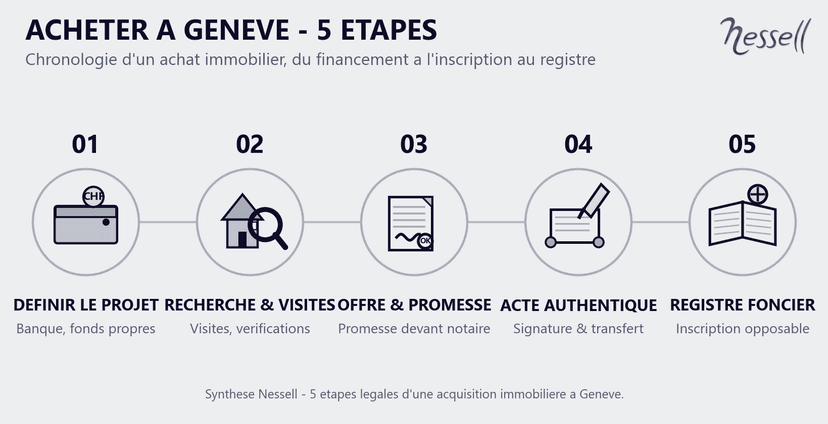
In Geneva, purchasing a property takes place in 5 steps, from defining the project to registering the transfer with the cantonal land register. Each one is covered in this guide: defining your project and purchasing capacity, searching for and viewing properties, making an offer and signing the promise of sale, signing the notarial deed before a notary, then registering the transfer with the land register.
The guide then details the length of the process, the documents required, the budget to put together and the acquisition costs specific to the canton. Special situations, from a first purchase to buying new-build property, are also covered, along with buyer profiles for which purchasing by a person domiciled abroad follows specific rules (B or C permit, cross-border commuters, joint purchases). This guide sets out useful advice before signing and the buy-versus-rent trade-off.
What are the 5 steps to buying property in Geneva?
The purchase process unfolds in 5 successive steps.
- Define your project and calculate your purchasing capacity with a bank or a mortgage broker.
- Search for and view properties for sale, checking their condition and compliance.
- Make an offer, then sign a promise of sale setting out the price and the conditions precedent.
- Sign the notarial deed at the notary’s office, which legally records the transfer.
- Register the transfer with the land register, the step that makes the transfer enforceable against third parties.
This timeline summarises the complete chronology of the five steps of a property purchase in Geneva.
Each step involves its own parties and timeframes, detailed below.
1. Define your project and calculate your purchasing capacity
As a first step, the prospective buyer must define the scope of their purchase project and have their purchasing capacity validated, before actively starting the search. They settle on the type of property sought (apartment in a condominium (PPE), detached house, land), the target geographical area, and a range of usable floor area.
They then approach a bank or a mortgage broker, who calculates their maximum borrowing capacity from three main variables (available equity, stable annual income, existing liabilities). Under the rules set by the Swiss Bankers Association, a minimum equity contribution of 20 % of the property’s value is required, of which at least 10 % must be hard equity (excluding second-pillar assets). This initial work should result in the bank’s written agreement in principle, a document required by the seller before entering into a promise of sale.
2. Search for and view properties for sale
The second step is the active phase of searching for and viewing properties for sale in the canton. The buyer browses listings on Swiss property portals, approaches local agencies, and views shortlisted properties.
At each viewing, the overall condition is checked, and for a condominium (PPE) unit, the condominium charges, the condominium bylaws, the easements recorded in the land register and planning compliance are verified. A diligent buyer consults the local neighbourhood development plans available from the cantonal authorities and asks the seller for the latest charges statement, the minutes of the last condominium (PPE) general meeting, and the building’s maintenance logbook. This step takes on average four to six months for a buyer resident in Geneva.
3. Make an offer and sign the promise of sale
The third step consists of formalising the mutual commitment through a purchase offer followed by a promise of sale. The buyer submits a written offer specifying the proposed price, the conditions precedent and a validity period.
Once accepted, a promise of sale is signed by the parties before a notary, a deed specifying the final terms of the transaction (price, date of the notarial deed, conditions precedent relating to financing and, where applicable, to LFAIE approval). A deposit is generally paid into the notary’s escrow account on the date the promise is signed. This binds both parties for a period generally of two to three months, during which no other buyer may submit a competing offer on the property.
In Geneva, this step often pits several buyers against each other for the same property, sometimes through a sealed-bid process.
4. Sign the notarial deed at the notary’s office
The fourth step culminates in the signing of the notarial deed at the notary’s office. Under article 657 of the Civil Code, the involvement of a notary is mandatory in Switzerland for any property transfer.
The deed is signed before the Geneva notary, a public officer holding a cantonal licence (“brevet”), supervised by the Chamber of Notaries. The notary drafts the deed based on the promise of sale, and verifies the identity of the parties, their legal capacity, the absence of restrictions enforceable against the transfer, and the effective release of the price.
It is at this stage that buyers subject to the LFAIE must produce before the notary the prior authorisation granted by the canton’s Department of Institutions and Digital Affairs. The notarial deed effects the legal transfer of ownership, subject to its registration with the land register.
5. Register the transfer with the land register
The fifth step consists of registering the transfer with the Geneva land register, the only formality that makes the transfer enforceable against third parties. The notary promptly sends the registration request to the Land Registry Office, together with the supporting documents and payment of the registration duty.
The entry in the land register’s daybook establishes the legally effective date; the master register is updated afterwards. Under article 970 paragraph 4 of the Civil Code, no one may claim to be unaware of an entry recorded in the land register.
The time between the signing of the notarial deed and final registration ranges from a few days to several weeks, depending on the Office’s workload. This registration formally concludes the purchase and makes the buyer the owner within the meaning of Swiss law.
Where can you find properties for sale in Geneva?
Properties for sale in Geneva can be found through four main channels: national property portals, the websites of agencies and property management firms, developers marketing new-build schemes, and the broker network through which off-market sales are concluded. In a market where supply remains scarce, combining these channels and becoming known to agencies is the fastest way to access new listings.
- Check national property portals such as Homegate and ImmoScout24, which centralise most listings.
- Browse the websites of Geneva agencies and property management firms, such as the properties for sale offered by Nessell, often published as previews.
- Follow developers and new-build schemes for properties sold off-plan.
- Activate the broker network, through which off-market sales pass before any publication.
How do you make an offer in a tight market in Geneva?
To make an offer in a tight market in Geneva, the buyer needs to stand out on price, on the strength of the financing, and on speed. For the most sought-after properties, the sale often goes through a sealed-bid process: each candidate submits a written offer without knowing the others, and the seller selects the most advantageous one. An offer backed by a financing agreement in principle and a complete file reassures the seller as much as the amount proposed.
How long does a property purchase take in Geneva?
Between the start of the property search and the handover of keys, a buyer in Geneva must wait on average six to nine months. The property search phase lasts four to six months depending on how tight the market is and the buyer’s criteria.
From the signing of the promise of sale to registration with the land register, the notarial phase then requires a further one to three months. Its length depends mainly on three variables: how quickly bank financing is obtained, the legal complexity of the property (easements, co-ownership, parcel subdivision), and whether LFAIE authorisation is needed for buyers subject to the Lex Koller. When a file must be submitted for cantonal authorisation, several months are generally added to the overall timeline.
What documents should you prepare to buy in Geneva?
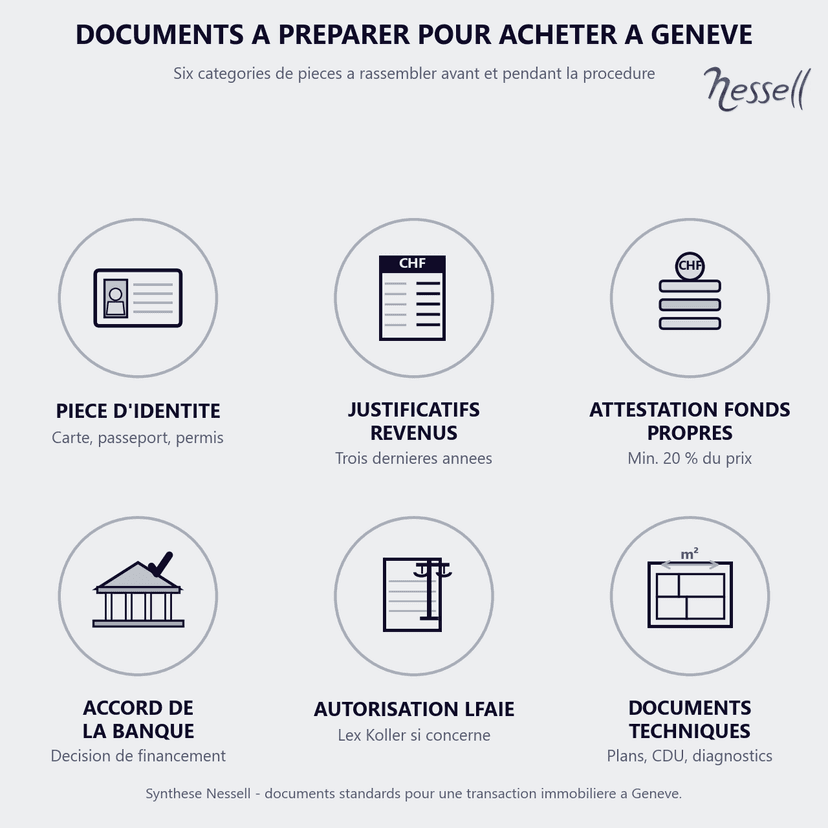
The buyer must gather several categories of documents, both beforehand and during the process.
- A valid form of identification for each buyer (identity card, passport, residence permit).
- Proof of income for the last three years (salary certificates, tax returns).
- A certificate of equity and proof of its origin (bank statements, second-pillar certificate).
- The written agreement in principle from the bank approached regarding the intended mortgage financing.
- For buyers subject to the LFAIE, the prior authorisation issued by the Department of Institutions and Digital Affairs.
- The property’s technical documents, provided by the seller: land register extract, plans, condominium (PPE) bylaws, charges statements, energy diagnostics.
This overview summarises the six categories of documents to gather for a purchase in Geneva.
From the start of the process, the notary draws up the precise list of documents required and ensures they are collected.
What budget should you plan for buying in Geneva?
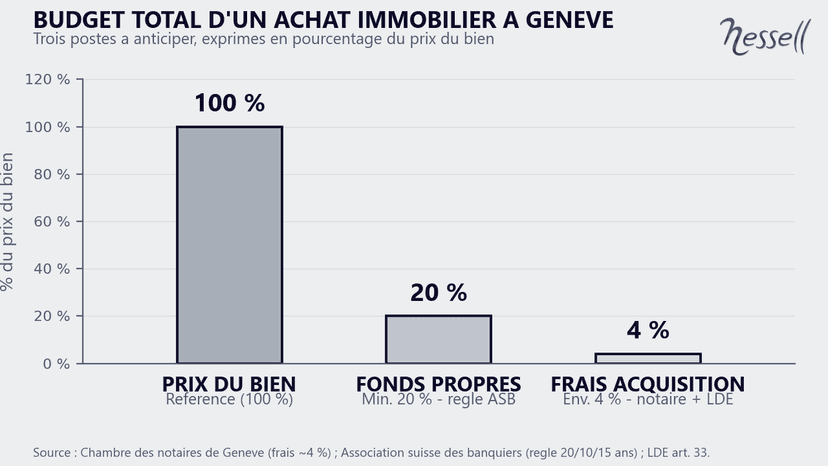
The total budget to put together to buy in Geneva is made up of three items:
- the property price
- the equity contribution
- acquisition costs
The Swiss Bankers Association sets the rules: the buyer must contribute a minimum of 20 % of the property’s value in equity, of which at least 10 % must be hard equity excluding second-pillar assets.
Borrowing capacity then depends on income, age at maturity, and the mandatory amortisation bringing the debt down to two-thirds of the pledged value within 15 years at most. The precise method for calculating purchasing capacity and the full list of available equity sources are set out on the page dedicated to the budget for buying in Geneva.
What acquisition costs are added to the purchase price in Geneva?
In Geneva, acquisition costs are added to the purchase price and represent around 4 % of that price (according to figures published by the Geneva Chamber of Notaries). These costs include the cantonal registration duty set at 3 % of the price under article 33 of the Registration Duty Act (LDE), the notary’s fees, and the costs related to the mortgage note.
The Casatax scheme allows registration duty to be reduced for any buyer who establishes their primary residence in the property, within a price cap indexed each year (and not only for first-time buyers). The precise breakdown of each item, and the conditions for applying Casatax, are available on the page dedicated to acquisition costs for buying a home in Geneva.
This chart visually compares the three items that make up the total budget for a purchase in Geneva.
How does a first property purchase work in Geneva?
Just like any other property purchase, a first purchase in Geneva follows the same 5-step process, while presenting strategic specificities. Like any buyer of a primary residence, you benefit from the cantonal Casatax scheme, can access certain homes in development zones as a priority, and can draw more extensively on your second pillar to build up your equity.
Common mistakes to avoid relate to underestimating recurring condominium (PPE) charges, maintenance costs, and the taxable imputed rental value. A complete guide to a first property purchase in Geneva will let you learn in detail about the cantonal assistance you may be entitled to and the pitfalls you need to anticipate.
How do you buy new-build property in Geneva?
Buying new-build property in Geneva falls under an off-plan sale agreement (vente en l’état futur d’achèvement), a sale contract signed on plan with a developer or an investor, payable in instalments as work progresses and delivered on completion under a ten-year warranty. New homes built in a development zone are subject to cantonal control of sale prices for ten years from the average move-in date of the first owners (General Act on Development Zones, LGZD).
They offer their buyers more recent energy standards, compliant with the new cantonal building regulations. In our guide dedicated to buying new-build property in Geneva, we present the payment schedule and the contractual specificities.
What notarial steps structure a purchase in Geneva?
In Geneva, the notarial phase of a purchase consists of three successive steps, in which the notary intervenes under the federal requirement for authentication.
- The purchase offer formalises the buyer’s preliminary commitment.
- The promise of sale fixes the conditions and timetable of the transaction.
- The notarial deed of sale effects the legal transfer of ownership.
1. The purchase offer
The purchase offer formalises the buyer’s preliminary commitment. It is generally submitted after one or two viewings of the property, before the signing of the promise of sale, within days of the decision.
It takes the form of a written document specifying the proposed price, the conditions precedent (financing, LFAIE authorisation where applicable), a validity period and, sometimes, a reservation deposit. The guide dedicated to the purchase offer in Geneva details its required form and legal scope.
2. The promise of sale
The promise of sale fixes the conditions of the transaction between acceptance of the offer and the notarial deed. It specifies the price, the description of the property, the conditions precedent (financing, LFAIE authorisation), the timetable and the amount of the deposit.
Under article 216 of the Code of Obligations (CO), a real estate promise of sale is valid only in authenticated form: it is drawn up by the notary. If a condition precedent is not fulfilled through no fault of the buyer, the promise lapses and the deposit is returned. The guide dedicated to the promise of sale in Geneva develops its clauses.
3. The notarial deed of sale
The notarial deed of sale effects the legal transfer of ownership. It identifies the parties, precisely describes the property, sets the price and its payment terms, mentions the easements recorded in the land register, and sets out the legal warranties.
Article 657 of the Swiss Civil Code requires the authenticated notarial form for any property transfer: without a deed executed by a notary, the sale is null and void. The Geneva notary drafts the deed, holds the funds in an escrow account, sends the registration request to the Land Registry Office, and releases the price to the seller after registration. The guide dedicated to the notarial deed of sale and the one on the notary in Geneva go into further detail on these points.
Who can buy property in Geneva?
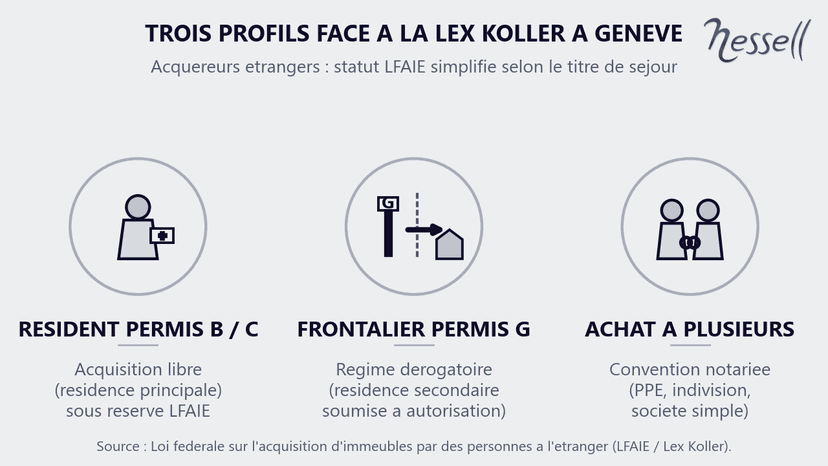
In Geneva, whether a purchase is possible depends on the buyer’s administrative status. The Federal Act on the Acquisition of Real Estate by Persons Abroad (LFAIE, known as the Lex Koller) distinguishes between Swiss citizens, holders of a B or C permit, cross-border commuters, and multi-party arrangements. Three cases receive particular treatment: residence or settlement permit, cross-border commuter status, joint purchases.
This diagram summarises the three buyer profiles subject to the Lex Koller in Geneva.
Buying with a B or C permit in Geneva
Buying with a B or C permit in Geneva follows different rules depending on the residence title. Any holder of a C permit, regardless of nationality, freely acquires property without LFAIE authorisation, provided they act on their own behalf and the financing does not come mainly from abroad.
For a national of a European Union or EFTA member state holding a B permit and actually domiciled in Switzerland, the purchase takes place under the same conditions as for Swiss nationals. For any other B permit (outside the EU/EFTA), the acquisition of a primary residence actually occupied by the buyer takes place without authorisation.
However, the buyer may not freely acquire either a secondary residence or an investment property: these acquisitions fall under the LFAIE and are subject to authorisation, generally refused for investment properties. We detail on our page dedicated to buying with a B or C permit in Geneva the conditions by nationality and type of acquisition.
Buying as a cross-border commuter in Geneva
Buying as a cross-border commuter in Geneva falls under a special regime provided for by the LFAIE. A holder of a G permit legally domiciled abroad is in principle subject to authorisation to acquire property in the canton.
The exception provided for by the federal law nonetheless allows a cross-border commuter who is a national of a European Union or EFTA state to acquire, without authorisation, a secondary residence in the region of their workplace, which they may not rent out for as long as they continue their cross-border activity. Any other arrangement will require an authorisation application to be filed with the canton’s Department of Institutions and Digital Affairs. Our guide dedicated to buying as a cross-border commuter in Geneva will shed light on these exceptions and on the procedure to follow.
Buying jointly in Geneva
Buying jointly in Geneva essentially falls into four arrangements: a married couple under the ordinary regime of participation in acquired property, a married couple under the regime of separation of property, unmarried partners under a co-ownership agreement, and a simple partnership of investors. These four arrangements have specific consequences regarding the allocation of the equity contributed, joint liability for the mortgage debt, rights on resale, and transfer on the death of a co-owner.
In practice, the notary usefully advises the parties on drafting a suitable agreement before proceeding with the notarial deed. The guide dedicated to buying jointly in Geneva sets out the advantages and risks of each arrangement.
What advice should you follow before buying in Geneva?
There are several pieces of advice to follow to secure a purchase in Geneva before signing the promise of sale.
- Have your true borrowing capacity checked with at least two banking institutions before making any offer.
- Review the property’s land register extract to identify easements, liens, and restrictions.
- Request the condominium (PPE)’s multi-year accounts and the renovation fund to anticipate upcoming works.
- Have all acquisition costs precisely quantified (duty, fees, mortgage note) before the preliminary agreement.
- Anticipate recurring taxation: imputed rental value, supplementary property tax, ongoing charges.
- Consult a notary other than the seller’s to review the promise of sale.
Each of these points is developed, and others are added, on the page dedicated to advice for buying in Geneva.
Should you buy or rent in Geneva?
It depends above all on the planned length of occupancy, your capacity to contribute equity, and the ratio of purchase price to annual rent observed in the target neighbourhood. With one of the lowest home-ownership rates in Switzerland and a tight rental market, the canton shows a longer break-even point between buying and renting than other cantons.
A stability horizon of under five to seven years most often tips the balance in favour of renting; beyond that, it is buying that allows you to build up assets, provided you have sufficient equity. The page dedicated to the buy-or-rent trade-off in Geneva develops the calculation of the break-even point and typical scenarios.