
Lex Koller in Geneva: Foreign Buyers, Eligible Properties and Authorization Procedure
When a foreigner purchases real estate in Geneva, one particular federal law must be taken into account: the Lex Koller, which governs the acquisition of Swiss soil by buyers domiciled outside Switzerland.
This article explains who the law designates as a "person abroad," which properties remain freely accessible or require authorization, and sets out the Geneva cantonal procedure, the exceptions, the penalties incurred and the cantonal rules. A final section reviews the state of the ongoing reform and points toward the first steps of the purchase.
What is the Lex Koller?
The Lex Koller is the federal law that makes the acquisition of real estate by foreign persons subject to authorization, officially known as the Federal Act on the Acquisition of Real Estate by Persons Abroad (LFAIE, SR 211.412.41).
Passed by parliament on 16 December 1983, it entered into force on 1 January 1985. Its purpose is to prevent foreign control over Swiss soil by limiting non-residents' access to the real estate market.
The Federal Office of Justice is responsible for ensuring compliance and enforcement, and each canton has designated the competent authority to issue authorizations. In Geneva, this is the Department of Institutions and Digital Affairs.
The law is supplemented by an implementing ordinance, the OAIE, which sets out in detail the criteria for liability to authorization. Originally called the "Lex Friedrich," it took the name "Lex Koller" following the 1997 revision led by Federal Councillor Arnold Koller.
Who is considered a "person abroad"?
Under the LFAIE, a person abroad refers to any buyer the law classifies among the non-residents subject to the authorization regime. This status is assessed on the basis of nationality, domicile and residence permit, never on origin alone.
Four scenarios meet this qualification.
- Non-EU/EFTA nationals without a settlement permit (Permit C): persons living in Switzerland who do not hold a valid settlement permit.
- Persons domiciled abroad: any non-Swiss buyer whose actual domicile is outside Switzerland, including a European national living abroad.
- Companies with their registered office abroad: foreign legal entities, regardless of the nationality of their owners.
- Swiss companies under foreign control: companies whose registered office is in Switzerland but whose capital or voting rights are held in a controlling manner by persons abroad.
Conversely, an EU or EFTA citizen domiciled in Geneva, like a Permit C holder, escapes this status and buys housing just as a Swiss citizen would.
What real estate can a foreigner buy in Geneva?
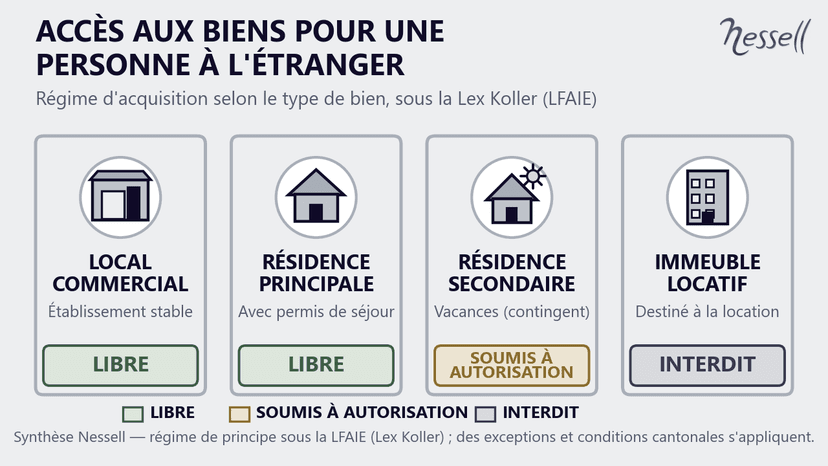
In Geneva, a foreigner can freely acquire commercial premises and their primary residence, while investment housing and secondary residences are closed to them or subject to authorization. This regime attaches to the property category, not the neighborhood.
These categories are defined as follows.
- Permanent business establishment: premises for a commercial, production or craft business, or a liberal profession, may be freely acquired without authorization, following the 1997 liberalization.
- Primary residence: a buyer holding a valid residence permit purchases, without authorization, the home they personally occupy, provided it is not sublet.
- Secondary residence and vacation home: these properties fall under the authorization regime and a national quota, reserved for tourist cantons.
- Residential rental property: the acquisition of housing intended purely as an investment remains prohibited for a person abroad.
Geneva clearly illustrates the scope of these rules: since the canton is not among the recognized tourist areas, secondary residences and vacation homes are not accessible at all to a non-resident buyer, except in particular situations such as that of cross-border workers.
This matrix summarizes the acquisition regime by property type for a person abroad.
Are you subject to the Lex Koller?
It depends on your status as a buyer and the nature of the property: authorization to acquire becomes necessary as soon as the buyer's liability to the law is not immediately excluded, for example when a person abroad targets a non-exempt residential property. Three scenarios arise.
- Acquisition requiring authorization: a foreigner acquiring a secondary residence, a vacation home or a residential rental property must apply for prior authorization.
- Unrestricted acquisition: a residence permit holder who acquires a permanent business establishment or a primary residence they occupy does not need to apply for authorization.
- Buyer not subject to the law: an EU/EFTA national living in Switzerland, or a Permit C holder, acquires without any formality under the LFAIE.
In case of doubt, the buyer requests a ruling of non-liability from the cantonal authority: it officially certifies that the transaction is not subject to this law, allowing it to be recorded in the land register.
The test below establishes your acquisition regime based on your situation.
Lex Koller liability test (Geneva)
Indicative, based on the general regime in Geneva. Cantonal exceptions and conditions apply; only the competent authority can issue a ruling.
How to obtain Lex Koller authorization in Geneva?
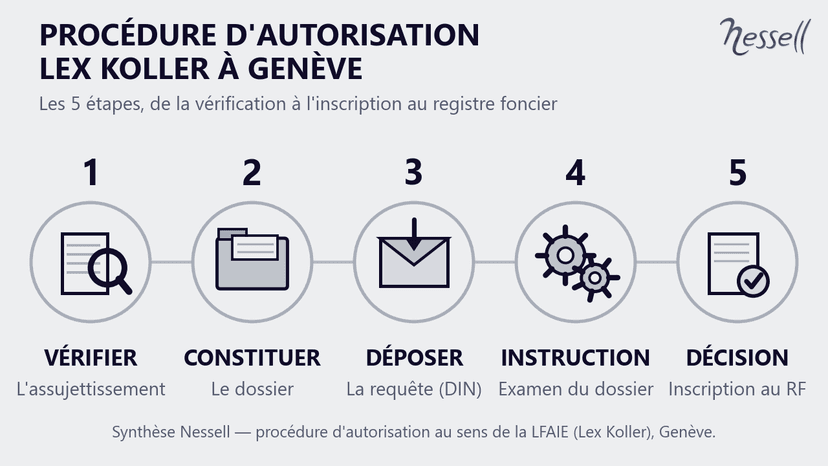
In Geneva, Lex Koller authorization is requested through an application addressed to the Department of Institutions and Digital Affairs, which reviews the file and rules on it. Five essential steps emerge.
- Check liability to the law by establishing whether the buyer and the property are subject to authorization.
- Compile the file with identity documents, the residence permit, the draft deed and the description of the property.
- File the application with the Legal Directorate of the Department of Institutions and Digital Affairs, the competent cantonal authority.
- Review the application by checking the grounds for authorization and the legal compliance of the project.
- Notify the ruling, which starts the appeal period; its entry into force is a precondition for recording the deed in the land register.
The notary makes the deed conditional on this authorization, set as a condition precedent: the land registration awaits the ruling's entry into force. A ruling of non-liability serves as authorization if the transaction is not subject to the law.
This timeline presents the five steps of the authorization procedure in Geneva.
What are the exceptions to the Lex Koller?
The exceptions to the Lex Koller are the cases in which certain buyers and certain transactions are exempt from any authorization, even though the buyer would otherwise be classified as a person abroad. Article 7 LFAIE sets out the exhaustive list.
The main scenarios can be grouped as follows.
- Legal heirs: authorization is not required when the person concerned acquires a property through inheritance in the direct line or as a spouse.
- Close relatives: acquisition from a relative in the ascending or descending line is exempt from the regime.
- EU/EFTA residents: a European national domiciled in Switzerland acquires any housing freely.
- Permit C holders: a person holding a settlement permit is treated the same as a Swiss national.
- Permanent business establishment: premises used for an economic activity are exempt from the authorization regime.
Each exception must meet specific conditions that the authority verifies. In case of doubt, the ruling of non-liability formally establishes that no authorization is necessary.
What are the risks of failing to comply with the Lex Koller?
The first effect of non-compliance with the Lex Koller is the nullity of the acquisition deed, which strips the buyer of any right to the property and blocks its recording in the land register. The consequences are numerous, ranging from civil to criminal. Three types of sanctions apply cumulatively.
- Civil nullity. Under Article 26 of the LFAIE, a deed concluded without the required authorization is void, as is a deed based on false information.
- Restoration of the previous situation. Under Article 27, the competent authority is empowered to act to end the unlawful situation and to request the forced sale of the property, with the buyer recovering only the purchase price, never any capital gain.
- Criminal penalty. Under Article 28, anyone who intentionally carries out a void acquisition for lack of authorization is liable to a custodial sentence of up to three years or a monetary penalty.
The competent Geneva authority and the public prosecutor's office pursue these offenses. A transaction structured to defraud the law, through a nominee or a shell company, is subject to the same regime of nullity and prosecution.
What Geneva-specific rules apply to the Lex Koller?
Geneva's specific features are those of a non-tourist canton, where secondary residences and vacation homes remain closed to non-resident buyers. Federal law is supplemented there by cantonal directives and a dedicated authority.
The cantonal specifics come down to a few points.
- Competent authority: the Legal Directorate of the Department of Institutions and Digital Affairs reviews and issues authorizations for the entire canton.
- No tourist quota: since it has no recognized tourist zones, Geneva does not open any vacation-home quota for persons abroad.
- Secondary residence closed off: the acquisition of a secondary residence by a non-resident remains excluded, except in the case of a cross-border worker.
- Land pressure: the scarcity of land and sustained demand lead the authority to strictly examine every ground for authorization.
This Geneva application reflects the purpose of the law: to reserve housing for those who live and work in the canton, rather than for investments from abroad.
Where does the reform (tightening) of the Lex Koller stand?
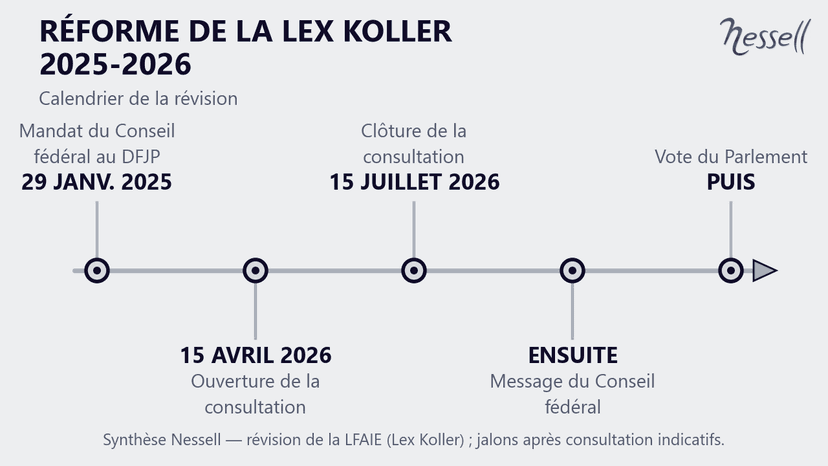
As of spring 2026, the Lex Koller reform is still only at the federal consultation stage, opened on 15 April 2026 and closing on 15 July 2026, and aims to tighten access to Swiss housing for persons abroad.
On 29 January 2025, the Federal Council instructed the Federal Department of Justice and Police to draft this preliminary bill, in line with the measures linked to the "No to a 10-million Switzerland!" initiative. According to its press release of 15 April 2026, several tightening measures have been put out for consultation.
- Housing and nationality: the purchase of housing by a national of a non-EU/EFTA state would come under the authorization regime.
- Vacation homes: their acquisition would be further restricted.
- Resale obligation: a person leaving Switzerland would have to resell their property within two years.
- Commercial buildings: their acquisition for investment purposes would be limited to own use only.
The timeline remains open: after the consultation, the Federal Council finalizes its dispatch, and then Parliament decides.
This timeline sets out the schedule of the Lex Koller reform in 2025-2026.
Foreigner: where to start to buy property in Geneva?
Even before targeting a property, a foreign buyer assesses their own liability to the Lex Koller. This preliminary check lets them know from the outset whether the purchase is unrestricted, subject to authorization, or closed off.
Once that point is settled, the project joins the standard path followed by any buyer. The main steps to buy in Geneva, from financing to signing at the notary's office, are identical to those followed by a Swiss resident, with only the cantonal authorization added as a condition precedent where applicable.
What role does the notary play in an acquisition subject to the Lex Koller?
The role of the notary is to check the buyer's liability to the Lex Koller and to draw up the deed of sale, prior to any application to the land register. Their involvement legally secures the transaction.
In concrete terms, the notary in Geneva verifies the buyer's status, inserts the cantonal authorization or the ruling of non-liability as a condition precedent, and refuses to request registration until this condition has been fulfilled. Their professional liability compels them to report any transaction designed to circumvent the law. In this gatekeeping role, the notary stands out as the key player in a purchase subject to the regime for persons abroad.
Can a foreigner without a permit buy in Geneva?
It depends on the type of property involved. A foreigner domiciled abroad or without a residence permit cannot freely acquire housing in Geneva: residential purchases remain closed to them or subject to authorization, and rental investment is prohibited. However, they can acquire commercial premises for business use, which are exempt from the authorization regime.
Can a cross-border worker buy housing in Geneva?
Yes, a cross-border worker can buy housing in Geneva. Permit G grants its holder an exception specific to the Lex Koller: they can acquire a secondary residence in the region of their workplace, without authorization, provided they occupy it themselves. This option sets them apart from other buyers domiciled abroad, for whom secondary residences remain closed off in Geneva. Purchasing commercial premises for business use also remains open to them.