
Real Estate Due Diligence in Geneva: Checks, Steps and Control Points
Buying in Geneva involves substantial amounts, in a market where the seller often excludes any warranty. Due diligence examines the property before signing and spares the buyer unpleasant surprises.
This article defines it, explains why and when to carry it out, then lists the points to check: legal, technical, financial. It specifies who carries it out, what it costs, how long it takes, and how it secures the purchase in Geneva.
What is real estate due diligence?
Real estate due diligence is the thorough examination of a property before purchasing it. It verifies its legal, technical and financial situation, so that the buyer purchases with full knowledge of the facts, free of hidden defects or charges.
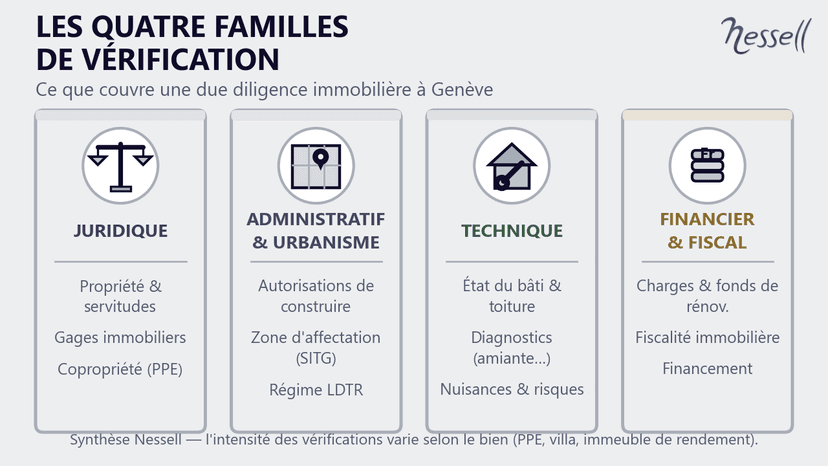
The term comes from Anglo-Saxon practice: it refers to the duty of reasonable care of a prudent buyer. In Geneva, this verification covers four categories: the legal component (ownership rights, easements, liens), the administrative and planning component (permits, zoning), the technical component (condition of the building) and the financial and tax component (charges, financing, taxation).
Due diligence is not a single formality: it is a bundle of checks that cross-references public registers, the seller's documents and professional opinions. Its intensity varies with the property: an apartment held as a condominium (PPE), a villa or an income-producing building do not call for the same checks. It is distinct from a simple viewing, which reveals neither the legal situation nor the regulatory constraints.
This diagram summarizes the four categories of checks in a due diligence process in Geneva.
Why carry out due diligence before buying in Geneva?
Due diligence becomes essential when the seller excludes the warranty against defects, leaving the buyer to face any defects alone. Without these checks, the buyer only becomes aware too late of the legal, technical and financial risks weighing on the transaction.
Under Swiss law, the seller warrants against defects in the property that diminish its value (article 197 of the Code of Obligations (CO)). Sales concluded "as is" exclude this warranty, except in case of fraud: the seller then remains liable for defects intentionally concealed (article 199 CO). For housing that is new or completed less than two years ago, the right to repair is mandatory and renders any exclusion void (article 219a CO, in force since 2026). For older properties, the buyer must prove concealment before the courts, a lengthy and uncertain process.
Three concrete risks reveal what is at stake. An overlooked easement weighs on the use of the land. An unnoticed technical defect, in the roof or insulation, imposes unforeseen work. A planning constraint, such as LDTR protection, limits planned alterations. Through due diligence, uncertainty becomes a known fact before commitment, which often leads to a renegotiation of the price or the buyer's withdrawal.
When should due diligence be carried out in the purchase process?
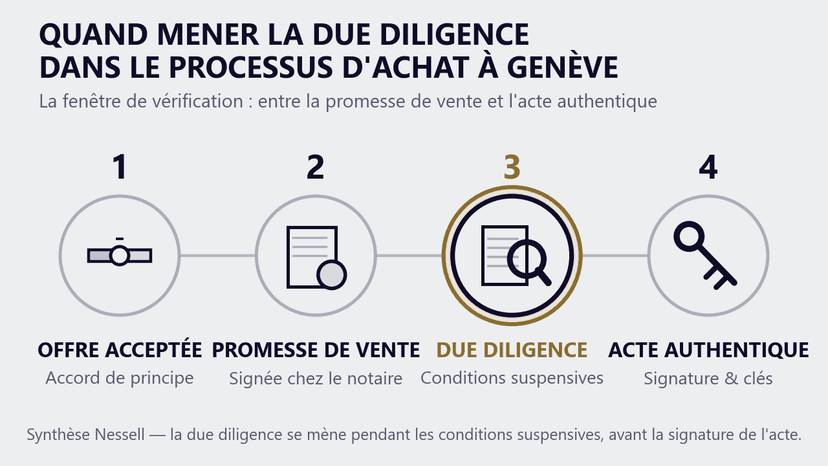
Due diligence is carried out between the agreement in principle on the sale and the signing of the notarial deed. This is the time allowed to fulfill the conditions precedent, the period during which the buyer has committed without yet being bound for good.
In Geneva, the process illustrates this well. An accepted offer often leads to a preliminary sale agreement signed before a notary, which sets out the price and conditions; this agreement most often makes the sale conditional on conditions precedent, such as obtaining mortgage financing. It is during this window that the buyer carries out their checks, before the final deed is executed.
Carrying out due diligence too late, once the deed has been signed, deprives the buyer of any leverage: the sale is final, and only the warranty against defects still applies. Scheduling it upstream, by contrast, makes it possible to revise the price, adjust a condition precedent, or withdraw without penalty.
This timeline situates due diligence within the purchase process in Geneva.
What points should be checked during due diligence in Geneva?
The points to check are divided into four categories: legal, administrative and planning, technical, then financial and tax. Each brings together several checks, the omission of which puts the buyer at risk.
The checklist below lists the points to review, to be ticked off as you carry out your checks.
Legal
Administrative & planning
Technical
Financial & tax
0 / 12 points checked
The legal and administrative component relies on public registers and permits. The technical component concerns the actual condition of the building. The financial component brings together charges, taxation and financing. In Geneva, consulting the land register and the territorial information system (SITG) forms the documentary foundation of any serious due diligence.
Legal and administrative checks
Legal and administrative checks concern the rights and permits attached to the property. They rely on Geneva's public registers.
- Land register extract: it reveals the owner, easements, mortgage liens and notes encumbering the property.
- Building permits: they attest to the compliance of the construction and alterations carried out.
- Zoning: the zoning plan and the territorial information system (SITG) set the permitted use of the land.
- LDTR regime: in Geneva, the law on demolitions, alterations and renovations (LDTR) regulates work on housing.
- Condominium status: for a unit held as a condominium (PPE), the regulations, minutes and charges provide information about the community.
Technical and financial checks
Technical and financial checks concern the condition of the property and its economics. They complement the legal analysis with material and accounting elements.
- Condition of the building: the structure, roof, systems and insulation determine the work to be planned.
- Surveys and nuisances: the presence of asbestos, exposure to noise or natural hazards weighs on the value.
- Charges and renovation fund: for a property held in condominium, the amount of the charges and the condition of the renovation fund commit the buyer.
- Taxation: the tax value, property tax and the future real estate capital gains tax affect the return.
- Financing: borrowing capacity and mortgage conditions determine the feasibility of the purchase.
Who carries out real estate due diligence?
Due diligence is carried out by the buyer, who brings in professionals depending on the complexity of the property. Each covers a distinct field of verification.
- The notary: in Geneva, they execute the sale, verify ownership and rights in rem, and record the transfer in the land register.
- The expert or architect: they assess the technical condition of the building and cost the work.
- The lawyer: they analyze the legal constraints, easements and any potential disputes.
- The trust and fiduciary firm: it examines the taxation, charges and return of an investment property.
- The broker: they bring knowledge of the market and reference prices.
The extent of this support depends on the property: a standard apartment involves fewer parties than an income-producing building or a villa to be renovated.
How much does due diligence cost and how long does it take?
The cost of due diligence ranges from a few hundred to several thousand francs, and the timeframe from a few days to several weeks. Both depend on the complexity of the property and the professionals involved.
The cost covers the fees of the professionals engaged: technical expertise, legal advice or tax analysis. Notary fees relate to the deed of sale and are calculated separately. A simple document check remains modest, while a full technical audit of a building is more substantial.
The timeframe depends on the availability of documents and experts. Consulting the land register is immediate, whereas obtaining certain permits or an expert report takes longer. The period of the conditions precedent, often a few weeks, sets in practice the time available to complete due diligence before the deed is signed.
How to secure a real estate purchase in Geneva after due diligence?
At the conclusion of due diligence, the buyer secures the acquisition by translating their findings into the deed. The checks feed into the negotiation and the contractual protections. The sensitive points identified become conditions precedent, price adjustments or specific warranties in the preliminary sale agreement. The notarial deed, executed by the notary, then finalizes the transaction. The place of due diligence in the purchase process and consultation of the land register complete this overview.
How to integrate due diligence into a purchase in Geneva?
Due diligence takes place upstream of the deed, as a verification step in the purchase process. It precedes the firm commitment and informs the buyer's decisions.
In practice, it takes place after the property has been selected and before signing, during the conditions precedent. The main steps to buy in Geneva, from financing to handover of the keys, thus include a verification phase at the heart of which is due diligence, and whose thoroughness determines the security of the entire transaction.
How to check the land register for a property in Geneva?
Checking the land register consists of obtaining an official extract for the property and analyzing its content. This extract reveals the owner, easements, liens and notes.
In Geneva, a party to the intended acquisition has the legitimate interest required to obtain the full extract, whereas free access is limited to the owner's identity and the description of the property. Examination of the land register covers the chain of ownership, real charges and restrictions encumbering the property. This review, often carried out with the notary, constitutes the first legal check of a due diligence process and reveals rights enforceable against third parties that a viewing never shows.
Is due diligence mandatory to buy in Geneva?
No, due diligence is not legally mandatory in Geneva. No statute requires the buyer to check the property before acquiring it. It nevertheless remains strongly recommended: absent an automatic warranty from the seller, especially in the case of a sale "as is," the buyer who forgoes these checks alone bears any defects they could have detected.
Can one withdraw after due diligence?
It depends on the stage of the transaction. As long as the notarial deed of sale has not been signed, the buyer may withdraw if a condition precedent is not fulfilled, for example if financing is refused: the sale then falls through at no cost and the deposit is refunded. On the other hand, withdrawal without legitimate grounds exposes the buyer to the penalty clause provided for in the contract and to loss of the deposit, or even to forced performance of the sale. After the deed is signed, the sale is final, subject only to the warranty against defects.