
Land Register in Geneva: Content, Access and Extract
Every property located in Geneva is governed by a detailed list of the rights attached to it: its owner, its easements and its liens are recorded in the land register. The register, kept by the State and vested with public faith, guarantees ownership and every transaction.
This article sets out a definition of the land register, distinguishes the cadastre from the land register, and explains how to consult it or obtain an extract in Geneva. It clarifies how it fits into real estate transactions, its cantonal particularities and who can access this information.
What is the land register?
The land register is the official public register recording the rights in rem over real property, kept by the State and enjoying public faith (art. 942 et seq. CC). For each property, it establishes who the owner is and what encumbrances affect it.
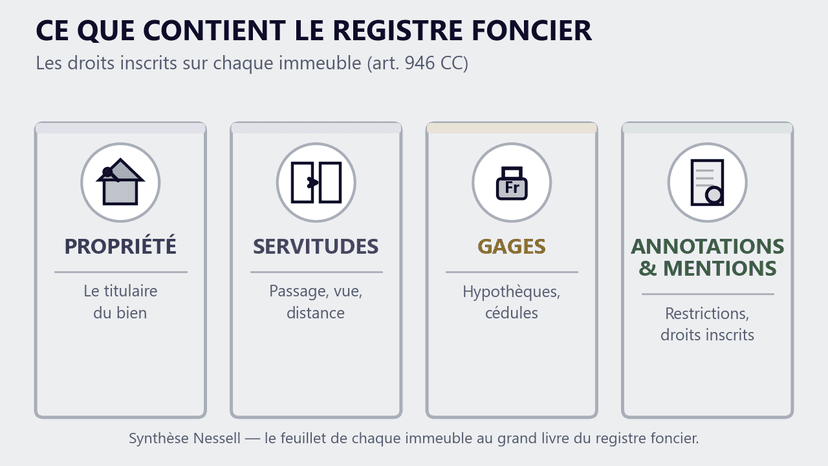
The sheet covering each property states its description, the right of ownership, easements, land charges, mortgage liens, as well as annotations and notes (art. 946 CC). Its registration is constitutive: ownership of real property is only acquired from the moment of entry in the main register (art. 656 CC).
The register carries public notice: no one may claim to have been unaware of a registered entry (art. 970 para. 4 CC). Anyone who acquires a right in good-faith reliance on a registered entry is protected, even if that entry proves inaccurate (art. 973 CC). This public faith makes the land register the linchpin of real estate security.
This diagram summarizes what the land register contains.
Land register or cadastre: what is the difference?
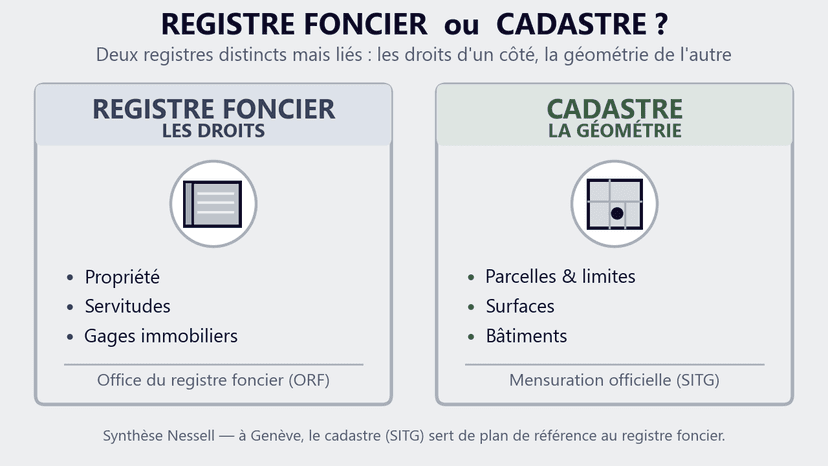
The land register deals with rights, the cadastre with the geometry of the land. The two are linked but distinct.
The official land survey, or cadastre, describes physical reality: parcels of land, their boundaries, their areas and the buildings on them. In Geneva, this geodata is published by the territorial information system (SITG) and serves as the reference plan for the land register. The land register, for its part, attaches to each parcel thus delimited the rights concerning it: ownership, easements, liens.
In other words, the cadastre locates and measures the property, while the land register states who owns it and what encumbers it. In Geneva, the geometric component falls under the Directorate for Territorial Information, and the rights component falls under the Land Registry Office.
This comparison distinguishes the two registers.
How to consult the land register in Geneva?
The land register is subject to a tiered access regime depending on the data in question. Some data is open to everyone, other data requires demonstrating an interest.
The tool below indicates, for each piece of information, whether it is freely accessible or subject to a legitimate interest requirement.
Without having to demonstrate any interest, anyone can find out the description of the property, its owner, as well as the type of ownership and the date of acquisition (art. 970 para. 2 CC). This data, however, remains without public faith.
Other information (easements, mortgage liens, notes) is disclosed only to someone who demonstrates an interest (art. 970 para. 1 CC). The interest must be personal, current and concrete: a prospective buyer satisfies this requirement, whereas a curious party or a marketing approach does not. In Geneva, consultation takes place at the Land Registry Office.
How to obtain a land register extract in Geneva?
The land register extract is obtained from the Land Registry Office of the canton of Geneva, online or at the counter. It is the document that officially reproduces the legal situation of a property.
In Geneva, the office issues the extract only through the State's online services portal or at its counter; it cannot be ordered by simple mail or telephone. The certified true copy, which alone is authoritative, is distinct from simply consulting the public data. Its issuance is subject to a fee, in the order of 50 francs for a certified extract. Access to the complete data likewise requires a legitimate interest to be shown.
What role does the land register play in a purchase or sale?
In a purchase or sale, the land register makes the transfer enforceable against third parties and secures the parties' rights: it is the registration that transfers ownership.
Registration is requested in writing from the office (art. 963 CC); in practice, the notary applies for the transfer after the authentic deed is signed. Ownership only changes hands at that moment, through entry in the main register. Beforehand, the buyer or their notary consults the extract to find out about the easements, liens and notes encumbering the property. Afterward, registration makes the right enforceable against everyone and protects the good-faith acquirer through public faith.
What are Geneva's specific features regarding the land register?
In Geneva, the land register is kept by a cantonal Land Registry Office, separate from the notarial profession. The canton clearly separates the two components of the system.
Rights in rem fall under the Land Registry Office; the official land survey and geodata fall under the Directorate for Territorial Information, which feeds the territorial information system (SITG). This organization is reflected even in the regulation setting the fees of the Land Registry Office and the Directorate for Territorial Information. Since the Geneva notarial profession is a liberal profession, the notary and the land registrar are two separate actors in the same transaction.
What legal rules govern real property ownership in Geneva?
The land register forms part of a body of rules that govern real property ownership in Geneva, from federal law to cantonal provisions. Ownership, easements and liens are governed by the Civil Code (CC), while planning, taxation and permits largely fall within the canton's remit. The place of the land register in Geneva real estate law and in the course of a purchase completes this picture.
How to secure the purchase of a property in Geneva?
Confirming the property's legal status with the land register is an essential precaution for securing a real estate purchase in Geneva. This extract provides information on the true owner, on any easements that may exist, and on liens that could affect the use or value of the property. This verification is part of the steps to buy in Geneva, from financing to signing before the notary, and it determines the security of the commitment.
Is the land register extract accessible to everyone?
It depends on the data being sought. The basic information about a property (its description, the identity of its owner, the type and date of acquisition) is freely accessible to anyone, without having to provide justification (art. 970 para. 2 CC). Easements, liens and notes, however, are disclosed only to someone who demonstrates a legitimate interest. The full extract is therefore not freely accessible.
Can the Geneva land register be consulted online?
Yes, partly. In Geneva, the basic data about a property can be consulted online, and an extract can be ordered through the State's online services portal for a fee. Professional platforms offering extended access to the register, however, are reserved for authorized users (such as notaries, banks or property management firms) and are not open to the general public.