
Heat pump in Geneva: types, cost, subsidy, procedures and noise
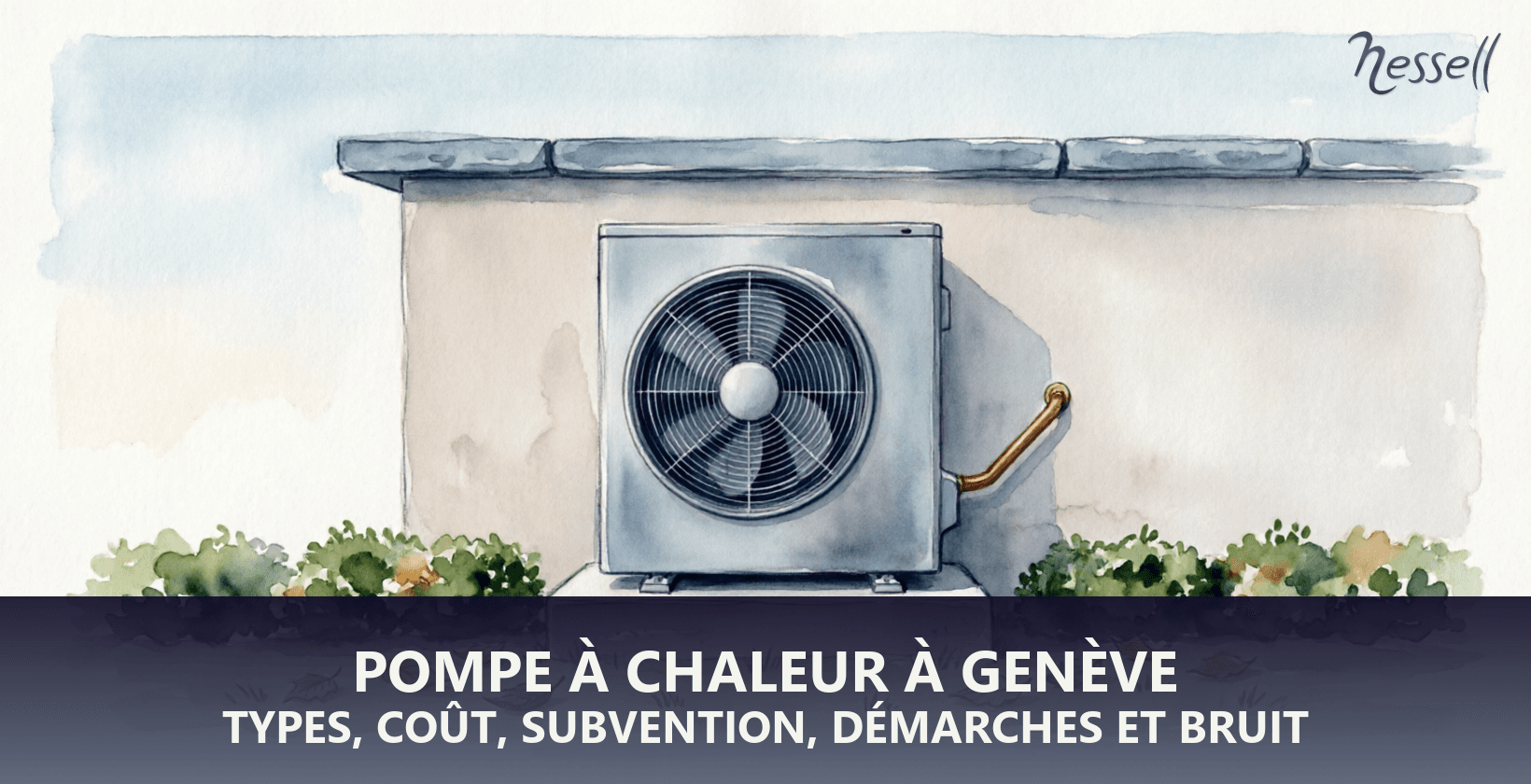
A heat pump is a heating appliance that draws heat from the air, the ground or water to heat a building and its hot water, using electricity.
In Geneva, the State treats the energy of a heat pump as renewable energy and subsidises the installation: 3 000 francs plus 400 francs per kW for an air-to-water heat pump of 70 kW or less that replaces an oil, gas or electric heating system (GEnergie scale applicable from 1 February 2026).
This article covers how it works and the types, the price and the subsidy, the procedure, noise, then heating replacement.
How does a heat pump work?
A heat pump works in three stages: a refrigerant evaporates on contact with the source, an electric compressor raises its temperature, then the fluid condenses and gives up its heat to the heating system.
The coefficient of performance (COP) states the kWh of heat produced per kWh of electricity: the Swiss Federal Office of Energy (SFOE) cites 4.5 at B0/W35 (probes at 0 °C, flow water at 35 °C). The annual COP (ACOP) ranges from 2.5 to 3.0 for an air-to-water heat pump in a renovation.
The diagram follows the refrigerant from one stage to the next, from the heat drawn from the air, the ground or water to the heating and hot water, with the coefficients of performance cited by the SFOE.

In severe cold, the efficiency of an air-to-water pump drops sharply because defrosting consumes electricity.
Which heat pump should you choose in Geneva?
In Geneva, the heat pump to choose depends on the heat source available on the plot; air-to-water is among the most widely used in Switzerland and suits villas heated by radiators.
The table compares four types by annual performance in a renovation (ACOP, SFOE) and Geneva constraints.
| Type | Source | ACOP | Constraints in Geneva | Relative cost |
|---|---|---|---|---|
| Air-to-water | Outdoor air | 2.5-3.0 | Noise limits of the OPB at the neighbour's | Lowest purchase price apart from air-to-air |
| Ground-to-water | Ground, probes | 3.2-4.0 | Drilling prohibited above the Genevois and Allondon aquifers, at CERN | Higher investment |
| Water-to-water | Groundwater, lake | 3.5-4.5 | Pumping subject to cantonal authorisation | Extraction well on top |
| Air-to-air | Air | Low | Not eligible for the subsidy | No water circuit |
In town, the space for the outdoor unit and the noise at the neighbour's decide. The air-to-air heat pump does not qualify for the GEnergie subsidy, which is reserved for the other types: air-to-water, ground-to-water and water-to-water.
Is the building suited to a heat pump?
Yes, the building is suited to a heat pump if the heating works with a low flow temperature, that is, with heating water that is not very hot; otherwise the annual performance drops.
- Flow temperature: 35 °C with underfloor heating, less than 55 °C with radiators; beyond that, efficiency falls.
- Sizing: proof under standard SIA 384/1 is required from 15 kW.
- Location: an indoor monobloc unit needs two openings at least 2 metres apart; an outdoor unit must comply with the OPB noise limits at the neighbour's.
Insulating the building envelope is part of the energy renovation.
How much does a heat pump cost in Geneva?
A heat pump in Geneva costs 45 000 to 60 000 CHF installed as air-to-water for a villa, and 55 000 to 80 000 CHF as ground-to-water with drilling (Swiss ranges from SuisseEnergie, 2024/25).
The table gives the installed cost of a villa by type of installation.
| Type of installation | Installed cost (CHF) | Items included | Source |
|---|---|---|---|
| Air-to-water | 45 000 to 60 000 | Installation, storage tank, hydraulics | SuisseEnergie |
| Ground-to-water | 55 000 to 80 000 | Same items and drilling (15 000 to 25 000) | SuisseEnergie |
Three items, absent from the table, are priced in the quote.
- Removal of the boiler and the oil tank.
- Electrical work.
- A new heat distribution system if the existing radiators are unsuitable.
The cost rises with the capacity, which is determined by calculating the building's needs.
In a price analysis by the Swiss Federal Office of Energy (December 2015), the median was 36 000 CHF excluding VAT for a 9 kW air-to-water pump, within a range of 26 000 to 49 000 CHF. SuisseEnergie cites a lifespan of at least 20 years for a heat pump and 50 years for geothermal probes.
What subsidy is available for a heat pump in Geneva?
The subsidy for a heat pump in Geneva is 3 000 CHF plus 400 CHF per kW for air-to-water, and 800 CHF per kW for ground-to-water or water-to-water (GEnergie scale applicable from 1 February 2026).
The table sets out the scale up to 70 kW.
| Type | Base amount | Amount per kW | Bonus / cap |
|---|---|---|---|
| Air-to-water (M-05) | 3 000 CHF | 400 CHF | +1 000 CHF (heat meter); 50 W/m² of energy reference area (SRE) |
| Ground-to-water and water-to-water (M-06) | 3 000 CHF | 800 CHF | Same |
The subsidy requires three conditions.
- Replace an oil, gas or electric resistance heating system.
- Attach the SuisseEnergie performance guarantee.
- Be located outside the zone of a structuring district heating network.
For example, a villa with 200 m² of SRE gives a capacity limit of 10 kW (200 × 50 W), that is 3 000 + 10 × 400 = 7 000 CHF for air-to-water and 3 000 + 10 × 800 = 11 000 CHF for ground-to-water.
In Geneva, replacing an oil or gas heating system with a heat pump is deductible from income as maintenance costs of a private property, provided the heated volume is not changed (notice no. 1/2022 of the cantonal tax administration).
Is a heat pump cheaper to run than oil?
Yes, a heat pump is generally cheaper to run than oil, because it delivers several kWh of heat per kWh of electricity consumed (2.5 to 5 depending on the type and the building, SFOE and SuisseEnergie).
For a house near Bern using 2 400 litres of oil a year, SuisseEnergie puts the energy at 1 895 CHF a year for air-to-water against 3 120 CHF for oil, and the total annual cost, including amortised investment, at 4 344 CHF against 5 043 CHF (20 years, rate of 1.75%, subsidies assumed). A kWh of electricity costs about 27 centimes including tax in Geneva in 2026 (Services industriels de Genève, SIG).
The advantage shrinks when the annual coefficient of performance falls or electricity gets more expensive.
Is a permit needed to install a heat pump in Geneva?
Yes, installing a heat pump in Geneva requires a permit: a simplified procedure with the cantonal energy office (OCEN) if the project meets the conditions, otherwise a building permit.
Does the project meet the conditions of the simplified procedure?
- Yes, route A, simplified procedure. File the notice of start of works 14 days before the works. Attach the noise assessment validated by an acoustician and the installer's PAC-SM certification.
- No, route B, building permit from the building permit office (OAC). File the notice 30 days before the works. Attach the proof of the coefficients of performance under standard SIA 380/4.
Route A requires four conditions.
- Location in a building zone, in an existing building or outdoors below 20 kW in defined cases.
- Building neither protected nor agricultural.
- No other works.
- Compliance with the Noise Abatement Ordinance (OPB).
The decision tree starts from the conditions of the simplified procedure, then gives for each route the competent office, the notice period for the start of works and the documents to attach.

Within the zone of influence of a structuring district heating network, attach SIG's reply to the thermal information request. The file is submitted through e-démarches.
The installation must be reported to the Federal Office for the Environment (FOEN) above 3 kg of refrigerant. Legal bases: art. 1 LCI (L 5 05); art. 12F, 12I, 13M and 14H REn (L 2 30.01).
What are the noise rules for a heat pump in Geneva?
The noise rules for a heat pump in Geneva are the planning values of the federal Noise Abatement Ordinance (OPB), the ceilings for a new installation, measured in the middle of the open window of neighbouring noise-sensitive rooms.
The table gives the planning values of Annex 6 of the OPB in dB(A).
| Sensitivity level | Typical zone | Day value dB(A) | Night value dB(A) |
|---|---|---|---|
| I | Recreation zone | 50 | 40 |
| II | Residential zone | 55 | 45 |
| III | Mixed or agricultural zone | 60 | 50 |
| IV | Industrial zone | 65 | 55 |
The OPB sets no distance to the neighbour: the rating level of an air-to-water heat pump follows from its sound power at 2 °C outdoors. The cantonal implementation guide and the Cercle Bruit tool of the Swiss heat pump trade association (GSP) calculate this level. Keep the outdoor unit away from neighbouring bedroom windows.
In what order should you install a heat pump in Geneva?
Installing a heat pump in Geneva follows seven steps, including the subsidy application, received at least 14 days before any start of works.
- Ask a certified installer for a quote with sizing.
- File the subsidy application, received by the OCEN 14 days before the works.
- Obtain validation of the simplified procedure or of the building permit.
- Give notice of the start of works: 14 days before for the simplified procedure, 30 days for a permit.
- Carry out the works: 5 to 10 days on average, within 24 months of the subsidy decision becoming final.
- Have the commissioning recorded in a report, with the hydraulic balancing report.
- Declare completion with invoices and photos: the OCEN pays the subsidy after validation.
The timeline shows the seven steps, from quote to payment: the subsidy application comes second, before any start of works, and payment follows the declaration of completion.

The subsidy is lost after 24 months; an extension of 6 months can be requested 30 days before the deadline.
How do you choose a heat pump installer?
To choose a heat pump installer, check their Heat Pump System Module (PAC-SM) certification from the Swiss heat pump trade association (GSP), then compare several quotes.
- Certification: require PAC-SM certification; the partner lists of éco21 (SIG) and the GSP name approved installers.
- Quotes: compare offers with the same scope: capacity, COP, noise, boiler removal, subsidy paperwork.
- Payment: limit down payments and ask for an extract from the debt enforcement register.
Quality lies in the certification and the measured performance, not in a brand. The OCEN recommends not signing on the spot when approached by a door-to-door salesperson: free installations do not exist.
Should you insulate the building before installing a heat pump?
No, insulating the building before installing a heat pump is not compulsory, but a lower heat demand reduces the capacity to install and its cost.
Installing a heat pump fits within a broader energy renovation of the building. The decision on the order of the works relies on the cantonal energy certificate for buildings (CECB). The subsidy's capacity cap is calculated on the energy reference area before the works. Two special cases arise: replacing an oil boiler and installing in co-ownership.
Is a heat pump compulsory to replace an oil boiler?
No, a heat pump is not compulsory to replace an oil boiler, but the replacement must primarily use renewable energy.
Since 20 April 2022, article 13M of the energy regulation has required the new heating system to use renewable energy as a priority and as far as possible; the heat pump is one of them. Two other common routes are wood energy and the structuring district heating network, to which connection can be imposed if it is more rational and proportionate. The heating replacement file is to be submitted, depending on the case, to the cantonal energy office or to the building permit office.
What the law says (art. 13M para. 1 REn): “When a heat-producing installation is put in place, replaced or converted, it must be supplied primarily and as far as possible by renewable energy or waste heat.”
Can you install a heat pump in a PPE?
Yes, you can install a heat pump in a PPE (condominium ownership), by decision of the owners' meeting.
A majority of all co-owners decides on necessary works (art. 647c of the Civil Code). Useful works require this majority and more than half of the shares (art. 647d). An outdoor unit on the facade, a common part, is subject to the decision of the meeting.
What the law says (art. 647d para. 1 CC): “Renovations and refurbishments aimed at enhancing the value or improving the object’s profitability or serviceability require the approval of a majority of the co-owners together representing a majority share in the object.”