
CECB in Geneva: when required, reading the classes, CECB Plus and price
The CECB is the cantonal energy certificate for buildings: issued by a certified expert, it rates a building from A to G. Geneva has not made it mandatory for a sale, but the cantonal energy office requires it, together with the CECB Plus, for certain grants (measure M-10, envelope insulation).
This article covers the cases where the CECB is required in Geneva, how to read its classes and what the CECB Plus adds, then its price and how to obtain it.
What is the CECB?
The CECB is the cantonal energy certificate for buildings, which assesses and rates a building from A to G, a tool shared by the Swiss cantons and run by the CECB association.
The certificate assesses three dimensions.
- The quality of the building envelope.
- Overall energy efficiency, technical installations included.
- Direct CO2 emissions, shown since 2023.
Only a certified CECB expert issues the certificate, after visiting the building. The assessment is standardised: the tool calculates a theoretical demand (cross-checked against measured consumption to within 20%), which makes it possible to compare buildings. The CECB association's product regulations (2026 version) govern how the certificate is issued.
Is the CECB mandatory in Geneva?
No, the CECB is not mandatory in Geneva to sell a building; it becomes required to obtain the M-10 grant under the GEnergie cantonal grant programme.
The energy law (LEn, version of 1 September 2025) requires no CECB on a sale. Measure M-10 requires the CECB as well as the CECB Plus before a grant decision is issued.
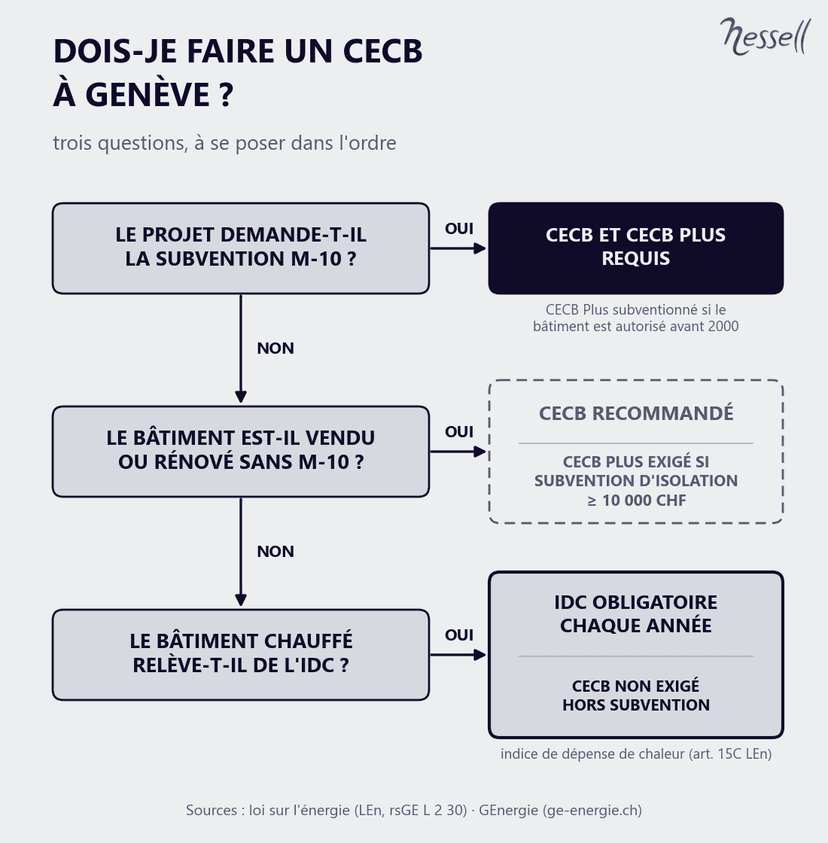
Three questions decide the case.
- Does the project apply for the M-10 grant? Yes: CECB and CECB Plus required.
- Is the building being sold or renovated without M-10? Yes: CECB recommended, CECB Plus required only for an envelope insulation grant of 10 000 CHF or more.
- Is the heated building subject to the IDC? Yes: the IDC is mandatory every year, the CECB is not outside a grant.
The tree below chains these three questions in order and gives, at the end of each positive answer, the document that is required or recommended.
Geneva's annual obligation relies on a different indicator, the heat consumption index (IDC, art. 15C LEn). Vaud, by contrast, has required the CECB on the sale of an existing residential building since 2017.
How do you read the CECB classes?
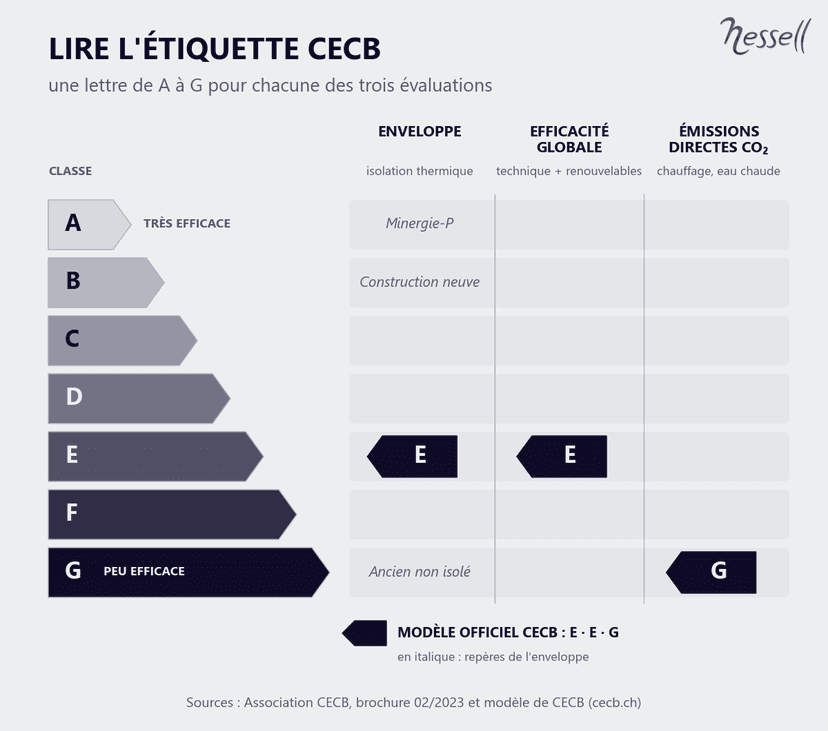
To read the CECB classes, place each letter on a scale from A (very efficient) to G (not very efficient) for each of the label's three assessments.
- The envelope rates the thermal insulation.
- Overall energy efficiency adds the technical installations and renewable energies.
- Direct CO2 emissions cover heating and hot water produced on site.
The same building receives different letters: the CECB association's model shows E for the envelope, E for overall efficiency and G for CO2. For the building envelope, A denotes a very well insulated building (Minergie-P), B a new build, G an old uninsulated building.
The label below places the official model's example, E, E and G, on the scale of each assessment, with the envelope benchmarks in italics.
The class lets you compare buildings; it is not a compliance rating under the legislation.
What is the difference between the CECB and the CECB Plus?
The difference between the CECB and the CECB Plus lies in the advisory report: the CECB Plus adds costed renovation options to the CECB.
Four criteria separate the CECB from the CECB Plus.
| Criterion | CECB | CECB Plus |
|---|---|---|
| Content | Classes A to G for the envelope, overall efficiency and CO2 emissions | CECB and advisory report |
| Renovation options | None | At least 3, including a full renovation |
| Use | Knowing the building's energy status | Planning the work |
| Grants | Document required for certain measures | Required for M-10 and for envelope insulation of 10 000 CHF or more; grant-funded under conditions |
The CECB is enough to get informed or to sell. For a works project, the CECB Plus is the right choice: it costs out the options and opens access to grants.
How much does a CECB cost in Geneva?
A CECB in Geneva costs the free price that the certified expert sets on a quote, with no official tariff. For a single-family house, the price list of the Romandy supplier Romande Energie (November 2022, VAT and CECB fee included) shows, as a guide, 850 CHF for a CECB and 2 200 CHF for a CECB Plus.
The same price list goes up to 1 050 and 2 700 CHF for a building with between 3 and 10 dwellings. The price depends on the building, the plans available and the expert.
The CECB association's fees and the 2026 cantonal grant vary with the document and the energy reference area.
| Document | Energy reference area (SRE) | CECB fees (excl. VAT) | Cantonal grant |
|---|---|---|---|
| CECB | All | 80 CHF | None under the 2026 scale |
| CECB Plus | Up to 500 m² | 190 CHF | 750 CHF |
| CECB Plus | Over 500 m² | 190 CHF | 1 500 CHF |
The expert passes these fees on in the invoice. The aid covers the first assessment of a building permitted before 2000. The cost of the CECB Plus is deductible as a maintenance expense. Compare several quotes.
How do you obtain a CECB in Geneva?
To obtain a CECB in Geneva, the owner hires a certified expert from the CECB association's official list.
- Choose a CECB expert by postcode on cecb.ch.
- Ask for several detailed quotes.
- For a grant-funded CECB Plus, submit the request on the Buildings Programme platform before the certificate is published.
- Gather the heating, hot water and electricity consumption over 3 years.
- Have the expert visit the building.
- Receive the certificate, as a signed paper copy and in electronic form.
A tenant does not order a CECB.
What does the CECB change when selling in Geneva?
When selling in Geneva, the CECB changes nothing in the legal obligations, but it documents the building's energy status. An existing certificate, with no major change to the building, remains valid for 10 years and stays with the building under the new owner.
The buyer asks for the CECB if there is one, the annual heat consumption index (IDC) statements and the condition of the heating system. A low class signals work to be costed, which serves as an argument for negotiating the price and the financing. Measured consumption and renovation grants complete this picture.
What is the link between the CECB and the IDC in Geneva?
The link between the CECB and the IDC in Geneva is that they complement each other: the IDC measures actual heat consumption every year, while the CECB assesses the building on a standardised basis.
The owner must have the heat consumption index calculated every year for heated buildings, with exceptions notably for buildings with fewer than 5 heat users. The owner must carry out an energy audit when the IDC exceeds the threshold of 125 kWh/m².year, then take measures (with excess values that fall in steps). The CECB Plus is used to plan these measures.
Is the CECB Plus required to obtain a grant for an energy renovation?
Yes, the CECB Plus is required for certain energy renovation grants in Geneva: measure M-10 and envelope insulation from a grant of 10 000 CHF.
Submit the grant application at least 14 days before the start of the work. The canton grants a subsidy for the CECB Plus itself for buildings permitted before 2000 (amounts in the price table). Without a CECB Plus, these two energy renovation aids remain closed.