
Eco-districts in Geneva: list, criteria, housing and drawbacks
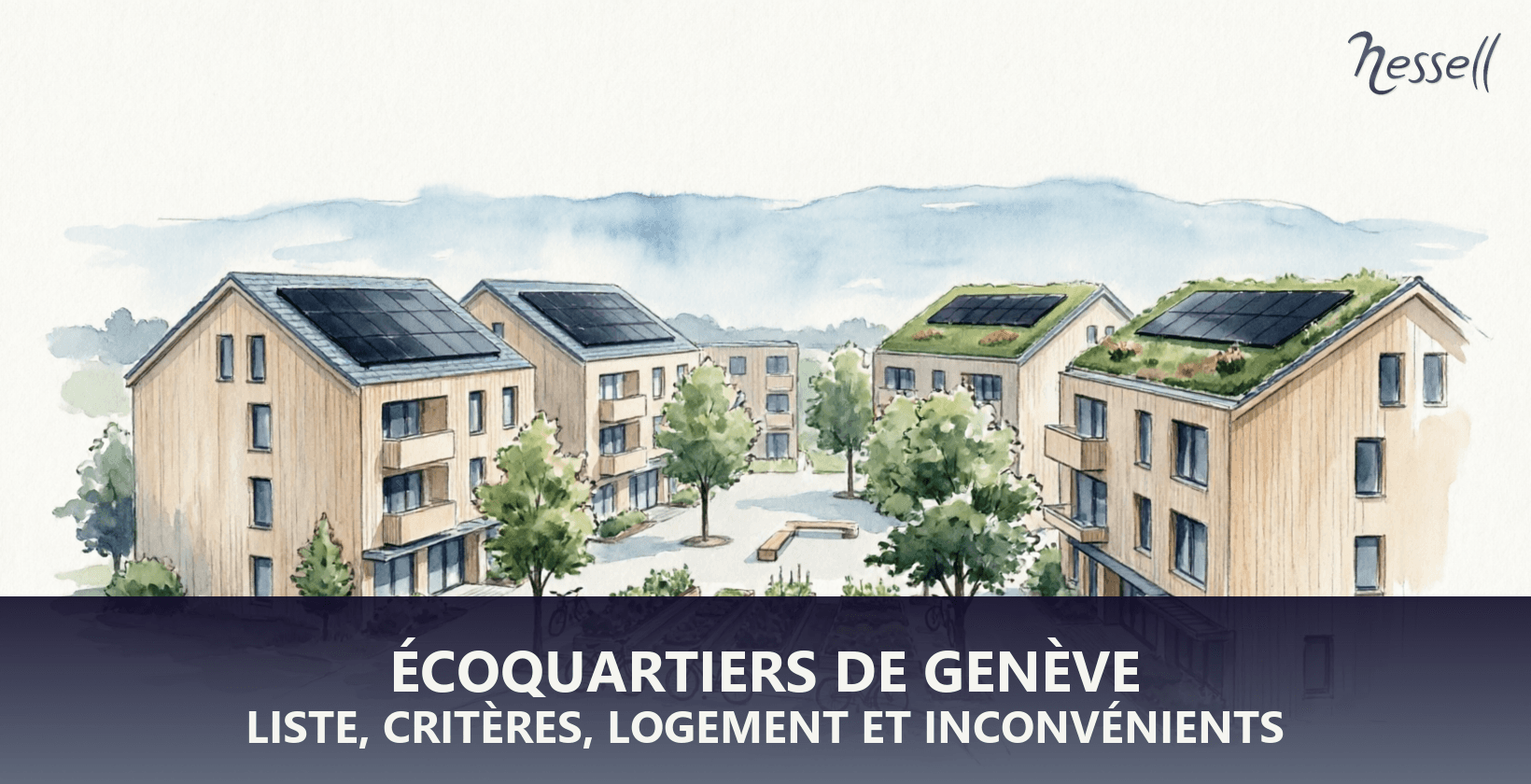
Geneva has six eco-districts, designed to limit their environmental impact: three are complete, three are still under construction, for nearly 10,500 homes. Getting a home there depends on the status of the housing.
They range in size from 304 to about 3,700 homes, five criteria set them apart and four routes give access to them. Noise, density and housing that is not always a free choice are the drawbacks.
This article covers the list of districts, their criteria, access to housing, its cost and the drawbacks.
What is an eco-district?
An eco-district is a district planned as a single whole, with from several hundred to several thousand homes, whose design limits the environmental footprint of urbanisation and aims for social mix.
In Geneva, the Council of State notes in its report M 1841-A of February 2011 that no precise or exhaustive definition exists: the notion covers a set of objectives and criteria that vary according to the approach taken and to each project. The sustainable development charter of the Communaux d'Ambilly lists eleven issues; four families emerge from it for residents.
- Energy: rational use of the resource and protection of the climate.
- Mobility: multimodal accessibility.
- Soil and water: preservation of soil and biodiversity, integrated water management.
- Society: social and functional mix, quality of life.
A new district that meets energy standards is not an eco-district: building energy is only one of the charter's eleven issues.
What are the eco-districts of Geneva?
The eco-districts of Geneva are six districts: three complete (Étang, Jonction, Vergers) and three with stages still to be built (Vernets, Communaux d'Ambilly, Cherpines). The table compares their size, their status and their housing types as of October 2026.
| Eco-district (commune) | Homes | Status | Developers or housing types |
|---|---|---|---|
| Étang (Vernier, Meyrin) | 1,144 | inhabited, inaugurated in September 2023 | PPE, subsidised, free-market rentals |
| Jonction (Geneva) | 304 | inhabited, built from 2014 to 2022 | Fondation de la Ville de Genève pour le logement social (HBM), CODHA, Coopérative des Rois |
| Vergers (Meyrin) | 1,360 | inhabited, 3,888 residents at the end of 2024 | 7 cooperatives, LUP, PPE, free-market rents |
| Vernets (Geneva) | 1,355 | 771 delivered in March 2026 | LUP (two thirds), student housing |
| Communaux d'Ambilly (Thônex) | about 2,600 | first stage (about 670) inhabited since the end of 2021, completion targeted for 2034 | Batima, C2I, cooperatives, CPEG |
| Cherpines (Plan-les-Ouates, Confignon) | about 3,700 | first stage under construction, delivery from 2027 | subsidised, PPE, free-market rents |
This map shows the six eco-districts within the canton: the area of each disc follows the number of homes, and its shade indicates whether the district is inhabited, partly delivered or still under construction.

In total, that is nearly 10,500 homes spread across six developments. Three are in suburban communes (Vernier, Meyrin, Thônex), one in Plan-les-Ouates and Confignon, and two in the city of Geneva. Deliveries are staggered from 2021 to 2034.
Where is the Étang district?
The Étang district is located in Vernier and Meyrin, on 11 hectares of a former industrial site close to Geneva airport.
It comprises 1,144 homes (PPE, subsidised and free-market rentals) in blocks of 4 to 8 storeys, and 2,500 jobs. The local district plan was adopted in October 2015, construction started in 2017, the first delivery dates from 2021 and the district was inaugurated in September 2023. The district has the 2000-watt Site label.
The district has a 16-class school and a nursery. Thanks to centralised, shared car parks, green space rises from 12% to 55% of the perimeter.
What became of the Artamis site at Jonction?
The Artamis site at Jonction became the Jonction eco-district, 304 homes built from 2014 to 2022 on 12,000 m2 between boulevard Saint-Georges and quai du Rhône.
The land has housed in turn a gasworks opened in 1844, then the self-managed cultural collective Artamis from 1996 to 2008. The clean-up of the "Carré Vert" was carried out from 2008 to 2012.
The homes are spread across three buildings: 113 HBM homes, 103 CODHA homes and 88 homes of the Coopérative des Rois. A public building houses a nursery, an after-school centre, a gym and a performance hall.
How many homes does the Vergers eco-district have?
The Vergers eco-district has 1,360 homes for 3,888 residents at the end of 2024, on former farmland in Meyrin.
The canton counts 764 rental homes with controlled or subsidised rents (435 HM and 329 LUP), 418 free-market rental homes and 178 PPE homes. 7 cooperatives (Polygones, Equilibre, Les Ailes, La Ciguë, CODHA, Voisinage and Niton) own 468 homes in total.
These buildings, which aim for Minergie-A or Minergie-P standards, produce photovoltaic electricity. A district heating system, fed by a networked heat pump, makes use of industrial waste heat. A participatory process accompanied the project from 2013 to 2018.
Where does the Vernets district stand?
The Vernets district is partly delivered: 771 homes were inaugurated on 27 March 2026, out of 1,355 planned in the end. It occupies the former Vernets barracks, where the Quai Vernets construction site began in October 2022, within the Praille-Acacias-Vernets perimeter.
Two thirds of the homes are public-utility housing. GeniLac energy is 100% renewable and the district has the 2000-watt Site label.
What does the Communaux d'Ambilly district plan?
The Communaux d'Ambilly district, named Belle-Terre, plans about 2,600 homes in Thônex by 2034, in three stages.
The first stage plans about 670 homes, a school complex and shops; the first residents moved into the district at the end of 2021. The second adds about 1,000 homes by 2030, and four cooperatives are among the developers; adoption of the local district plans is targeted for 2026. The third stage adds about 1,000 homes by 2034.
When will the Cherpines district be built?
The Cherpines district is being built in stages starting with the Rolliet construction site, whose first homes are announced for 2027.
The project covers 58 hectares in Plan-les-Ouates and Confignon, as an extension onto agricultural land, for about 3,700 homes and 2,500 jobs, with a horizon initially set at 2030. Only the Rolliet, a first stage of about 1,000 homes, is under construction. The overall local district plan was put to public consultation in October 2024, before being rejected by the population of Confignon on 8 March 2026, in a vote that does not bind the State.
This timeline places the six eco-districts in time: a solid line for what has been completed, a dotted line for the planned horizons, from Jonction completed in 2022 to the Communaux d'Ambilly stages announced until 2034.

Deadlines that no public source dates, such as the completion of the Vergers or of the Vernets, are not shown.
What criteria set a Geneva eco-district apart?
Five criteria set a Geneva eco-district apart, and the Vergers eco-district illustrates them. The charter's "society" family splits there into mix and participation.
- Energy: high-performance buildings heated by a renewable network; according to the City of Meyrin, the Vergers buildings aim for Minergie-A standards and produce photovoltaic electricity.
- Mobility: parking is grouped into shared underground car parks, away from the buildings.
- Mix: several housing types coexist; according to the State of Geneva, more than half of the Vergers homes have controlled or subsidised rents (2025 census).
- Nature and water: the Vergers district master plan provides for a retention ditch and green roofs.
- Participation: the Open Forum of April 2014 brought together 171 participants to launch the participatory process for the Vergers district.
In a development zone, the State sets the rules on rents, sale prices, housing types and facilities.
How do you get a home in an eco-district?
Getting a home in an eco-district goes through 4 routes, depending on the status of the housing: public-utility housing, cooperative, free-market rental and PPE in a development zone.
| Route | Who it is for (conditions) | Where to apply | Timeframe or constraint |
|---|---|---|---|
| Public-utility housing (HBM, HLM) | 4 continuous years of residence in Geneva over the last 8 years, income below the access scale, rooms at most equal to occupants + 2 | SFIDP (receiving applications since 2018), or the building's property manager | Application valid for 1 year, renewable (foundations) |
| Cooperative | Adult person, with a member share (Codha: CHF 100) that is not enough to obtain the home | The project's cooperative | Allocation by seniority, 3 to 7 years of waiting according to Codha |
| Free-market rental | Home as main residence; Geneva taxpayer for the Gérance immobilière municipale | Property manager, or the Gérance immobilière municipale in the City of Geneva | Application valid only for the vacant home advertised |
| PPE in a development zone | Buyer who lives in the home | The operation's developer | Controlled price, obligation to live there for 10 years |
This tree summarises the path in three questions, from buying a PPE to free-market rental, and leads to the route that fits each situation.

The status of the building concerned should be checked before applying: it determines the route and the counter.
How much does a home in an eco-district cost?
A home in an eco-district costs from CHF 1,010 to 1,639 a month to rent and CHF 7,041 per m2 to buy as controlled PPE, according to cantonal benchmarks, which give an order of magnitude.
| Route | Entry cost | Rent or price (cantonal benchmark) | Source |
|---|---|---|---|
| Public-utility housing | Deposit, 3 months' rent at most | CHF 1,252/month, controlled or subsidised homes, all sizes | OCSTAT, May 2025; OFL |
| Cooperative | Share of CHF 100, then CHF 5,000 to 6,000 per room, refundable | CHF 1,010/month, 4 rooms | Codha; OCSTAT, May 2025 |
| Free-market rental | Deposit, 3 months' rent at most | CHF 1,639/month, 4 rooms | OCSTAT, May 2025 |
| PPE in a development zone | Sale price controlled for 10 years | CHF 7,041/m2, against 10,284 for free-market new builds | OCSTAT, 2024 |
Heating costs, charged on top of rent in Geneva, depend on the district's energy system.
What are the advantages and drawbacks of an eco-district?
The advantages of an eco-district are walkability, green space and neighbourliness; its drawbacks are noise, density and a housing choice that was forced for 31% of respondents.
Advantages
- Getting around: according to the cantonal survey of October 2025 (1,020 respondents), residents value the ease and safety of walking as well as access to public transport.
- Green space: 91% of Vergers respondents consider the amount sufficient.
- Neighbourliness: satisfaction with neighbourly relations is very good, and more than 40% of respondents say they are very satisfied with their home.
Drawbacks
- Noise: daytime and night-time noise comes up in all three districts of the survey (Jonction, La Chapelle in Lancy, Vergers), notably from the bars at Jonction.
- Density: 30% of Vergers respondents find it too high.
- Access: in the Vergers, underground parking, with no direct access from the buildings, is a nuisance for families and people with reduced mobility.
- Forced choice: 31% of respondents did not really choose their district, in a tight housing market.
These results come from the cantonal survey published in October 2025 among residents of Jonction, La Chapelle and the Vergers.
What place do eco-districts hold among Geneva's districts?
Eco-districts hold the place of new urban areas, built on the periphery or on converted industrial land, alongside the canton's historic districts.
Of the six eco-districts, four extend into suburban communes, often on former farmland as in the Vergers or the Cherpines, and two convert sites in the city of Geneva, Jonction and the Vernets.
This distribution places the eco-districts among the districts of Geneva: they extend the city towards its periphery more than they transform the historic districts. This place can be read through four points: car traffic, the existence of a Swiss label, the role of cooperatives and the comparison with eco-districts in the rest of Switzerland.
Can you have a car in an eco-district?
Yes, residents can have a car in an eco-district, but parking is concentrated in underground car parks.
In the Vergers, according to the City of Meyrin (2026), the three public underground car parks count 1,245 spaces for a district of 1,360 homes. At Jonction, only one home in three has a parking space according to Espazium (May 2021), and the CODHA cooperative runs the Codhality car-sharing service, with five vehicles according to the same source.
Is there an eco-district label in Switzerland?
No, there is no official eco-district label in Switzerland.
According to the French Ministry of Ecological Transition, the éco-Quartier label is a scheme launched in 2009, with a first labelling campaign in 2012. Swiss districts are certified by site labels. According to Minergie, the 2000-watt Site label, first obtained by Greencity in Zurich, has given way to Minergie-Quartier and SNBS-Quartier. According to a press release of September 2023, the Étang district in Vernier holds the first SNBS-Quartier certificate.
Why are housing cooperatives so present in eco-districts?
Housing cooperatives are so present in eco-districts because public authorities grant them public land under a building right.
This building right is provided for by the Geneva law on public-utility housing (LUP) for non-profit organisations. In the Vergers, the commune of Meyrin transferred its building rights to seven cooperatives and to the Fondation Nouveau Meyrin.
A housing cooperative belongs to its members, who are formally tenants, are involved in decisions and elect the board of directors.
Where are the eco-districts in Switzerland?
Eco-districts in Switzerland are found in the urban areas of French-speaking and German-speaking Switzerland.
The City of Lausanne presents the Plaines-du-Loup as the first eco-district of its Métamorphose project, planned for 8,000 residents and 3,000 jobs. In Gland (VD), the developer of Eikenøtt claims the first eco-district in French-speaking Switzerland. At the Greencity site in Zurich, about 2,000 residents are announced. Geneva completes this picture with the Étang district in Vernier.