
Geneva Neighbourhoods: Map, Characteristics and Property Prices by Area
The City of Geneva has been officially divided into eight neighbourhoods since 2013: Eaux-Vives Cité, Pâquis Sécheron, Grottes Saint-Gervais, Plainpalais Jonction, Saint-Jean Charmilles, Servette Petit-Saconnex, Acacias Bâtie and Champel. This guide presents their map, their profile and their property positioning, the average price per neighbourhood, the effect of the Léman Express and the Praille-Acacias-Vernets project on their value, and how to choose a neighbourhood according to your profile. Not to be confused with the canton's forty-five municipalities: a neighbourhood of the central City has no political authority of its own.
How does the City of Geneva divide its territory into neighbourhoods?
The City of Geneva structures its territory into eight municipal neighbourhoods, approved in 2013. This division aggregates the sixteen GIREC statistical sectors, tracked by the Office cantonal de la statistique, into a stable grid intended for communication and local services.
GIREC sectors offer a scale of observation finer than the municipality and broader than the parcel; they are only recalibrated marginally, notably to track changes in the lakeshore boundary.
How do you read the map of Geneva's neighbourhoods?
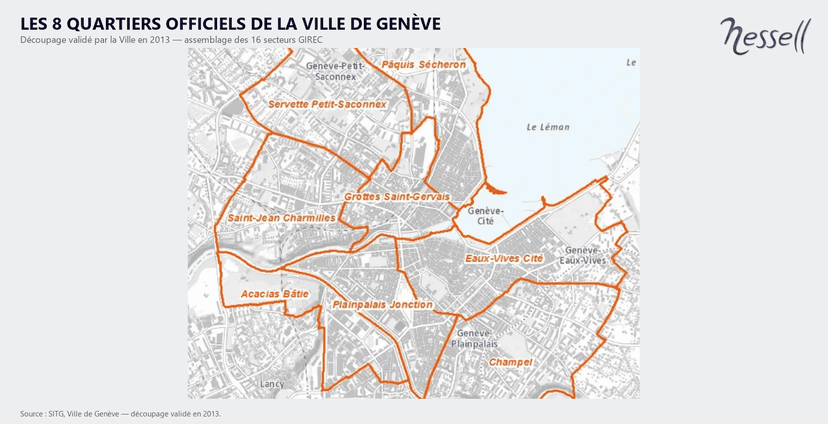
The neighbourhood map overlays the layer of the City's eight official boundaries on the cadastral base map. The SITG, the Geneva territorial information system, publishes this layer with a colour code per neighbourhood and allows the finer breakdown of GIREC sub-sectors to be displayed alongside it.
Reading the map in practice relies on three markers: municipal boundaries shown as dashed lines, the neighbourhood's coloured outline, and the alphanumeric GIREC codes for each sub-sector.
What is the difference between a City neighbourhood and a municipality of the canton?
A neighbourhood is a subdivision of a municipality, whereas a municipality is an autonomous political entity recognised by cantonal law. The canton of Geneva has forty-five municipalities, including the City of Geneva (OCSTAT).
The central City's neighbourhoods have no political authority of their own: they are boundaries for communication and local services, whereas municipalities have a municipal council, an executive body, and fiscal and regulatory powers. Cologny, Carouge and Veyrier are not City neighbourhoods but municipalities in their own right.
What are the 8 official neighbourhoods of the City of Geneva?
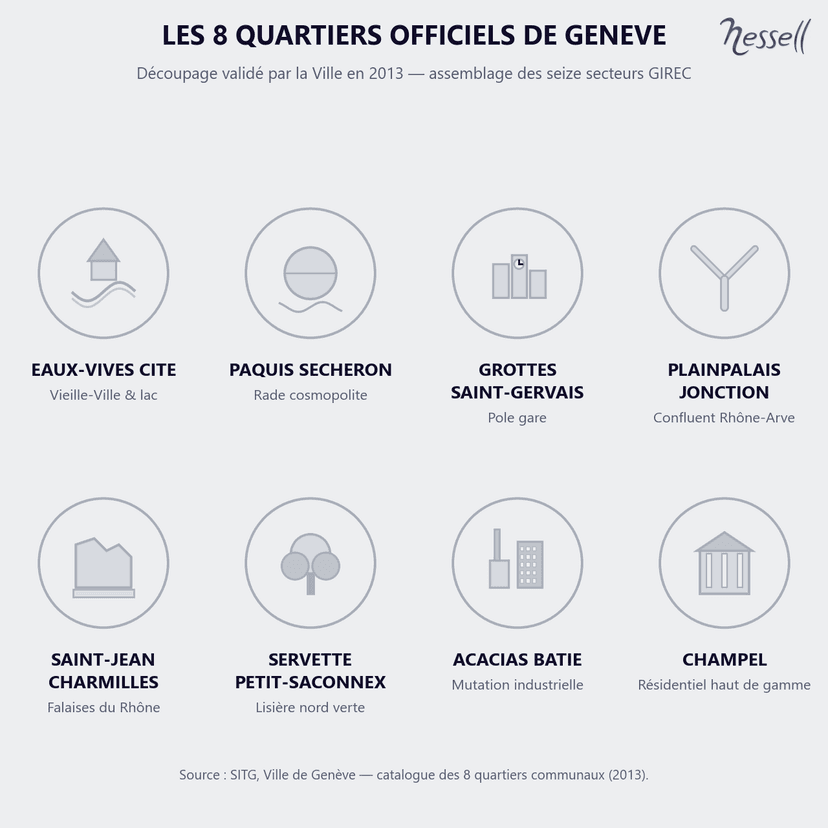
The City of Geneva recognises eight official neighbourhoods, set by its SITG catalogue in 2013. These eight areas form the reference grid for local communication: Eaux-Vives Cité, Pâquis Sécheron, Grottes Saint-Gervais, Plainpalais Jonction, Saint-Jean Charmilles, Servette Petit-Saconnex, Acacias Bâtie and Champel.
The eight sections below detail, for each one, the population profile, the atmosphere and the property positioning.
Eaux-Vives Cité
Eaux-Vives Cité occupies the historic heart of the left bank and opens onto the lake. The area brings together the Old Town, the centre of Eaux-Vives and the shoreline near the Jet d'Eau, in an atmosphere both heritage-rich and lively, anchored by St. Pierre Cathedral, Place du Bourg-de-Four and the shopping avenues.
It attracts international executives, long-standing owners and second-home residences. Its proximity to the lake and the heritage value of its buildings place its property positioning among the highest in the City.
Pâquis Sécheron
On the right bank, Pâquis Sécheron runs along the harbour between Cornavin station and the mouth of the lake. The area brings together two contrasting atmospheres: Pâquis, cosmopolitan and intense, and Sécheron, more institutional and residential. Its population mixes diplomats from international organisations, established families and young residents, around the Bains des Pâquis and Quai Wilson.
Property positioning changes radically from one street to the next: top-tier prices along the lake, and noticeably more affordable prices inland in Pâquis.
Grottes Saint-Gervais
In the north-centre of the City, undergoing major change around Cornavin station, Grottes Saint-Gervais combines the Grottes neighbourhood, with its strong identity and colourful buildings, and the lower town of Saint-Gervais with its medieval lanes. A village atmosphere sits alongside densification projects around the station hub. The population brings together long-established families, young professionals and neighbourhood associations.
Property positioning remains moderate on average, but properties overlooking the Rhône or the Old Town are highly sought after.
Plainpalais Jonction
Plainpalais Jonction stretches along the left bank, at the confluence of the Rhône and the Arve, marked by student life and an alternative scene. Plainpalais is home to the university, the plaine open space, the flea market and several cultural institutions; the Jonction extends the neighbourhood westward, over former industrial wasteland now occupied by creative and residential projects.
The population brings together students, young professionals and families drawn by the cultural energy. Property positioning remains one of the most affordable in the City, below the City median (14'530 francs per square metre, signed sales).
Saint-Jean Charmilles
On the right bank, Saint-Jean Charmilles nestles between the cliffs of the Rhône and the urban routes of the north-west. The urban fabric plays on the contrast between the row of pre-war buildings and the cliffs overlooking the Rhône, with the Bois de la Bâtie remaining accessible on foot, on the other bank, via the footbridge of the same name. A local neighbourhood life is organised around the shops on Rue de Saint-Jean, with a population balanced between families, retirees and young professionals.
The neighbourhood sits in the lower-middle range of the City, with moderate growth in recent years.
Servette Petit-Saconnex
North of the City, Servette Petit-Saconnex stretches between Servette, dense and demographically active, and the more open fringe of Petit-Saconnex. Population diversity dominates, with a strong presence of international executives near the Nations district. Servette concentrates shopping streets and transport links, while Petit-Saconnex offers residential pockets, parks and views of Mont Blanc.
The population brings together families, UN expatriates and established residents. Property positioning remains mixed, higher on the residential Petit-Saconnex side.
Acacias Bâtie
In the southern neighbourhood of the City, Acacias Bâtie is gradually shedding its industrial and commercial character for that of a mixed-use area. It breathes thanks to Parc des Acacias and the urban forest of Bois de la Bâtie, which gave it its name.
Former logistics warehouses are giving way to housing and businesses, between new developments, period buildings and offices. Young professionals, long-established families and service-sector companies mix here, while ongoing construction projects are gradually bringing new-build prices closer to the Geneva average.
Champel
Champel, on the left bank, is an upscale residential neighbourhood, marked by its green spaces, renowned schools and the arrival of the Léman Express station. The area brings together high-end buildings, private mansions and university hospitals, in a calm, discreet atmosphere, along tree-lined avenues opening onto the Arve. The population brings together wealthy families, doctors, senior executives and an international clientele.
Property positioning sits above the City median: the square metre stands at 14'952 francs as a median of signed sales (August 2026).
What is the average property price by neighbourhood in Geneva?
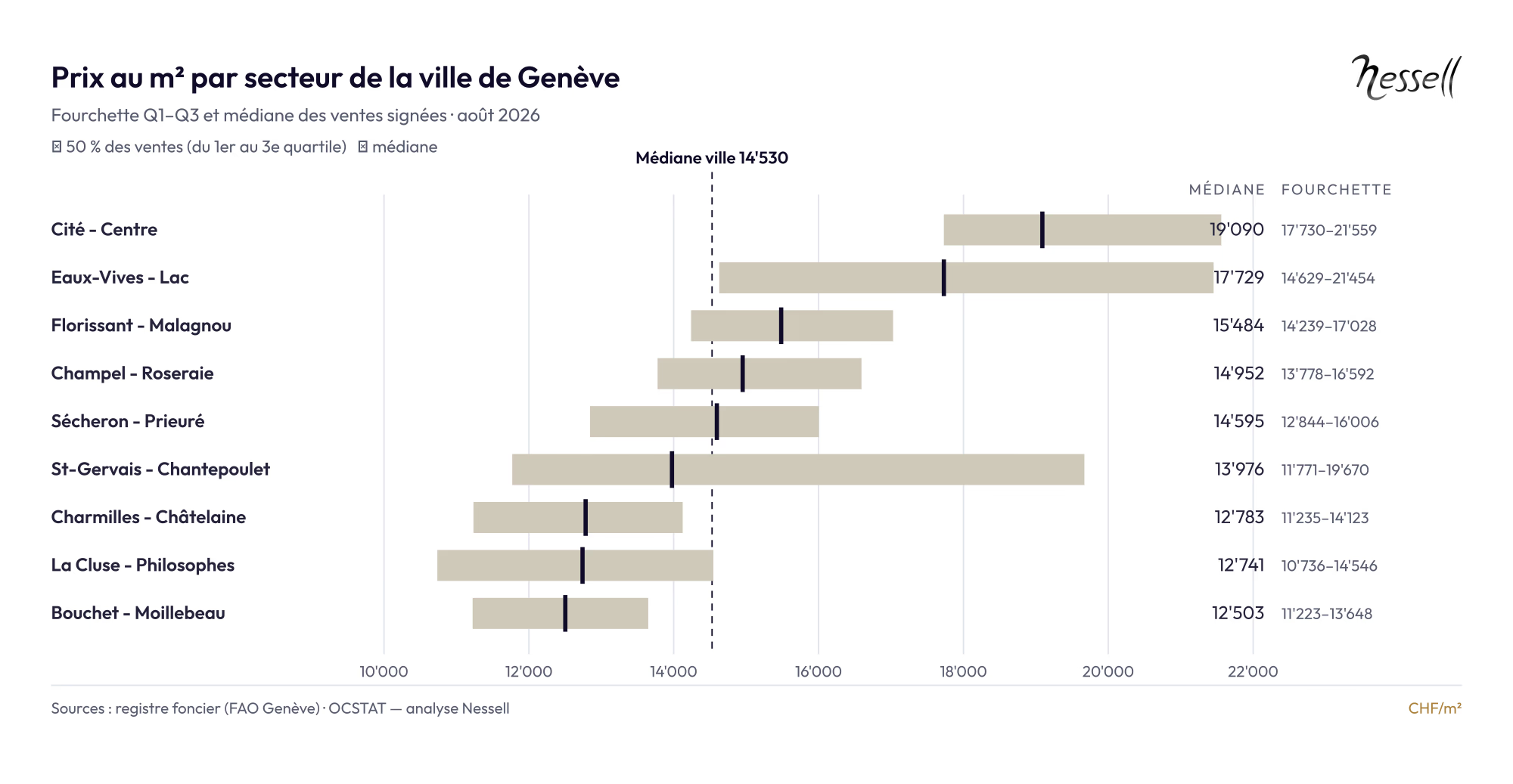
How to read it: the bar covers the middle half of sales, the tick marks the median. The city sits at CHF 14'530/m² as a median of signed sales (August 2026); the most sought-after sectors stand well above, the most affordable well below.
The average property price in the City of Geneva stands at 14'530 francs per square metre in August 2026 (signed land-registry sales), with a marked gap between expensive and affordable neighbourhoods. The hierarchy is driven mainly by which bank, proximity to the lake and the heritage quality of the buildings.
At the top, Cité - Centre (19'090 francs per square metre as a median) and Eaux-Vives - Lac (17'729). In the middle, Florissant - Malagnou (15'484), Champel - Roseraie (14'952) and Sécheron - Prieuré (14'595). More affordable, St-Gervais - Chantepoulet (13'976), Charmilles - Châtelaine (12'783), La Cluse - Philosophes (12'741) and Bouchet - Moillebeau (12'503).
These ranges apply to the standard market: in the exceptional segment, lakefront, Old Town and penthouses, the square metre goes beyond the top of the city-centre range (21'559 francs).
Which Geneva neighbourhoods are most sought after for property?
The most sought-after neighbourhoods are Champel, Eaux-Vives Cité, the Pâquis lakefront and residential Petit-Saconnex, all valued above the City average (14'530 francs per square metre, signed sales, August 2026). Their standing rests on three criteria: proximity to the lake, which benefits the Eaux-Vives and Pâquis waterfronts; the heritage prestige of the exceptional buildings of the Old Town and Champel; and the quality of schools, both public and international, in Champel and Petit-Saconnex.
Which Geneva neighbourhoods are most in demand for letting?
For letting, the most sought-after neighbourhoods are Pâquis Sécheron for an international clientele, Plainpalais Jonction for students and young professionals, and Eaux-Vives Cité for executives drawn to the city-lake combination. Rental market pressure remains high: as of 1 June 2025, the canton's vacancy rate stood at just 0.34% (OCSTAT), which shortens letting timelines.
How do the Léman Express and the PAV project add value to the neighbourhoods?
In Geneva, two large-scale projects are rewriting the geography of property value. The Léman Express, a cross-border regional rail network, launched in late 2019 on the CEVA infrastructure, giving Champel and Eaux-Vives their own stations and contributing to the renewed appeal and prices of the left bank.
The Praille-Acacias-Vernets project, one of the country's most ambitious urban development schemes, is replacing the industrial wasteland in the south of the City, around Acacias Bâtie, with mixed-use neighbourhoods, adding value to this changing area.
How do you choose a Geneva neighbourhood based on your profile?
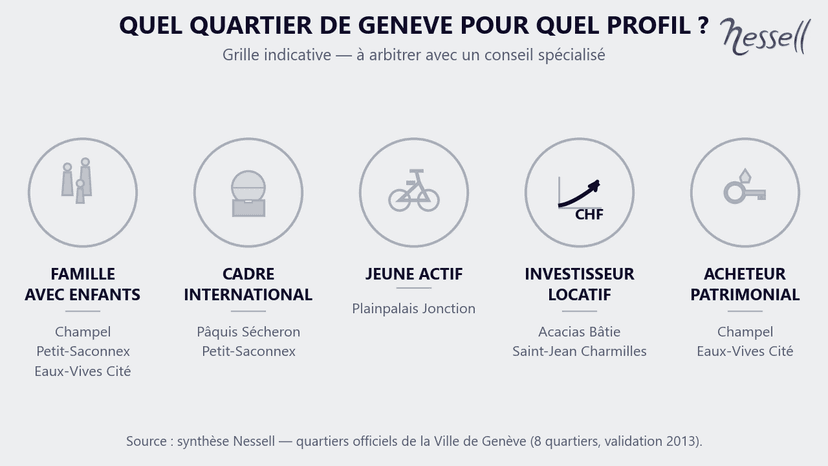
Choosing a neighbourhood depends on the resident's profile, the intended use of the property and the holding horizon.
- Family with children: Champel, Petit-Saconnex or Eaux-Vives Cité, for the schools, green spaces and paediatric care on offer.
- International executive: Pâquis Sécheron and Petit-Saconnex, long-standing hubs of the UN community, with a suitable range of furnished accommodation.
- Young professional: Plainpalais Jonction, for its student energy, affordable entry prices and access to university hubs.
- Rental investor: Acacias Bâtie and Saint-Jean Charmilles, changing areas with the best rental yield potential.