
Condominium (PPE) Regulations in Geneva: Content, Adoption and Amendment
Daily life in a condominium property in Geneva is shaped by its regulations. The condominium (PPE) regulations, or rules of administration and use (RAU), set out the rules for using the common areas, the formula for allocating charges, and the operating rules of the community of co-owners.
Relating to the status of the co-ownership, they supplement the founding deed and fall within the regime of articles 712a to 712t of the Swiss Civil Code (CC). Geneva stands out for its high proportion of homes held in condominium (PPE), which reinforces the central place of the regulations in the relationships between co-owners, between co-owners and the management company, and between co-owners and occupants.
What are condominium (PPE) regulations?
The regulations of a condominium (PPE) are the rules of administration and use (RAU). These regulations define the use of the common areas and the formula for allocating charges of a condominium property. The regulations supplement the founding deed that creates the PPE and defines the units. Articles 712a to 712t of the Swiss Civil Code deal only with the internal relationships of co-owners, leaving open the possibility of organising them within the regulations.
The regulations mainly cover three matters:
- the boundary between private and common areas
- the allocation of costs among co-owners
- the operation of the general meeting and the powers of the management company
The regulations constitute the internal reference framework of the co-ownership, distinct from the notarial deed of constitution. In the absence of regulations, the default provisions of articles 712a to 712t CC apply directly.
What do condominium regulations contain?
Condominium regulations contain the rules for using the common areas, the formula for allocating charges, and the rules for managing the co-ownership. They break down into four types of provisions.
- Use of the common and private areas.
- The financial allocation of costs.
- The organisation of general meetings.
- The contribution to the renovation fund.
The regulations govern practical situations:
- use of the shared garden
- parking in the courtyard
- installation of awnings on the facade
A cost allocation formula sets each co-owner's share of maintenance, heating and administrative costs; it is defined based on the value of the ownership shares. Operating rules specify the frequency of general meetings, the methods of convening them, and the powers of the management company. The contribution to the renovation fund is often set out in the regulations: around four out of five PPEs provide for such a fund according to the USPI, even though it is not legally mandatory.
How are condominium regulations adopted?
Condominium regulations are drawn up when the co-ownership is created, within the notarial deed, and then accepted by the co-owners. They are drafted by the developer or the building's notary, at the same time as the founding deed. When a unit is purchased, each buyer adheres to them.
Article 712g para. 3 CC provides that each co-owner may require the establishment of rules of administration and use. Noting these regulations in the land register is mandatory, and they become enforceable against third parties through this notation. They become valid once adopted by the majority of co-owners representing more than half of the value of the shares. This adoption meets a double majority requirement, relating to the number of co-owners and the value of their ownership shares. Once adopted by this double majority, the regulations take effect, even where they appear within the founding deed.
How can condominium regulations be amended?
Amending condominium regulations results from a resolution of the co-owners, decided by the double majority under article 712g paragraph 3 of the Swiss Civil Code. This qualified double majority combines the majority of co-owners representing more than half of the value of the shares.
This double majority can amend the regulations even when they are inserted within the founding deed. Amending the allocation, under the regulations, of specific rights of use also requires the agreement of the co-owners directly concerned. Certain sensitive clauses may require unanimity, but a rule making unanimity systematically required for any amendment remains inadmissible. In its ruling 5A_100/2020 of 18 May 2020, the Federal Supreme Court accepts a qualified majority of two-thirds or three-fifths, while rejecting a general unanimity requirement. An amendment adopted in this way is recorded as a notation in the land register so as to be enforceable against new buyers.
Are condominium regulations enforceable against all co-owners?
Yes, condominium regulations are enforceable against all co-owners, present and future. The regulations noted in the land register bind each current co-owner, and the buyer of a unit becomes subject to the regulations by the mere fact of the purchase.
The enforceability of the regulations extends to the successors of co-owners and to holders of rights over the ownership shares, from the moment they are noted in the land register. Tenants and occupants remain bound by the rules on using the common areas, incorporated into their contractual relationship with the landlord co-owner. This general enforceability ensures the stability of the rules of the condominium property through successive changes of ownership.
Condominium regulations, founding deed and house rules: what are the differences?
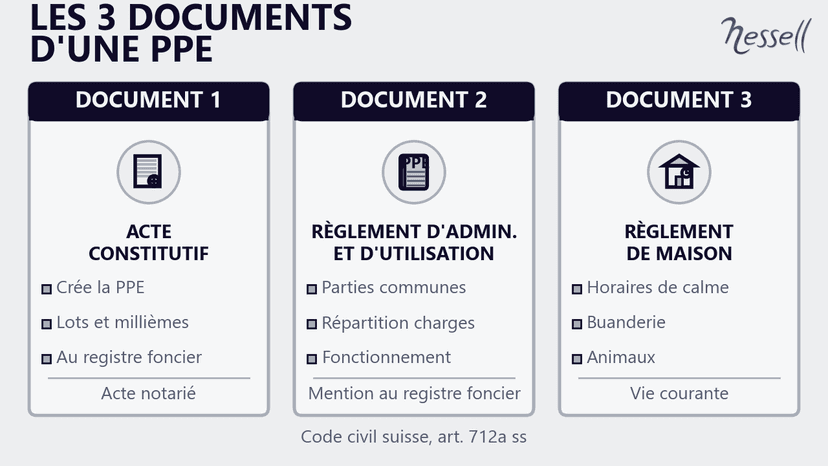
The condominium regulations, the founding deed and the house rules are three documents with distinct roles. The founding deed brings the PPE into existence, determines the units and the per-mille shares, and is recorded in the land register. The rules of administration and use organise the use of the common areas, the allocation of costs and the operation of the community. The house rules govern the day-to-day life of the building.
The founding deed is a notarial deed, a condition for the existence of the condominium property under articles 712a and following of the Swiss Civil Code. The rules of administration and use, covered by article 712g CC, are noted in the land register. The house rules address practical matters such as quiet hours, use of the laundry room, and the presence of pets, and do not require the formality of a notarial deed. This hierarchy distinguishes the founding title, the internal constitution of the community, and the everyday rules of use.
How do the regulations organise life in a Geneva co-ownership?
The life of a Geneva co-ownership organised by the regulations takes shape in two of its main aspects: on the one hand, the financial allocation of charges, and on the other, the designation of the bodies responsible for enforcing them. The allocation of charges and the designation of bodies specify who bears the costs and who ensures the regulations are enforced. Through these two dimensions, the regulations translate into the practical management of the building.
How do the regulations allocate PPE charges?
The regulations impose PPE charges in proportion to the ownership share of each unit, absent a contractual formula set out in the regulations. Maintenance, heating and administrative costs are allocated per mille (art. 712h of the Swiss Civil Code). The regulations may provide for a differentiated allocation of PPE charges for certain items, such as an elevator financed only by the floors it serves. This allocation is intended to determine each co-owner's annual contribution to the community's budget.
Who ensures the condominium regulations are enforced?
The condominium regulations connect the management company and the general meeting of co-owners to the text, requiring them to ensure it is enforced. Under the oversight of the general meeting that appoints it, the management company is responsible for implementing its decisions, managing the common areas and ensuring the rules of use are respected. PPE administration thus provides the link between the regulations and the actual management of the building. The general meeting decides on common matters and approves the accounts presented to it by the management company.
Is there a standard template for condominium regulations?
Yes, standard templates for condominium regulations exist, distributed by notaries, co-owner associations and professional organisations. The templates from the USPI and notarial firms offer a standard framework covering internal organisation, the delimitation of common areas and the powers of the management company. Each template is then adapted to the building concerned: its layout, the number of units. The existence of a standard template does not preclude a case-by-case review by the notary handling the deed.
Can the condominium regulations be departed from?
This depends on whether the rule in question is mandatory or default in nature. The mandatory provisions of the Swiss Civil Code, such as the classification of essential common areas under article 712b CC, admit no departure by the regulations. Default provisions, by contrast, leave the regulations free to arrange the terms of use and cost allocation. No individual co-owner may depart from the regulations on their own initiative: only the general meeting can amend the regulations, by the double majority under article 712g paragraph 3 CC.