
PPE in Geneva: How Condominium Ownership Works, Service Charges and Management
Condominium ownership (PPE) organizes a Geneva building under the regime of articles 712a to 712t of the Swiss Civil Code: each co-owner holds exclusive ownership of their apartment and an ownership share in the whole.
This page explains what PPE is, how it works in Geneva, how the condominium is organized, service charges and the budget, the rights and duties of co-owners, and finally the specifics of buying or selling a unit.
What is PPE (condominium ownership)?
Condominium ownership (PPE) is a form of joint ownership that grants an exclusive right over a specific part of a building. Under article 712a of the Swiss Civil Code, this right covers a unit for private use, combined with an ownership share in the common property. Within the private areas, the owner of a unit fits out, maintains and uses their private space without the consent of the other co-owners, provided the regulations are respected.
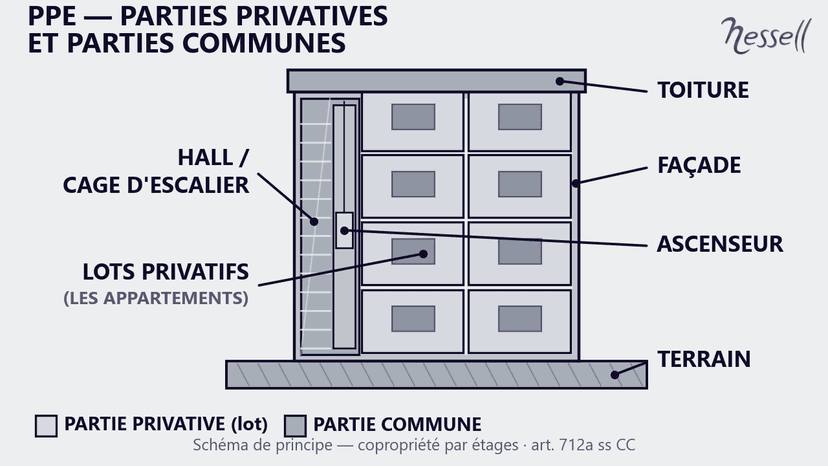
The boundary between private areas and common areas structures the whole regime. Private areas are limited to the inside of the unit:
- the interior fittings of the apartment
- floor and wall coverings
- non-load-bearing partitions
The mandatory common areas comprise three groups under art. 712b CC: first the land and foundations; then the load-bearing structure and the roof; and finally all elements that determine the exterior appearance, such as the façade, exterior windows and balconies.
The ownership share expresses the weight of each unit within the whole, usually in thousandths recorded in the land register. The ownership share serves as the basis for allocating common charges and voting weight at the general meeting.
How does a condominium (PPE) work in Geneva?
Combining an individual private right with collective management of the common areas, PPE in Geneva is governed by the administration and use regulations. The co-owner freely enjoys their unit, votes on common decisions at the general meeting, and contributes to costs according to their ownership share. The property management company, acting as appointed administrator, implements these decisions on a day-to-day basis.
Three documents govern condominium ownership in Geneva.
- The founding deed, recorded in the land register, allocates thousandths to the units.
- The administration and use regulations set out how the common areas are used and how charges are allocated.
- The house rules set out day-to-day living rules, such as quiet hours or use of the laundry room.
Condominium ownership in Geneva has a distinctive building insurance regime. Geneva operates a free market, with no cantonal insurance body as exists in Vaud or Fribourg. The condominium takes out a private fire insurance policy for the building, whose value serves as the reference for the renovation fund.
How is a condominium organized under PPE?
The general meeting of co-owners, the sovereign decision-making body of the condominium, is supported by an executive administrator. It votes on the budget, approves the accounts, decides on works, and appoints the administrator. Each co-owner has one vote per unit, or a weight proportional to their ownership share, depending on the regulations.
Three majority thresholds govern decisions under the Swiss Civil Code.
- Routine administrative acts and works necessary for maintenance — repairing a roof, servicing an elevator — are passed by a simple majority of the co-owners present.
- Beneficial works that increase the value of the building through the installation of new equipment, such as an elevator, require the double majority under art. 712g para. 3 CC: a majority of co-owners representing more than half the value of the shares.
- Purely ornamental works undertaken for enjoyment alone, such as building a swimming pool, require unanimity.
The quorum follows art. 712p CC: the general meeting deliberates validly if half of the co-owners, and at least two, representing half the value of the shares, are present or represented.
What charges and what budget apply under PPE?
The charges of a condominium comprise the operating, maintenance and administration costs of the common areas, allocated according to each unit's ownership share. The annual budget aggregates several items voted on each year by the general meeting. In Geneva, the ongoing service charges of a condominium amount to around CHF 35 per square metre per year, according to Blue Immobilier, a figure that varies depending on the age and amenities of the building.
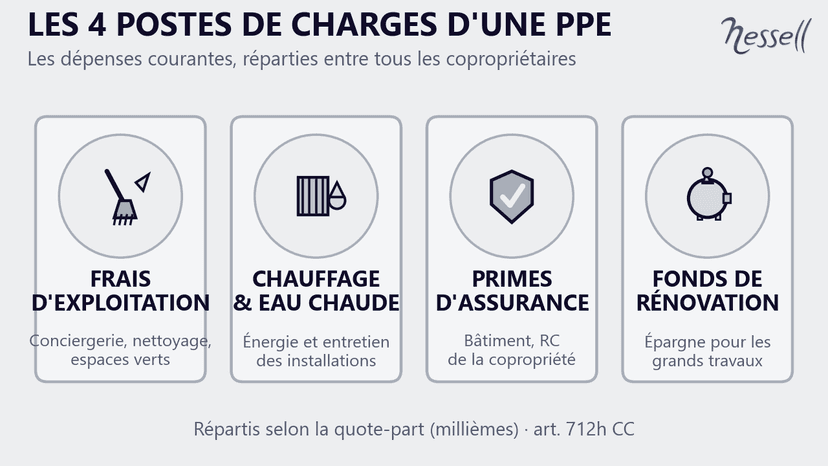
A Geneva condominium distinguishes four budget categories.
- Operating costs: caretaking, electricity for common areas, upkeep of green spaces, cleaning.
- Heating and hot water costs, often allocated according to actual consumption where units are fitted with individual meters.
- Insurance premiums for the building, covering fire and the building's civil liability.
- Contribution to the renovation fund, which anticipates upcoming major works.
The principle of allocation is set out in art. 712h CC. Co-owners contribute to common charges in proportion to the value of their shares. An alternative allocation key may be provided for in the regulations, adopted by double majority.
What are the rights and duties of a co-owner under PPE?
A co-owner under PPE holds three major rights and assumes three main duties, as determined by the Swiss Civil Code and the regulations.
The co-owner's rights fall into three areas.
- The private right allows the interior of the unit to be fitted out, let and sold without the consent of the other co-owners.
- The right to vote carries weight over the budget, works, and the appointment of the administrator.
- The right of use gives access to common areas such as the elevator, laundry room or garden.
The duties frame collective life.
- The co-owner owes their share of the charges in proportion to their ownership share, failing which the community's statutory lien may be secured on their unit, art. 712i CC.
- They must comply with the house rules and the designated use of the common areas.
- They must maintain their unit without harming other co-owners or the building.
Buying or selling a unit under PPE in Geneva: what specifics apply?
Selling or buying a unit under PPE in Geneva requires three checks specific to this type of transaction, which have no equivalent for a detached house. The buyer of a unit takes on an ownership share, a share of the renovation fund, and the condominium's accounting position. The seller transfers a unit encumbered by the community's decisions and debts.
A condominium transaction in Geneva revolves around three checkpoints.
- The minutes of the most recent general meetings reveal the works voted on and any ongoing disputes, which will bind the future owner.
- The status of the renovation fund shows whether the community has sufficient reserves for major works, or whether further capital calls are still to come.
- The charges statement and any arrears owed by the seller determine the balance taken over at the time of purchase.
As with any property transfer in Geneva, the deed of sale for a condominium unit must be executed in the authentic form before a notary and is recorded in the land register. Geneva's transfer duty is set at 3% of the purchase price (cantonal tax administration).
How to manage and live well under PPE in Geneva?
The practical management of a condominium raises questions that every co-owner in Geneva encounters. The breakdown of the charges paid each month, the role of the renovation fund, the content of the regulations, and the identity of the administrator all shape day-to-day life within the condominium. Practical management covers charges, the renovation fund, the regulations and the administrator, right through to the case of a first-time purchase.
What charges does a co-owner pay under PPE?
A co-owner under PPE pays four categories of charges, based on their ownership share calculated in thousandths. The cost of operating expenses, heating costs, insurance premiums and the contribution to the renovation fund make up their annual statement. The administration regulations set the exact allocation key, in principle the value of the shares for general charges.
The amount varies according to the size of the unit and the amenities available in the building. For a comparable size, a unit in a building with an elevator, caretaking service and green spaces bears higher charges than in a small building with no services. The item-by-item breakdown of condominium charges appears on the annual statement prepared by the property management company, which allocates each expense among the units.
What is the renovation fund of a condominium used for?
The renovation fund is used to finance the major, deferred works of a condominium, for example roof repairs, façade renovation, or replacing an elevator. As a genuine common reserve, it avoids large capital calls at the time of major works. The fund is built up through an annual contribution voted on at the general meeting, kept separate from ongoing charges.
Several property management firms in French-speaking Switzerland, including Galland, recommend an annual contribution of between 0.5% and 1% of the building's insurance value. The Swiss Association of Condominium Owners recommends a floor of 0.3% per year. An alternative method sets aside between CHF 5 and 15 per square metre of habitable floor space per year, with the long-term aim of building a fund representing 6 to 8% of the insurance value.
What does the condominium regulations contain?
The function of the condominium regulations is to set out the rules for using the common areas, as well as the key for allocating charges among the units. They are often referred to as the administration and use regulations. They supplement the founding deed recorded in the land register. The owner of a unit cannot depart from them, and they are not renegotiated with each new acquisition.
The condominium regulations contain three sets of rules: the rules of use specify how the common areas are designated, for example access to the garden or use of the laundry room; the allocation key specifies which costs follow the thousandths and, among these, which follow actual consumption; and the operating rules govern how general meetings are held and the powers of the administrator. Amending the condominium regulations requires the double majority set out in art. 712g para. 3 CC.
Who administers a condominium in Geneva?
In Geneva, it is the administrator who manages the condominium. The general meeting of co-owners appoints an administrator, who may be a private individual or a professional property management company. The administrator carries out the decisions taken at the general meeting, manages the accounts, and maintains the common areas, under art. 712q CC. Only the general meeting has the authority to renew or revoke their mandate.
Their duties fall into three groups. Administrative management covers convening general meetings, keeping the accounts, and preparing the charges statement. Technical management covers routine maintenance, maintenance contracts, and organizing works that have been voted on. Financial management covers collecting charges, funding the renovation fund, and paying suppliers.
Is PPE suitable for a first-time purchase in Geneva?
It depends on the buyer's profile and the condition of the condominium in question. Choosing PPE for a first-time purchase in Geneva is fully justified when the aim is to acquire a property in the city at a lower cost than a house, with shared exterior maintenance.
On the other hand, it exposes the buyer to recurring charges and to decisions imposed collectively when the renovation fund is underfunded. First-time buyers should check the status of the renovation fund, read the minutes of general meetings, and verify the amount of the charges before committing.