
Condominium Renovation Fund in Geneva: Definition, Funding and Obligations
The renovation fund of a Geneva condominium (PPE) is the common financial reserve used to carry out major works on a jointly owned building. Specifically, the reserve built up each year is intended to finance large-scale renovations of the common areas: roof repairs, façade renovation, replacement of the elevator.
This fund is distinct from the payment of ongoing charges, which is allocated to recurring operating expenses. In accordance with articles 712a to 712t of the Swiss Civil Code, the community of co-owners builds up such a fund through an annual contribution voted on at the general meeting in Geneva.
What is the renovation fund of a condominium?
The renovation fund of a condominium is a collective reserve built up in anticipation of major works on the building. It is the undivided property of all co-owners and is attached to the community as a whole, not to each unit taken individually. The renovation fund consists of contributions accumulated over several financial years. It is distinct from ongoing charges, which are consumed within the year.
Three characteristics define it.
- Its nature: earmarked assets, dedicated to a specific purpose, and distinct from each co-owner's own assets.
- Its purpose: large-scale renovations of the common areas, excluding routine maintenance.
- Its duration: long-term accumulation, over several decades, tracking the building's ageing.
This reserve is enshrined in the Civil Code under article 712m, as a power of the general meeting of co-owners, without any set amount being prescribed.
What is the renovation fund used for?
Dedicated to financing major structural works on the common areas, the renovation fund spreads the cost over time. Such a reserve avoids exceptional capital calls — one-off requests for several thousand francs made to co-owners when cash is lacking for unplanned works.
The fund covers major works such as complete roof repairs, façade renovation, elevator replacement, or heating system modernization. These are all high-cost interventions, often amounting to several hundred thousand francs for a medium-sized building. Gradual capitalization spreads the burden of this cost across successive owners, in proportion to their thousandths. When generously funded, a reserve preserves the value of the building and makes it easier to resell a unit, since the buyer inherits a building whose future works are already funded.
Is the renovation fund mandatory in Geneva?
No, the renovation fund is not mandatory in Geneva under the Civil Code, but it becomes binding as soon as it is provided for in the condominium's regulations. Articles 712a to 712t of the Swiss Civil Code recognize the possibility of setting up such a fund but do not require its creation. Setting up the fund is a decision for the general meeting of co-owners.
This fund is very often mandatory under the condominium's administration and use regulations (RAU). The magazine Houzy reports that four out of five condominiums have one in Switzerland. Real estate professionals strongly recommend this reserve to ensure sound and sustainable management of the building. Where the regulations set an annual contribution, each co-owner remains required to contribute according to their thousandths, and the general meeting votes on the exact amount each year.
How is the renovation fund funded?
The renovation fund is funded through an annual contribution voted on at the general meeting of co-owners and built into the charges budget. This contribution appears as a separate line in the budget, distinct from ongoing operating charges. Each co-owner pays their share in proportion to their thousandths of co-ownership.
The general meeting sets the amount of the contribution when voting on the annual budget. Payment is made through periodic charge calls, monthly or quarterly depending on the property management company. The administrator deducts the portion earmarked for the fund into a separate account, distinct from the operating account used to settle recurring expenses. This accounting separation ensures that the reserve remains dedicated to major works and does not fund the building's day-to-day operation.
What amount should be paid into the renovation fund?
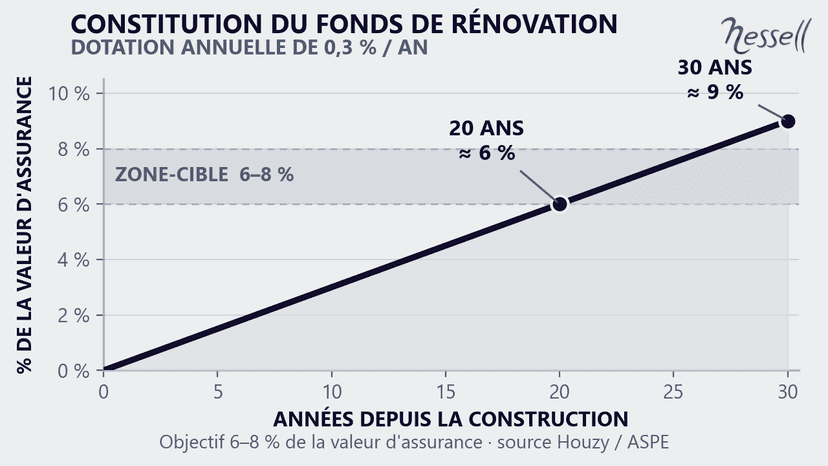
The amount to be paid into the renovation fund is between 0.2% and 0.5% of the building's fire insurance value per year, according to the magazine Houzy, in line with the Swiss Association of Condominium Owners. This association recommends setting the annual contribution at 0.3% of this value. Under the other method, the contribution is between 5 and 15 francs per square metre of net habitable floor space per year, according to Banque Cantonale Vaudoise.
Both calculation methods lead to relatively comparable annual amounts. For a building insured for 4 million francs, a 0.3% contribution represents 12,000 francs per year for the community. In the long term, the reserve aims for a level of between 6% and 8% of the insurance value. With a contribution of 0.3% per year, this level is reached after around 20 years (6%) and approaches 9% after 30 years, according to Houzy. Reserves of the right size make it possible to absorb a building's major renovation cycles without an exceptional capital call.
How is the renovation fund managed?
The renovation fund is held in a separate bank or postal account in the name of the community of co-owners, and only the administrator or the property management company may operate this account. The reserve is managed by the administrator without any commingling between the community's assets and their own. Interest earned remains the property of the community.
This separation ensures that the reserve remains protected should the administrator run into difficulties. Only a community account guarantees that the fund belongs to the co-owners and remains dedicated to its purpose. Interest earned on investments increases the fund's capital. For tax purposes, each co-owner declares their share of the fund as part of their taxable wealth and their share of the interest as part of their income, in accordance with cantonal practice.
Is the renovation fund tax-deductible in Geneva?
Yes, in Geneva, provided the fund finances the maintenance of the building. Geneva's cantonal tax administration (AFC) allows these payments to be deducted as maintenance costs for the building, under Tax Information Notice 1/2021 on the deductibility of maintenance costs for privately owned buildings.
Deductibility depends on the works financed. The AFC distinguishes between value-maintenance costs, which offset normal wear and tear on the building and remain deductible, and value-enhancing expenses, which increase the value of the property and are not deductible. Payments relating to new installations or value creation fall outside the deductible scope. In the GeTax software, the payment into the renovation fund is declared under a category dedicated to maintenance costs. The deduction applies to both cantonal and communal tax (ICC) and direct federal tax (IFD).
What happens to the renovation fund when a unit is sold?
The share of the renovation fund remains with the community when a unit is sold. The seller is never reimbursed for their ownership share directly by the community: the fund remains collective property, attached to the building rather than to any individual. Their share of the fund follows the unit and passes to the new co-owner.
Three situations illustrate this mechanism. In the first case, the seller factors the value of their share of the fund and the savings already accumulated into the sale price. In the second case, a building with a well-funded reserve trades at a higher price, since the buyer inherits future works that are already funded. In the last case, conversely, a still-modest reserve weighs on the value of the unit, as the buyer anticipates future capital calls. The ownership share of the fund therefore remains tied to the unit, changes hands with the property, and the seller is not reimbursed for it separately.
How does the renovation fund fit into the charges of a condominium in Geneva?
The renovation fund fits into the overall charges of a condominium in Geneva, alongside operating charges, as an investment reserve distinct from ongoing expenses. Its contribution appears in the annual budget voted on at the general meeting, alongside operating costs. This arrangement raises two questions: the relationship between the fund and the condominium's ongoing charges, and which body has the authority to decide on payments into this reserve.
How does the fund relate to the condominium's ongoing charges?
The renovation fund and ongoing charges make up two items in a condominium's budget: the former builds up capital over the long term for major works, while the latter covers recurring operating expenses (cleaning, electricity for common areas, elevator maintenance). In periodic charge calls, the contribution to the fund is added on top of ongoing charges, as a separate line. The distinction between the investment reserve and operating expenses forms the entire structure of the condominium's budget.
Who decides on payments into the renovation fund?
Co-owners meeting together determine contributions to the renovation fund on the administrator's proposal. The contribution is set through the adoption of the annual budget, by the majority provided for in the condominium's regulations. The condominium's administration prepares this budget, sets out the works required, and carries out the general meeting's decisions. Governance of the common reserve rests on this division of roles between the deliberative body and the executive body.
Renovation fund or operating fund: what is the difference?
The renovation fund and the operating fund differ in their time horizon and purpose. The renovation fund is a long-term reserve, set aside for major works on the common areas: roof, façade, elevator. The operating fund, sometimes called the working capital fund, is the condominium's day-to-day cash used to settle immediate running costs. The former builds up over decades; the latter turns over within the financial year. This difference in time horizon justifies two separate accounts and two budget lines.
Is the renovation fund recovered when selling?
No, the co-owner does not recover the renovation fund when selling their unit: the ownership share of the fund remains with the community and passes to the buyer along with the unit. The seller takes this share into account in the sale price, with the buyer taking over the reserve already built up. The seller is not directly reimbursed for their share by the community: the fund remains collective property attached to the building.