
PPE Service Charges in Geneva: Composition, Allocation and Average Amount
In Geneva, condominium (PPE) service charges cover all the shared expenses of a condominium property, allocated among the co-owners according to their ownership share: building operations, heating, water, insurance, administration and contribution to the renovation fund.
Their amount depends on the age of the building, the shared facilities and services, and the level of services provided. The legal framework in Geneva is that of the Swiss Civil Code (CC), supplemented by the canton’s tax rules and by tenancy law.
What do PPE service charges in Geneva consist of?
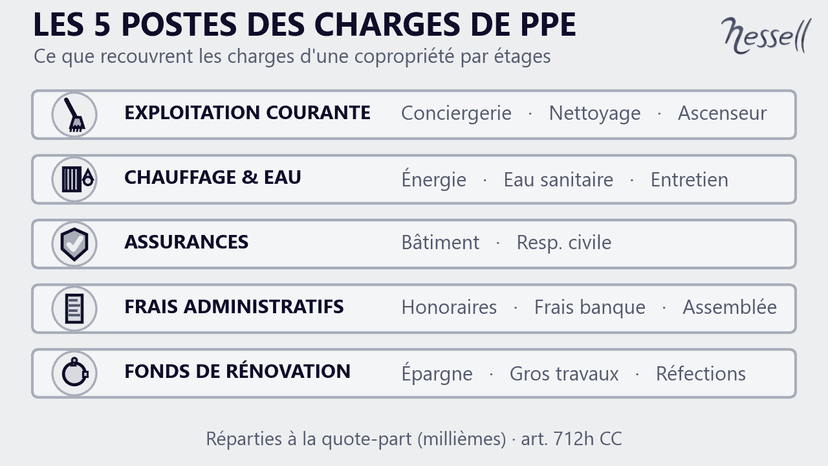
In Geneva, PPE service charges are divided into five main categories, each comprising the recurring expenses needed for the condominium to run properly.
Day-to-day operations include all the costs of maintaining the common areas:
- the caretaker’s salary
- cleaning of lobbies and stairwells
- upkeep of green spaces
- elevator maintenance
- electricity for common areas
Heating and water form a separate category. These charges are often allocated on an actual-consumption basis for each unit. Insurance covers the building premium (fire, water damage) as well as the condominium’s public liability.
Administrative costs break down into three parts:
- the fees of the management company administering the PPE
- the banking fees on the joint account
- the costs of holding the general meeting
The renovation fund is the fifth and final item: it builds up the savings needed for future major works (roofing, facade, heating). According to Migros Bank, PPE service charges represent 1% of the property’s price per year.
How are charges allocated among co-owners?
Charges are allocated among all co-owners in proportion to the value of their ownership share (art. 712h of the Swiss Civil Code). This ownership share, expressed in per mille (‰) of the building’s total value, is stated in the PPE’s founding deed.
The calculator below works out a unit’s annual and monthly share based on its ownership share.
PPE service charge allocation calculator
Indicative calculation: budget × ownership share ÷ 1000. Items allocated by consumption (heating, hot water) may differ from this formula.
The per-mille allocation formula applies by default to the vast majority of shared items. According to the Tribune de Genève, a unit with an 85 per mille share bears 4 250 CHF out of a total annual budget of 50 000 CHF.
If the general meeting of co-owners wants to apply a different formula for certain items, it must vote by double majority — both the number of co-owners and the sum of ownership shares — for any formula departing from the regulations. Heating and hot water charges often escape the per-mille rule: the law requires them to be allocated according to each unit’s actual consumption, measured by individual meters.
What is the average amount of PPE service charges in Geneva?
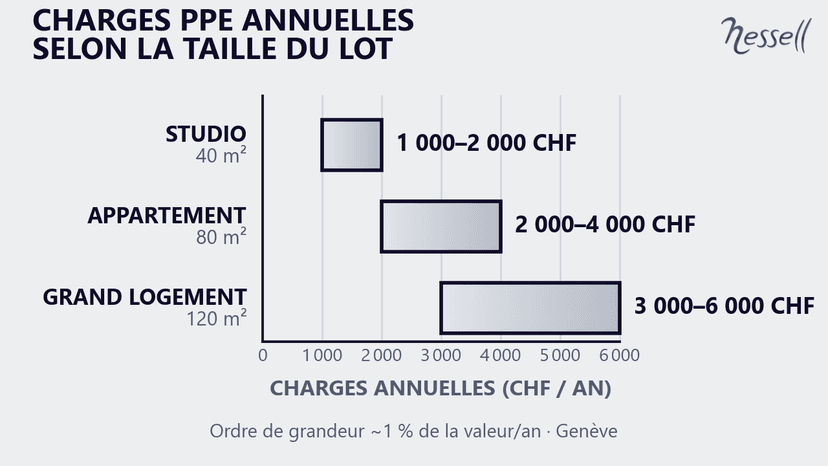
In Geneva, the average amount of PPE service charges is around 1% of the property’s value per year, corresponding to a typical range of 25 to 50 CHF per m² per year depending on the facilities. A building with an elevator, caretaker service and green spaces reaches the top of this range.
On top of this base comes the renovation fund. According to Leedy, its annual contribution represents 5 to 15 CHF per m² of net living space, or 0.2 to 0.5% of the building’s fire insurance value (ECA).
Three examples give an idea of the figures involved for units of different sizes. A 40 m² studio bears annual charges of 1 000 to 2 000 CHF, or 85 to 165 CHF per month. For an 80 m² apartment, charges reach 2 000 to 4 000 CHF, or 165 to 330 CHF monthly. A large 120 m² home generates 3 000 to 6 000 CHF a year, including the renovation fund contribution.
How are PPE service charges voted on and settled?
PPE service charges are voted on at the general meeting of co-owners, billed as instalments and settled through an annual statement drawn up by the management company: this annual cycle sets the rhythm of the condominium’s financial management.
Each year, the general meeting adopts the projected budget, which sets the total amount of charges and the contribution to the renovation fund. The management company bills this budget in instalments (advance payments) allocated according to each unit’s ownership share, either monthly or quarterly. These advance payments cover expenses over the course of the year.
At the close of the financial year, the management company draws up the annual statement: a comprehensive record comparing the instalments paid against the actual charges, item by item. The adjustment offsets the difference. A co-owner is reimbursed if their instalments exceed their actual share, or owes a balance in the opposite case. The co-owner may inspect the supporting documents for the statement.
Which PPE service charges are tax-deductible in Geneva?
In Geneva, tax-deductible PPE service charges include actual maintenance costs, current condominium service charges and the portion of the renovation fund used for maintenance. According to the Geneva Cantonal Tax Administration (AFC Genève), the owner chooses each year, and for each property, between deducting actual costs or a flat-rate deduction.
The flat rate equals 10% of property income for a building 10 years old or less, and 20% for an older building. An owner-occupier retains the option of the flat rate. A landlord who lets out their property may deduct only actual costs.
Actual costs include condominium service charges, the building insurance premium, heating maintenance contracts, the supplementary property tax and management fees. According to the AFC Genève, contributions to the renovation fund remain deductible provided the fund finances the upkeep of shared facilities, excluding value-adding improvements and new installations. Management company fees and administrative costs count as actual costs under management fees.
Co-owner or tenant charges: who pays what?
The line between co-owner and tenant is clear: the co-owner bears the owner’s charges, the tenant reimburses the ancillary costs related to use of the home. Article 257b of the Code of Obligations governs this allocation for residential leases.
- Borne by the tenant: heating, hot and cold water, electricity for common areas, caretaker service, upkeep of green spaces, cleaning and wastewater treatment charges, when specified in the lease.
- Borne by the co-owner: building insurance premium, property tax, management company fees, general administrative costs and renovation fund contribution.
Three examples illustrate this split. The heating share of a leased apartment is passed on to the tenant through ancillary costs. The building insurance premium remains the responsibility of the co-owner-landlord. The annual contribution to the renovation fund falls to the owner, never to the tenant. Unless specified in the lease, an ancillary cost is deemed included in the net rent.
How to control and plan for the charges of a PPE in Geneva?
Controlling the charges of a Geneva PPE relies on two complementary levers: funding the renovation fund and the quality of the administration. On one hand, an adequately funded renovation fund avoids urgent capital calls when major works come up; on the other, rigorous management optimises day-to-day items. The renovation fund and the division of management duties are the two levers of this control within the condominium.
How is the renovation fund funded through the charges?
The renovation fund is funded by an annual contribution entered in the service charge budget, voted on at the general meeting of co-owners. It finances upcoming major works: roof repair, facade renovation, heating replacement.
The contribution represents 0.2% to 0.5% of the building’s fire insurance value per year, indexed to construction costs. An insufficient contribution exposes the condominium to exceptional capital calls. The method for calculating this contribution and the targeted level of the renovation fund determine the PPE’s long-term financial sustainability.
Who manages the charges within the PPE?
Management of the charges within the PPE is entrusted to the management company, appointed by the general meeting of co-owners. This administrator collects the instalments, pays the common invoices, keeps the accounts and draws up the annual statement. The general meeting votes on the budget and appoints the management company for a set term. Day to day, PPE administration covers convening general meetings, monitoring the renovation fund and overseeing service providers. The co-owner retains the right to inspect the accounts and supporting documents.
« PPE service charges » and « cahier des charges »: what’s the difference?
Be careful not to confuse these two entirely unrelated concepts: PPE service charges and the cahier des charges. PPE service charges represent all the shared financial expenses allocated among co-owners: operating charges, heating, insurance, renovation fund. The cahier des charges is a technical document describing the services expected from a contractor or the specifications of a construction project.
The former belongs to condominium accounting, the latter to commissioning works or a service. A co-owner pays PPE service charges every month; they consult a cahier des charges when putting works out to tender.
Are PPE service charges recoverable from the tenant?
Yes, PPE service charges are recoverable from the tenant, but only for their ancillary-cost portion. The co-owner-landlord re-invoices the tenant for heating, water, electricity for common areas and caretaker service, provided these items are expressly listed in the lease.
Structural charges remain the landlord’s responsibility: building insurance, administrative costs, renovation fund. The statement invoiced to the tenant is limited to actual, substantiated costs (art. 257b of the Code of Obligations).