
Renting a Home in Geneva: The Tenant's Guide

Renting a home in Geneva, the tightest market in Switzerland, means knowing your rights as well as the procedures. This guide is aimed at the tenant, from the legal framework through to leaving the home. It begins with the rules governing tenancies, the federal Code of Obligations, the French-speaking Switzerland RUL and the cantonal LDTR, then sets out each party's obligations and the role of property management firms. It situates the cost of rent and how it changes, guides the search and the preparation of the application file, then moving in, daily life and moving out, from utility charges to termination. It finally covers the special forms of tenancy and indicates where to assert your rights.
What legal framework governs tenancies in Geneva?
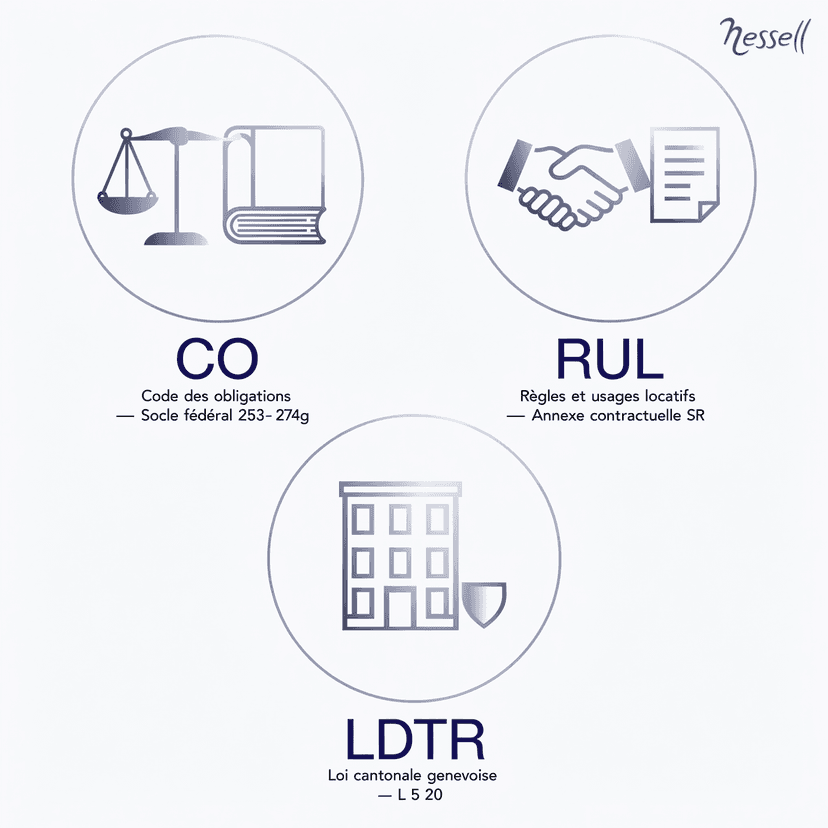
In Geneva, tenancies are governed by a layering of three sets of rules, from federal to cantonal.
- Federal tenancy law: the Code of Obligations (CO) sets the basic rules of the contract, applicable throughout Switzerland.
- The Rules and Practices of Tenancy (RUL): a French-speaking Switzerland agreement applied by most Geneva property management firms, which sets out the practices supplementing the Code of Obligations.
- Geneva cantonal law: the LDTR protects the local rental housing stock by regulating renovations and rents after works.
This illustration summarizes the three levels of rules governing tenancies in Geneva.
This federal foundation, the Code of Obligations, is detailed below.
Code of Obligations: what federal rules apply to the lease?
The residential lease contract is governed by the provisions of the Code of Obligations (art. 253 et seq.), federal law that takes precedence over cantonal and contractual rules and which governs the subject matter of the lease, its formation, duration and termination throughout Swiss territory. At the federal level, the Federal Office for Housing is the authority on tenancy law. In Geneva, this foundation is supplemented by the French-speaking Switzerland Rules and Practices of Tenancy and by the cantonal LDTR.
Rules and Practices of Tenancy (RUL): what scope in Geneva?
The Rules and Practices of Tenancy (RUL) constitute a contractual agreement of French-speaking Switzerland scope, applied by nearly all Geneva property management firms. Established by professional real estate associations and tenant advocacy associations, they become binding on the parties once they are appended to the lease agreement. Their effect is to supplement the Code of Obligations on local practices that federal law does not settle.
LDTR: what cantonal specifics for rental housing?
The LDTR, the law on the demolition, alteration and renovation of residential buildings, protects Geneva's rental housing stock from renovations deemed abusive. Overseen by the cantonal department of territory, it requires authorization for changes of use and major works carried out on homes. Its concrete effect on tenancies: following authorized works, the rent remains capped by the State for a set period, limiting increases.
What obligations does the tenant have in Geneva?
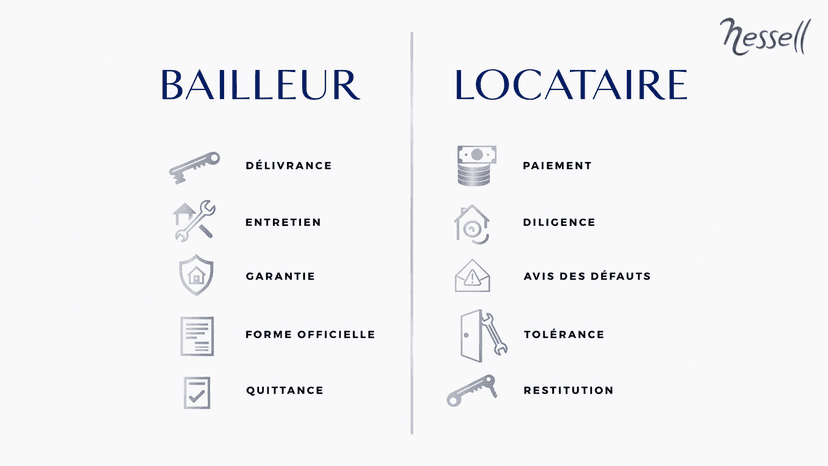
The Geneva tenant must comply with several obligations arising from the Code of Obligations.
- Pay the rent and utility charges on the agreed due dates (art. 257 et seq. CO).
- Exercise due care: use the apartment with care and show consideration for neighbors (art. 257f CO).
- Notify the landlord of defects as soon as they are discovered (art. 257g CO).
- Tolerate necessary repairs carried out by the landlord (art. 257h CO).
- Return the apartment in the condition received, normal wear and tear excepted, at the end of the lease.
This illustration compares the respective obligations of the landlord and the tenant in Geneva.
In the event of a serious breach, for example non-payment of rent despite formal notice, the tenant risks extraordinary termination.
What the landlord owes you in Geneva
The Code of Obligations imposes several obligations on your landlord, which you can demand as a tenant.
- Deliver an apartment in good condition, fit for the agreed use (art. 256 CO).
- Maintain the property and cover repairs that go beyond routine minor upkeep.
- Provide a warranty against defects affecting the use of the apartment (art. 259a et seq. CO).
- Notify the initial rent using the official form: in Geneva, the starting rent is communicated to you on a form approved by the State, which you can challenge within 30 days if it seems abusive to you (art. 270 CO).
- Use the official form for any increase during the lease, on pain of nullity (art. 269d CO).
- Provide a receipt for rents paid, upon request.
Failing that, you can refer the matter to the cantonal conciliation authority for tenancy and rent matters.
What role does the property management firm play in tenancies in Geneva?
The property management firm is the landlord's agent, overseeing the day-to-day management of the lease. Its duties are threefold: marketing, through finding tenants and conducting viewings; technical and administrative management, including maintenance and lease follow-up; and financial management, through collecting rents and preparing utility charge statements.
It operates under a management contract signed with the owner, and most property management firms belong to a French-speaking Switzerland professional association. In Geneva, nearly all leases go through a property management firm.
How much does renting cost in Geneva?
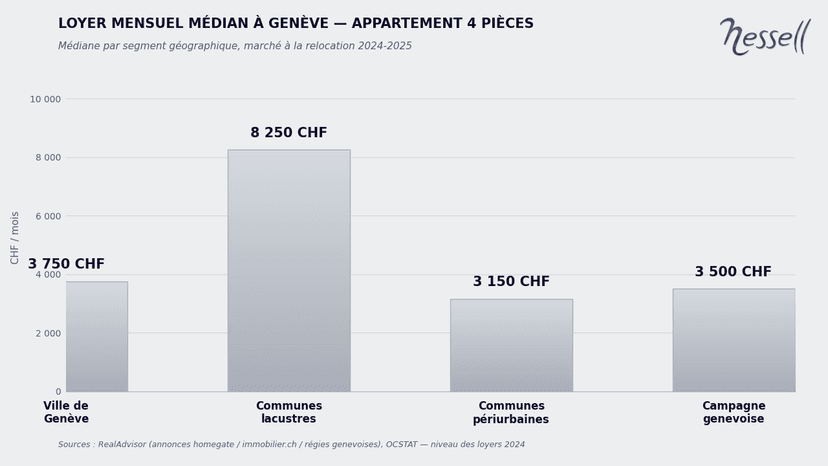
In Geneva, the average monthly free-market rent for a four-room apartment stands at 1'744 francs, against 1'420 francs for a three-room and 2'143 francs for a five-room (Cantonal Statistics Office, May 2025 survey). Three main factors make this amount vary: the number of rooms, the municipality and the age of the lease, the rent of a home occupied for a long time typically being lower than the market price. The cantonal office provides a rent calculator to help situate a property.
This chart compares the monthly rent by segment in Geneva.
Details on rent levels are covered in the article on rental prices in Geneva.
What is the rent difference between the free market and regulated housing in Geneva?
Two rent regimes coexist in the canton: the free market, where rent is set by supply and demand, and regulated housing, whose rent is capped by the State. These regulated categories are subject to cantonal laws such as the LGZD in development zones and the LGL on housing and tenant protection, capping the rent and controlling its change for a set period.
The uncapped market is covered in the article dedicated to free-market rent in Geneva.
The reference rate: how your rent changes in Geneva
In Geneva as throughout Switzerland, your rent is not fixed: it changes according to the reference mortgage rate published by the Confederation. When this rate falls, you can demand a corresponding rent reduction from your landlord; when it rises, the landlord can pass on the increase, but only using the official form. The request for a reduction is made in writing ahead of the next due date. How this works is explained in more detail in our article dedicated to the reference rate in Geneva.
How to find and secure a rental apartment in Geneva?
Finally securing a rental apartment in Geneva is the most competitive phase of the process, in a market where demand exceeds supply. In reality, it all comes down to three stages: finding listings, presenting a flawless application file, and putting together the rent deposit. Each of these steps is covered in the paragraphs below.
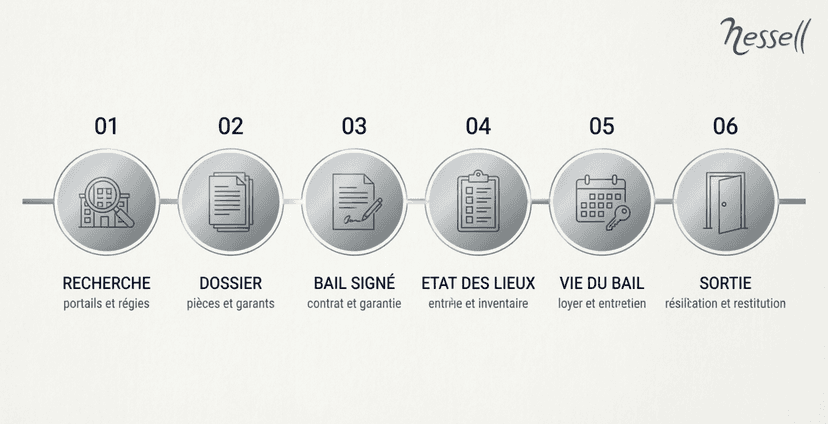
This timeline traces the course of a tenancy in Geneva, from the search to moving out.
How to find a rental apartment in Geneva?
Finding a rental apartment in Geneva involves several complementary channels.
- Check national real estate portals and property management firms' websites, such as the rental properties offered by Nessell.
- Monitor the cantonal portal and subsidized housing platforms.
- Activate your personal and professional network, often decisive in a tight market.
- Contact property management firms directly to be informed of upcoming properties.
Search methods are detailed in the article dedicated to finding a rental apartment in Geneva.
What application file should you present to rent a property in Geneva?
Geneva property management firms require a complete rental application file to distinguish between candidates.
- ID card or residence permit: to verify the applicant's identity and status.
- Proof of income or employment contract: property management firms generally require income of around three times the rent.
- Debt collection register extract less than three months old and clean: this is the decisive document, attesting the absence of debts.
- Household and personal liability insurance: required by most Geneva property management firms to validate the lease.
- Reference from the previous property management firm: to confirm a track record as a reliable payer.
- Application form completed and signed.
We detail what to include in a solid application file in the article devoted to the rental application file in Geneva.
Renting in Geneva as an expat or cross-border commuter
Yes. Without a full Swiss application file, an expat or a cross-border commuter can absolutely rent in Geneva, provided they present equivalent documents. In the absence of Swiss payslips, one can provide an employment contract, foreign pay slips or a letter of commitment, along with a B, C, L or G residence permit for cross-border commuters.
Without a guarantor in Switzerland, property management firms often accept a higher rent deposit or a surety company. Solutions are detailed in the article dedicated to renting for expats and cross-border commuters in Geneva.
What amount for the rent deposit in Geneva?
In Geneva as elsewhere in Switzerland, the rent deposit for residential housing is strictly limited to three months' net rent (art. 257e CO). This deposit can take two forms: either a deposit into a blocked bank account in the tenant's name, or a surety insurance from companies such as SwissCaution or Firstcaution, avoiding tying up the sum. The landlord must return the deposit at the end of the lease, barring justified claims. We detail this point in the article on the rent deposit in Geneva.
Moving in, living in and leaving the apartment in Geneva
Once the lease is signed, the life of the home begins: from move-in to move-out, the condition report opens and records occupancy, utility charges and maintenance punctuate daily life, and termination or re-letting organize departure. We address these below, point by point.
How does a condition report work in Geneva?
It takes place in two stages: on moving in, to record the original condition of the apartment, and on moving out, to compare it. It is a joint inspection, since any defects not reported at move-in become the tenant's responsibility.
Apparent defects are noted on the report; hidden defects, which the tenant discovers later, must be reported to the landlord immediately. The full process is covered in the article dedicated to the condition report in Geneva.
What utility charges can be billed to the tenant in Geneva?
Only ancillary costs actually incurred and expressly provided for in the lease can be charged to the tenant (art. 257a and 257b CO); absent such a clause, they are deemed included in the rent. An annual statement of charges must be provided and the tenant must be able to consult the supporting documents. These rules are regularly reiterated by tenant advocacy associations. The detail of the items that can be charged is covered in the text summarizing utility charges in Geneva.
Maintenance and defects: who pays for what in Geneva?
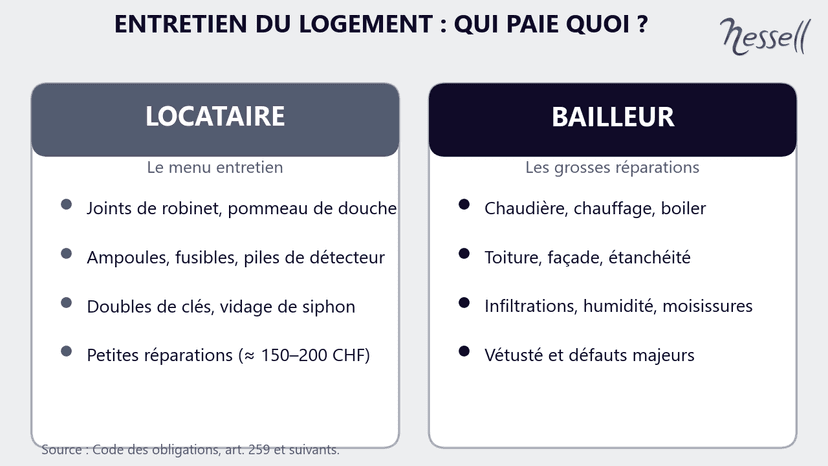
In Geneva, the split is clear: the tenant covers minor repairs of modest cost (in the order of 150 to 200 francs), commonly called minor upkeep, while more significant repairs fall to the landlord (art. 259 et seq. CO).
This illustration compares what falls to the tenant and to the landlord regarding maintenance.
The tenant must report any defect to the landlord without delay. If the landlord refuses to remedy a significant defect, the tenant may, under certain conditions, deposit their rent with the authority until repairs are made. This matter is developed in the article on maintenance and defects in the apartment in Geneva.
How to terminate your lease or challenge a notice of termination in Geneva?
As a tenant, you can terminate your lease for the next due date by observing the legal notice period of three months for housing, unless a longer local practice applies, and the written form requirement.
Conversely, if it is your landlord who gives notice, they must do so using the official form, and in Geneva you are protected against abusive terminations, which you can challenge before the conciliation authority. The law distinguishes ordinary termination from extraordinary termination, justified by a serious reason. We detail this procedure in our article dedicated to lease termination in Geneva.
How does re-letting work in Geneva?
This involves presenting the landlord with a replacement tenant, which allows you to leave the apartment before the end of the lease (art. 264 CO). The candidate presented must: be solvent, agree to take over the lease on the same terms, and present no major drawback for the landlord.
When these conditions are met, the outgoing tenant is released early from their obligations. This mechanism is described in more detail in our article on re-letting in Geneva.
What are the special forms of tenancy in Geneva?
Besides the standard residential lease, there are several special forms of tenancy in Geneva: subletting, furnished rentals, short-term rentals, house-sharing and student housing. Each is subject to its own regime, presented in the following subsections, several of which point to a dedicated child article.
Is subletting allowed in Geneva?
Subletting is indeed allowed in Geneva, provided the landlord consents (art. 262 CO), who can only refuse in three cases: refusal to disclose the terms, an abusive rent, or major drawbacks. Above all, the main tenant remains bound by the lease toward the landlord. Find the complete regime in our article dedicated to subletting in Geneva.
When to opt for a furnished rental in Geneva?
A furnished rental is chosen above all for a temporary stay: a work assignment, expatriation or a transitional period. The lease then includes a surcharge for the furniture and equipment provided, for a term often shorter than that of an ordinary lease.
The contractual regime takes this flexibility into account. These particularities are covered in the article devoted to furnished rentals in Geneva.
Is short-term rental legal in Geneva?
Yes, but short-term rental is heavily regulated there. Listing your home on a platform such as Airbnb requires, for a primary residence, complying with a cap of 90 days per year, beyond which authorization is required. Compliance with the rules is ensured by the cantonal department of territory. You can find the entire framework in our article dedicated to short-term rental in Geneva.
How to organize a house-share in Geneva?
Two arrangements underlie house-sharing: a single joint lease, with joint and several liability among the housemates for the rent, or individual leases per room. The arrangement affects liability for the rent and termination, whether joint or individual. A change of housemate requires the landlord's consent in both cases. These arrangements are developed in the article dedicated to house-sharing in Geneva.
How to find student housing in Geneva?
In Geneva, students have several alternatives: university residences, foundations for the housing of young people in training, and the private rental market or house-sharing. Part of the supply is managed by institutional actors, such as the university's housing office, subject to eligibility conditions and with application deadlines to plan ahead for. The channels are set out in detail in the article devoted to student housing in Geneva.
Where to get information and assert your rights regarding tenancies in Geneva?
Facing a tenancy dispute in Geneva, several remedies exist: the cantonal conciliation board for tenancy and rent matters, the tenancy and rent tribunal, as well as tenant advocacy associations. ASLOCA is the leading one in the canton. Prior conciliation remains mandatory before any lawsuit and to this day remains largely free of charge.
The deadlines for challenging a termination notice or a rent remain short, hence the value of acting promptly. Knowing these remedies means ensuring that your rights as a tenant, established by the legal framework, are actually respected.