
SARON Mortgage in Geneva: Rate, How It Works and Comparison with the Fixed Rate

Buying a property in Geneva financed with a SARON mortgage means acquiring it with a loan taken out at a variable rate tied to the market. This generally makes it possible to obtain financing that is cheaper than a fixed rate, even though the monthly payments carry a degree of uncertainty.
This article defines what a SARON mortgage is, traces the rate’s evolution and explains how to track it. It details how it is calculated, weighs its advantages and disadvantages, and compares it with the fixed rate. It specifies who it suits, how to protect against a rate increase and how to take one out, before concluding with the financing of a purchase in Geneva. It draws on publications from the central bank, the reference rate operator, and Swiss banking practices.
What Is a SARON Mortgage?
A SARON mortgage is a variable-rate property loan indexed to the overnight reference rate for the Swiss franc, as opposed to the fixed rate. Its cost has two components: the SARON (Swiss Average Rate Overnight), compounded over the period, plus a margin set by the bank.
SARON is the rate at which banks can lend each other liquidity overnight. It is calculated daily from transactions actually carried out on the Swiss franc money market. On top of this reference rate, the lending institution applies the margin it retains (fixed for the entire term of the loan).
The rate paid changes at every review: it rises when the market rate goes up, and falls when it goes down. Three examples illustrate this cost variability: with a stable money market, the monthly payment stays almost unchanged; if the policy rate rises, the loan costs more in quarter t+1; if it falls, the payment decreases by the same amount.
According to SIX, the Swiss stock exchange operator that calculates it, SARON replaced the former LIBOR rate as the reference for variable-rate loans on 1 January 2022. This calculation provides a cost indexed to the market, with no rate commitment over the term.
How to Track the SARON Rate’s Evolution?
This rate follows the monetary policy set by the Swiss National Bank. When the SNB adjusts its policy rate, the money market and SARON adjust accordingly. The box below shows its most recent value along with the SNB’s policy rate.
Source: Swiss National Bank (SNB) — monthly data, updated on 11.07.2026.
The chart traces the Swiss National Bank’s policy rate, the reference for SARON, from December 2022 to June 2026.
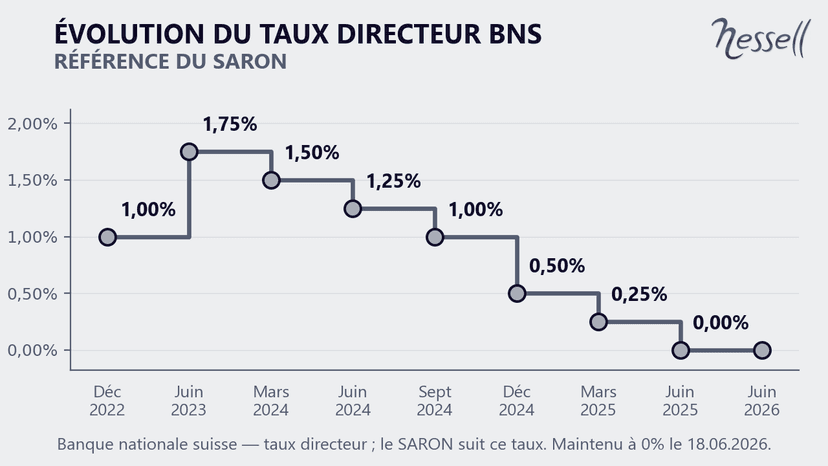
The transmission is direct. The policy rate sets the level at which banks exchange short-term liquidity; SARON, which measures this level day by day, aligns with it almost immediately. As long as the Swiss National Bank keeps its policy rate at 0%, as was the case at the monetary policy assessment of 18 June 2026, SARON stays close to zero and SARON mortgages remain at a low level.
Three sources make it possible to track this evolution:
- the daily and compounded SARON published by the Swiss stock exchange operator
- the policy rate and quarterly statements from the central bank
- banks’ mortgage rate schedules
According to the Swiss National Bank, the policy rate was kept at 0% at the monetary policy assessment of 18 June 2026.
How to Calculate the SARON Rate?
The rate on a SARON mortgage is formed by adding the SARON compounded over the quarter and a margin set by the bank. The first component varies every quarter, the second stays constant for the entire term of the loan.
The calculation follows a precise rule. A few business days before the end of each quarter, the bank calculates the compounded average of the daily SARON rates for the quarter just ended, the compounded SARON, from the daily rates published by the Swiss stock exchange operator. The bank then adds its margin, which ranges according to the institution between 0,9% and 1,5% depending on the borrower’s creditworthiness.
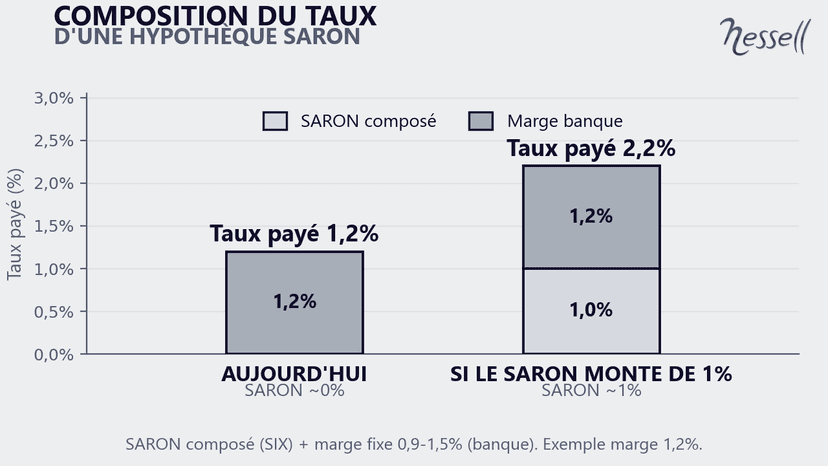
The resulting rate applies for the following three months, then is recalculated. Three examples put figures on the outcome: with a compounded SARON close to 0% and a margin of 0,9%, the rate paid is around 0,9%; with a margin of 1,2%, it reaches 1,2%; if the compounded SARON rises back to 1%, these rates become 1,9% and 2,2%.
The Swiss stock exchange operator publishes the daily SARON from which this calculation is derived; the compounded SARON specific to the loan is set by the bank at the end of each quarter. Only the margin lastingly distinguishes two SARON offers, since the reference rate is identical for all banks.
| Component | Role | Who Sets It |
|---|---|---|
| Compounded SARON | reference rate, basis of the calculation | the bank, by compounding the daily SARON rates published by SIX (the Swiss stock exchange operator) |
| Bank margin | the bank’s remuneration, 0,9 to 1,5% | the bank, fixed for the term |
| Rate paid | Compounded SARON + margin | recalculated every quarter |
The chart below breaks down the rate paid into compounded SARON and bank margin, under two rate scenarios.
What Are the Advantages and Disadvantages of a SARON Mortgage?
A SARON mortgage has three advantages and two disadvantages. The choice depends on the borrower’s risk tolerance.
- Historically lower cost: over the long run, the variable rate has worked out cheaper than the fixed rate.
- Transparency: SARON is public, calculated from real transactions, and identical for all banks.
- Flexible exit: terminating or switching to a fixed rate can happen at every quarterly deadline without a heavy penalty, whereas breaking a fixed-rate contract can cost several tens of thousands of francs.
- Risk of increase: if the money market rises, the rate and the monthly payment increase quickly, as early as the following quarter.
- Budget unpredictability: the cost of future interest is not known in advance, which complicates planning.
According to Swiss banking practices, these features make SARON a product suited to stable or falling markets, and less suited to budgets with no safety margin.
SARON Mortgage or Fixed Rate: Which One to Choose?
The choice between a SARON mortgage and a fixed rate depends on the borrower’s profile and the expected path of rates, with no one-size-fits-all answer.
The simulator below compares the cost of both solutions based on the amount, term and margin.
SARON vs Fixed Rate Simulator
Assumption: compounded SARON at 0% (current level), interest estimated excluding amortization. The actual cost of SARON varies with the market.
SARON bets on a lower cost and flexibility; the fixed rate buys the security of a known monthly payment.
Four factors set them apart. Rate stability goes to the fixed rate, whose monthly payment does not move; expected cost historically tilts toward SARON, cheaper on average; risk exposure is borne by the borrower with SARON, and by the bank with the fixed rate; a long horizon and a preference for peace of mind favor the fixed rate, while a short horizon or the capacity to absorb variations favors SARON.
In March 2026, a SARON mortgage stood at around 0,9 to 1,2%, versus 1,1 to 1,7% for a five-year fixed rate, a gap favorable to SARON given a 0% policy rate. According to banking practices, no option dominates in every circumstance.
Who Is a SARON Mortgage Suitable For?
A SARON mortgage suits risk-tolerant borrowers with reserves allowing them to absorb an increase in the monthly payment. Three profiles are particularly well suited.
The first has comfortable income and safety savings allowing them to absorb a rising monthly payment without strain. The second actively follows the markets and knows how to switch to a fixed rate at the right time. The third has a short horizon, for example a resale planned a few years out, over which the risk of a lasting increase is limited.
The limit of this exercise is above all numerical: a 1% rise in the rate on a CHF 800'000 loan adds around CHF 8'000 to the annual interest charge. A profile suited to SARON is able to absorb this difference without giving up other commitments. Conversely, a budget calculated too tightly, with no safety margin, does not sit well with the uncertainty inherent to SARON.
How to Protect Against a Rise in the SARON Rate?
Several levers protect the borrower against a rise in the SARON rate, to be combined according to their situation.
- Switching to a fixed rate: converting the SARON mortgage into a fixed rate at a quarterly deadline, with three months’ notice, makes it possible to lock in the rate before it climbs.
- Stronger amortization: speeding up the repayment of the principal reduces the share of debt subject to variable interest.
- Safety savings: keeping dedicated savings makes it possible to absorb higher monthly payments without budget strain.
- Splitting into tranches: financing part in a fixed rate and part in SARON limits overall exposure.
According to Swiss banking practices, switching to the fixed rate remains the most direct lever, available every quarter.
What Happens If SARON Turns Negative?
If SARON moves into negative territory, a standard contractual clause brings the reference rate back to zero, with only the bank’s margin remaining payable. The borrower never receives interest: the rate paid never falls below the level of the margin.
Such a floor protects the bank from a negative interest rate on the loan. As an illustration, for a margin of 1% and a compounded SARON of -0,2%, the rate paid remains 1%, not 0,8%: the zero floor cancels out the negative portion. During the episode of negative rates experienced by the Swiss market, SARON mortgages charged only the margin, with no additional benefit below zero.
How to Take Out a SARON Mortgage?
Taking out a SARON mortgage follows four steps, during which the borrower compares offers, checks their financing capacity, and chooses the various parameters before signing the framework agreement with their bank or through a broker.
- Compare several banks: since the reference rate is the same for all banks, only the margin and the terms differ.
- Gather at least 20% in equity capital and meet the affordability (debt-service) rule.
- Choose the term of the framework agreement and its frequency: the framework agreement is most often three or five years, while the rate is reviewed every quarter.
- Sign the framework agreement with the bank or broker, who takes care of formalizing the mortgage and its registration in the land register.
In Swiss banking practice, the margin is negotiated based on the borrower’s creditworthiness and the banking relationship.
How Does a SARON Mortgage Fit into Financing a Purchase in Geneva?
A SARON mortgage is just one building block of financing a purchase in Geneva, which combines equity capital, a mortgage loan and amortization. It is the variable-rate form of loan, chosen instead of or alongside the fixed rate. The other financing solutions available in Geneva and loan amortization complete the picture.
What Other Real Estate Financing Solutions Are Available in Geneva?
The other financing solutions in Geneva are equity capital, the mortgage loan and cantonal assistance schemes. They combine to cover the price and the costs.
- Equity capital: savings, gifts and pension assets (2nd and 3rd pillars).
- The mortgage loan: at a SARON or fixed rate, split into first and second charge.
- Cantonal assistance: state loans and guarantees for homeownership.
Within real estate financing in Geneva as a whole, the SARON mortgage takes the place of the variable-rate loan. The use of these building blocks depends on the funds available and the buyer’s risk profile.
How to Amortize a Mortgage in Geneva?
Amortizing a mortgage in Geneva means gradually repaying the borrowed capital, either directly or indirectly. With direct amortization, the debt decreases with each payment; with indirect amortization, the borrower pays into a pledged 3rd pillar, repaid in full at maturity.
This has an impact on the tax burden and on the total cost of the loan. The second charge must be amortized within a legal deadline, generally over fifteen years or before retirement age.
Is a SARON Mortgage Cheaper Than a Fixed Rate?
It depends on the market and the horizon, but over the long run a SARON mortgage has worked out cheaper than a fixed rate. The variable rate has historically cost less, because it does not charge the safety premium included in the fixed rate.
This advantage is not guaranteed: during a cycle of rapidly rising rates, SARON can exceed a fixed rate locked in at the right time. The outcome should be judged over the actual term of the loan, not quarter by quarter.
Can You Switch from a SARON Mortgage to a Fixed Rate?
Yes, switching from a SARON mortgage to a fixed rate is possible. The switch takes place at each quarterly rate deadline, with three months’ notice to the bank.
This conversion locks in the rate for the chosen fixed term and ends market exposure. Most banks allow it free of charge, within the framework of the SARON agreement signed at the outset.