
Real Estate Financing in Geneva: Mortgage, Equity and Banking Rules

Financing a home in Geneva draws on two complementary resources: the buyer’s equity contribution and the bank’s mortgage loan. Its framework consists of the self-regulatory rules of the Swiss Bankers Association, locally supplemented by cantonal assistance schemes. This guide covers the components of financing, the proportion and nature of equity, the one-third rule and purchasing capacity, the lending value, the two ranks of the mortgage and their amortisation, and finally Geneva’s assistance schemes.
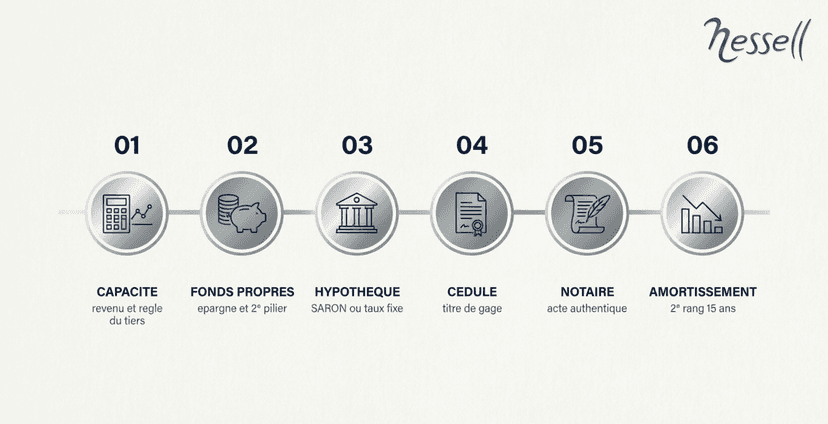
What is real estate financing in Switzerland?
In Switzerland, real estate financing is built around two contributions: the buyer’s equity and the mortgage loan granted by the bank. This framework stems from the Swiss Bankers Association’s Guidelines on minimum requirements for mortgage financing, established as a minimum standard by the Swiss Financial Market Supervisory Authority (FINMA) in its communication of 27 March 2024, the revised version of which has applied to the entire sector since 1 January 2025.
These federal rules apply in full in Geneva, alongside the cantonal schemes supporting home ownership.
What are the components of Swiss real estate financing?
Swiss real estate financing is built around four components, each meeting a banking self-regulation requirement.
- Equity: a personal contribution of at least 20 % of the property’s value, of which 10 % must come from outside occupational pension assets.
- The first mortgage: a loan covering up to 67 % of the lending value, with no amortisation obligation.
- The second mortgage: the additional tranche up to 80 %, to be amortised over fifteen years or until retirement age.
- Affordability: the ratio between the affordability calculation and gross income, capped at 33 % under the one-third rule.
What proportion must equity represent?
Equity must amount to at least 20 % of the property’s value for a primary residence, with the bank financing the remaining 80 % through a mortgage loan. This 20 % threshold stems from the Swiss Bankers Association’s Guidelines, which have been established as a minimum standard by the Swiss Financial Market Supervisory Authority since 1 September 2014.
Below 20 %, no Swiss institution grants a conventional mortgage loan.
What are hard equity and soft equity?
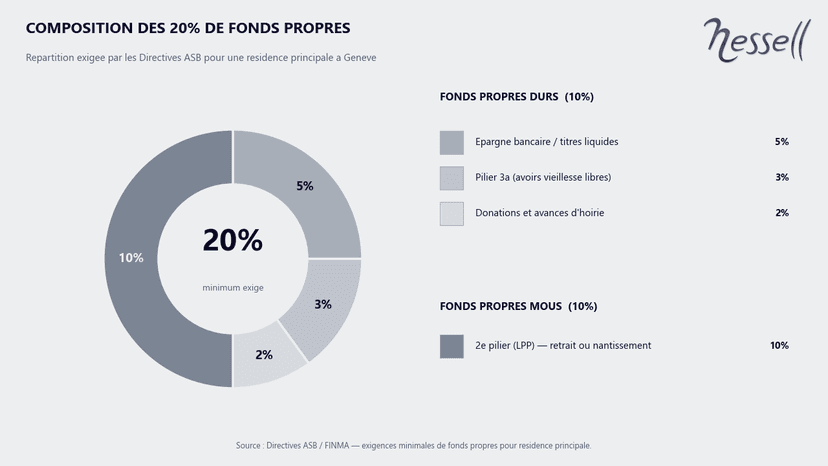
Hard equity comprises assets immediately available outside occupational pension savings, while soft equity comes from the 2nd pillar. The Swiss Bankers Association’s Guidelines require that, of the 20 % required, at least half, i.e. 10 % of the property’s value, be made up of hard equity.
Hard equity includes savings and account balances, liquid securities, gifts or advances on inheritance, and 3rd pillar assets. Soft equity is limited to the early withdrawal or pledging of the 2nd pillar, a limit designed to avoid undermining retirement provision as a whole.
Can you withdraw your 2nd pillar to buy property in Geneva?
Yes. The Federal Act on Occupational Retirement, Survivors’ and Disability Pension Plans allows, for a primary residence only, the early withdrawal of the 2nd pillar or its pledging. Withdrawal is subject to separate taxation at a reduced rate. Pledging leaves the assets intact and lets them continue to grow within the pension plan.
Can the 3rd pillar be used for indirect amortisation?
Yes, it is even a common arrangement. Instead of repaying the bank, the buyer pays into a 3rd pillar each year, pledged in the bank’s favour, up to the ceiling set by the Federal Tax Administration. The contributions reduce taxable income, and the capital, released at maturity, is used to repay the second mortgage in a single payment.
How does the one-third rule work?
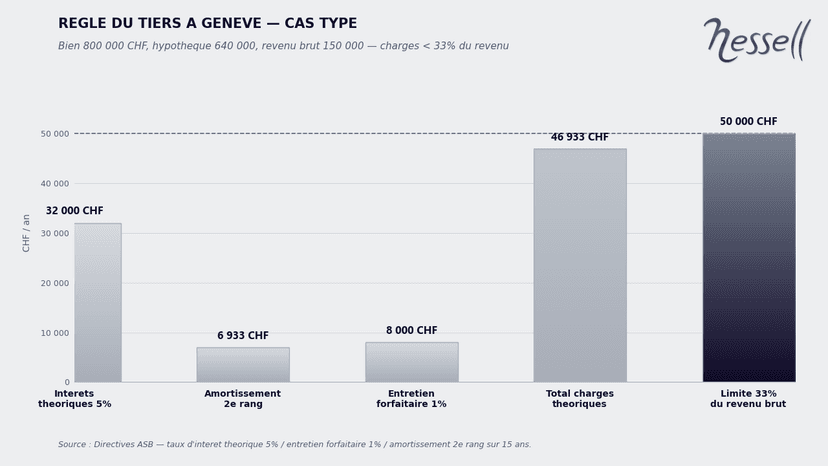
The one-third rule caps theoretical housing costs at one third of the buyer’s annual gross income. Like the 20 % equity requirement, this self-regulatory rule governs loan approval at every Swiss bank.
Three costs enter into the calculation: theoretical mortgage interest, calculated at a rate of 5 %, the mandatory amortisation of the second mortgage, and maintenance costs, set at a flat rate of 1 % of the property’s value per year. If their sum exceeds one third of gross income, the bank declines the financing.
What theoretical interest rate do banks apply?
Swiss banks apply a theoretical interest rate of 5 % when calculating costs. Set out in the Swiss Bankers Association’s Guidelines and recognised by the Swiss Financial Market Supervisory Authority, this rate is far higher than market rates.
It ensures the borrower will always be able to keep repaying even if mortgage rates rise durably.
What minimum income does financing a property in Geneva require?
To comply with the one-third rule, annual gross income must be roughly one and a half times the property price spread over ten years. Across land-registry signed sales of the past twelve months, the canton's median sale stands at CHF 1'300'000 (August 2026).
For a CHF 1.3 million property financed with 20 % equity and an 80 % mortgage, annual gross income must be around CHF 234’000 so that the affordability calculation, interest at 5 %, amortisation and maintenance, does not exceed one third of income.
How is purchasing capacity calculated?
Purchasing capacity is defined as the maximum price a household is able to finance. It is set by two limits: the equity actually available and the one-third rule applied to income.
In practice, annual gross income is multiplied by three to arrive at the maximum affordability calculation, and the purchase price matching that figure is then worked out, using a theoretical rate of 5 %, amortisation of the second mortgage and a flat-rate maintenance cost of 1 %. This result indicates the price range to search within, before any love-at-first-sight purchase.
Lending value: what if the bank’s appraisal is lower than the sale price?
If the bank’s appraisal comes in below the sale price, the gap must be covered with additional equity, on top of the 20 % required. Indeed, the bank does not lend against the purchase price but against the lending value, that is, the value it assesses through its own appraisal, and always applies whichever figure is lower, the price or that value.
This mechanism protects the bank in the event of a resale and explains why any price above market value must be paid in cash.
How is the balance beyond equity and the mortgage financed?
Beyond equity and the mortgage, what remains to be financed are the acquisition costs and any contribution above the bank’s minimum. According to the Geneva Chamber of Notaries, these costs amount to around 4 % of the sale price and must be paid in cash when the deed is signed.
The buyer covers them from remaining savings, a gift or advance on inheritance, the sale of a financial asset, or leftover 3rd pillar funds. They cannot be financed through the mortgage, which is capped at 80 % of the property’s value.
Can a property in Geneva be financed with less than 20 % equity?
Yes: the State guarantee scheme allows it, based on the law on assistance for individual home ownership (LAPI). In that case, the buyer puts up only 5 % equity; for the remaining 15 % needed to reach the bank’s 20 % threshold, the canton acts as guarantor.
How is the mortgage split between first and second rank?
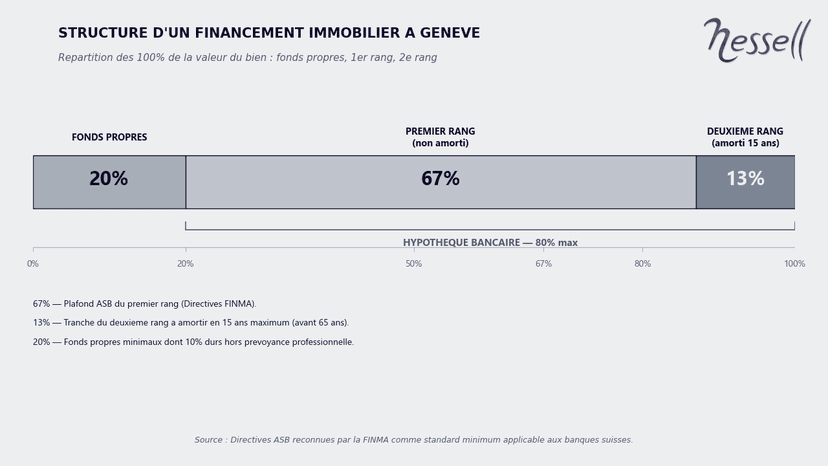
The Swiss mortgage is structured in two successive ranks, subject to distinct amortisation rules. The first rank, covering the upper portion of the financing, is not amortised, whereas repayment of the second rank must take place within a limited period.
This split allows the bank to segment risk according to the share of the property financed, and to require the progressive deleveraging of the tranche where it is most exposed.
How much can the first rank reach?
The first rank covers up to 67 % of the property’s lending value, under the Swiss Bankers Association’s Guidelines recognised by the Swiss Financial Market Supervisory Authority. This tranche carries no amortisation obligation and can remain in place for the entire holding period, with the bank collecting only interest on the outstanding principal.
How much must the second rank amortise?
The second rank, between 67 % and 80 % of the lending value (i.e. 13 % of the property’s value in the standard configuration), must be repaid in full within fifteen years at most, or before statutory retirement age if that comes sooner, under the Swiss Bankers Association’s Guidelines. Amortisation is carried out through staggered annual instalments, either direct or indirect.
How does mortgage amortisation work?
Amortising means gradually repaying the principal of the second mortgage, over fifteen years at most, so as to bring the debt down to 67 % of the lending value before retirement. There are two ways to go about it.
With direct amortisation, monthly instalments are paid to the bank: the debt and the interest decrease, but tax rises as deductible interest shrinks. With indirect amortisation, a pledged 3rd pillar is credited, to be released only at maturity: the debt stays stable, deductible interest is preserved, and 3rd pillar contributions are deducted from income, within the limits set by the Federal Tax Administration.
How to choose between a SARON mortgage and a fixed rate?
The choice between a SARON mortgage and a fixed rate depends on the borrower’s risk profile and their expectations for rates. The SARON mortgage is indexed to the Swiss money-market rate and is reset every quarter: its cost falls when rates drop, but rises when they climb.
A fixed rate locks in a rate for a period of two to fifteen years, securing the budget, but denies the borrower any potential drop in rates during the term.
What role does the mortgage note play in financing?
The mortgage note secures the loan. This real estate lien is recorded in the Geneva land register when the notarial deed is executed (on a mandatory basis) and remains enforceable against third parties for as long as the debt is not repaid.
What assistance does the State of Geneva provide to buyers?
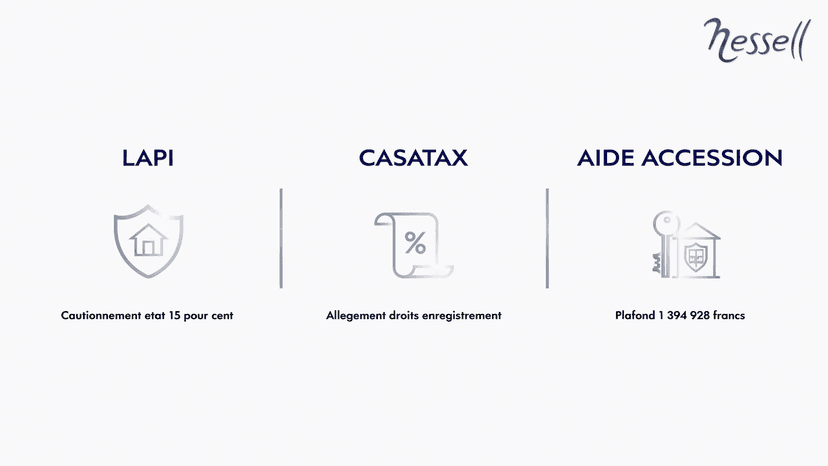
In Geneva, State assistance takes the form of a simple guarantee on the second mortgage, based on the law on assistance for individual home ownership (LAPI). Thanks to this scheme, a buyer of a primary residence puts up only 5 % equity, with the canton acting as guarantor for the remaining 15 % needed to reach the bank’s 20 % threshold.
Eligibility depends on price, income and wealth criteria, as well as actually occupying the home as a primary residence. The purchase price cannot exceed the Casatax ceiling, set at CHF 1’394’928 as of 1 March 2026.
How does Casatax reduce registration duties in Geneva?
In Geneva, Casatax reduces the registration duties owed by a buyer of a primary residence by exempting the first CHF 266’667 of the sale price. The saving reaches CHF 20’924 on registration duties, according to the canton, and mortgage note fees are cut in half.
One of the conditions for benefiting from it is to actually occupy the home for at least three years.
What additional costs are added to the purchase price in Geneva?
In Geneva, additional costs on top of the purchase price come to around 4 % of the price, according to the Geneva Chamber of Notaries. They cover four items.
- Registration duties: 3 % of the price, paid to the State (unless reduced under Casatax).
- Land register fees: 0,3 % of the price (recording the transfer and the mortgage note).
- Notary fees: around 0,7 % of the price.
- Cost of creating the mortgage note: variable, cut in half under Casatax.