
Real Estate Property Types in Geneva: Complete Catalogue of the Geneva Market
The real estate market within the canton of Geneva is structured around six major families. First and foremost, it is worth noting the predominance of the apartment in all its forms, from the studio to the loft. By comparison, houses (or villas) are few in number and buildable land is scarce. As for commercial real estate, it consists of offices, retail units and parking spaces.
For the sake of completeness, we should finally note that our Geneva real estate market involves two other dimensions: floor areas, through the technical conventions in force such as the SIA 416 standard, and legal ownership regimes (condominium (PPE), SIAL or cooperative).
We count more than 252 000 dwellings within our canton (source: OFS). As such, the "type of property in Geneva" rests on a legal framework on one hand (Swiss Civil Code, articles 712a et seq.; and the cantonal LGZD amended in 2020 and then 2022) and on customary usage on the other.
A type of property in Geneva corresponds to a categorisation based on a cross-matrix between use, the physical structure of the property and the legal regime. Logically, this typology determines its price, its taxation, its financing structure and the notarial process.
What apartments make up the Geneva market?
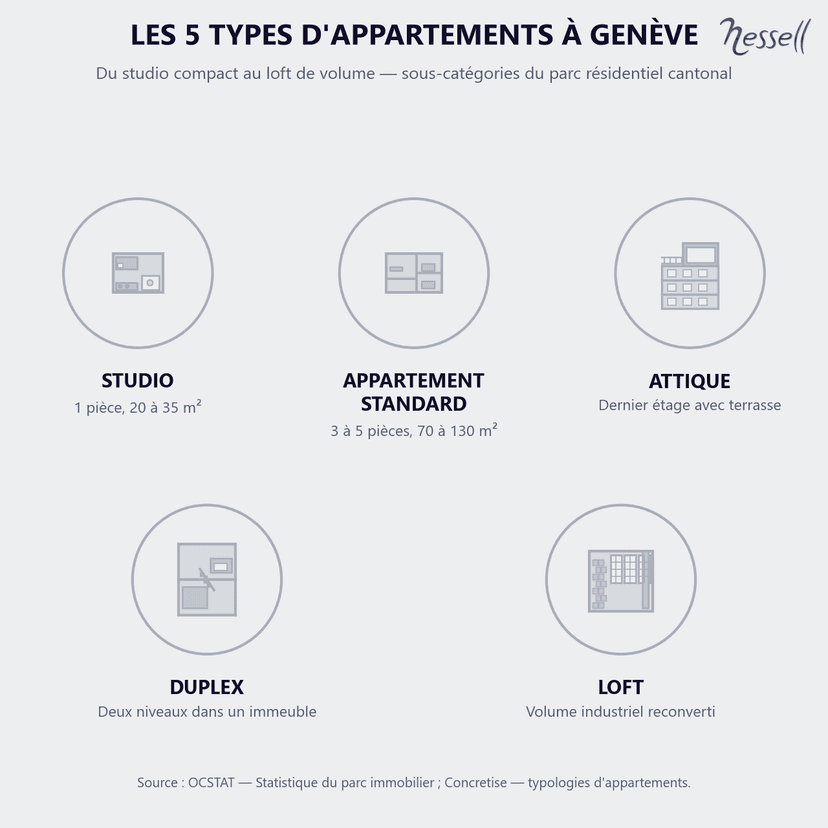
The apartment is the predominant type in the Geneva property stock according to the Office cantonal de la statistique, and accounts for the majority of the stock. Sub-types range from the studio (1 room) to the family five-room apartment, with four atypical formats: penthouse, duplex, loft and through-apartment. Condominium (PPE) ownership is the predominant regime for new apartments, which are recorded in the land register. The five sub-sections describe the studio, the standard apartment, the penthouse, the duplex and the loft.
This catalogue presents the five apartment sub-types recorded on the Geneva market.
What is a studio in Geneva?
The studio in Geneva is an apartment made up of one main room with a sleeping area, a kitchen corner or kitchenette and a bathroom, with a floor area of 20 to 35 m². Designed for first-time buyers, student rentals and single-person households, the studio responds to the particular tension in this segment within the canton. Due to its scarce supply, the studio plays a key role in the Geneva rental market. The detailed studio in Geneva fact sheet presents its prices, taxation and the procedures involved in a purchase.
What is a standard apartment in Geneva?
The standard apartment in Geneva is a 3- to 5-room dwelling in a collective building, mostly sold as condominium (PPE). Its floor area ranges from 70 to 130 m² depending on the layout, with a buyer profile made up mainly of families and working households. The apartment in Geneva makes up the largest part of the cantonal residential stock. Market details are covered within the fact sheets by layout and municipality.
What is a penthouse in Geneva?
The penthouse in Geneva is an apartment on the top floor of a building whose built floor area is reduced compared with the lower floors and which benefits from a panoramic terrace. The term "attique" is used as a synonym for penthouse in the French-speaking Switzerland market. According to market data, the penthouse in Geneva typically sells with a significant price premium compared with a standard apartment in the same building. The penthouse fact sheet details its technical specifics and market analysis.
What is a duplex in Geneva?
The duplex in Geneva is an apartment spanning two levels connected by an internal staircase, generally located on the upper floors of a building. The duplex in Geneva differs from the detached house in that it is recorded within a collective building under co-ownership. The duplex in Geneva therefore appeals to families wanting a generous living volume without the constraints of a house. The duplex fact sheet covers the technical particulars and market prices.
What is a loft in Geneva?
A loft in Geneva is defined as a former industrial or commercial space converted into housing, made up of a large open volume, high ceilings and exposed raw materials. Loft supply remains very marginal in the canton and is concentrated in redeveloping neighbourhoods such as Plainpalais, Carouge or Les Acacias. The loft in Geneva represents an atypical high-end segment sought after by an urban clientele. The loft technical fact sheet details its technical constraints and specific market.
What houses are found in the canton?
The house is a minority share of the Geneva stock, with a minority share of dwellings (in the order of 10 % according to the Office cantonal de la statistique). Concentrated in the canton's peri-urban and residential municipalities, outside the dense urban zone, its two main sub-types are the standard detached house and the high-standing villa. Tension in the house segment is not easing, due to the scarcity of available buildable land and cantonal planning constraints.
What is a detached house in Geneva?
A house in Geneva is an independent residential building, built on its own parcel of land, and intended for family use. The scarcity of supply in the canton places the canton's median villa at CHF 2'180'000, as a median of land-registry signed sales (August 2026). The house occupies a marginal place in the Geneva stock due to the tension on buildable land. Municipalities, prices and acquisition procedures are covered in the detailed house in Geneva fact sheet.
What is a villa in Geneva?
The villa in Geneva corresponds to the high-standing detached house with generally wooded grounds and above-average features. Most of the supply is located in the prestigious left-bank municipalities: Cologny, Vandœuvres, Genthod, Anières. Prices in the villa segment sit at the top of the cantonal market, above CHF 3 million for benchmark properties. Find in the detailed villa in Geneva fact sheet the prestige properties and the analysis by municipality.
What is a plot of land in Geneva?
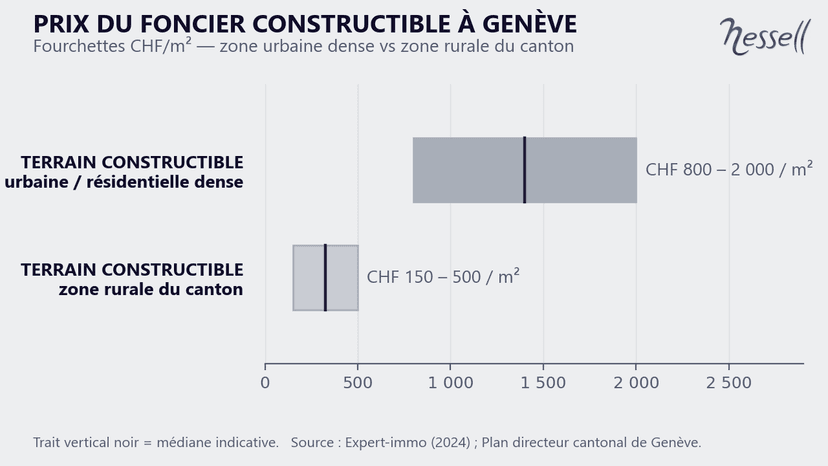
Land in Geneva is bare land, subject to a cantonal planning status, which determines its building potential. The canton differentiates buildable land (located in building zones) from non-buildable land (in agricultural, forest or protected zones), according to the Plan directeur cantonal. Prices per m² for buildable land in Geneva range between CHF 800 and CHF 2'000 in the canton's dense urban or residential zones, versus CHF 150 to CHF 500 in the canton's rural zone, according to Expert-immo. The limitation of available buildable land remains a strong determinant of planning constraints. Find the detailed land in Geneva fact sheet, covering zoning, prices, and the building authorisation.
This chart compares the price ranges observed by property category in Geneva.
What commercial real estate properties exist in Geneva?
Commercial real estate is organised around four main categories in Geneva: the office, the ground-floor retail unit, the activity unit and the parking space.
- The office, intended for tertiary-sector companies and international organisations, constitutes one of the dominant segments of the Geneva tertiary sector.
- The retail unit, intended for retail shops and food service.
- The activity unit, intended for crafts and small-scale production.
- The parking space, which is rented or purchased as an independent lot.
This entire tertiary segment accounts for a significant share of the canton's built floor area. Due to its uses, agreed rents and transactions, commercial real estate is covered by fact sheets specific to it.
How are the floor areas of a property measured in Geneva?
The canton of Geneva distinguishes three main ways of measuring floor area: living area, main usable area and weighted area. Living area represents the area of interior living rooms (excluding the area of annexes). Main usable area (SUP) corresponds to the Swiss professional standard SIA 416, which describes 31 different areas according to Concretise. Weighted area includes annexes (balcony, terrace, cellar) with a weighting coefficient. Beyond the displayed sale price, it is this distinction that determines the property's tax assessment.
What is the difference between living area and weighted area?
Living area thus corresponds to only the heated interior living rooms (living room, bedrooms, kitchen, bathroom), whereas weighted area includes annexes according to a certain coefficient. For instance, it is customary in the canton of Geneva to count balconies in the weighted area at 50 %, terraces at around 33 % and cellars at 10 %. It is precisely this distinction that gives rise to the gap observed between living area and weighted area found in listings, and which justifies the price of a property. In the detailed living area / weighted area fact sheet, we cover the calculation methods and the standards in force in the canton of Geneva.
What legal ownership regimes exist in Geneva?
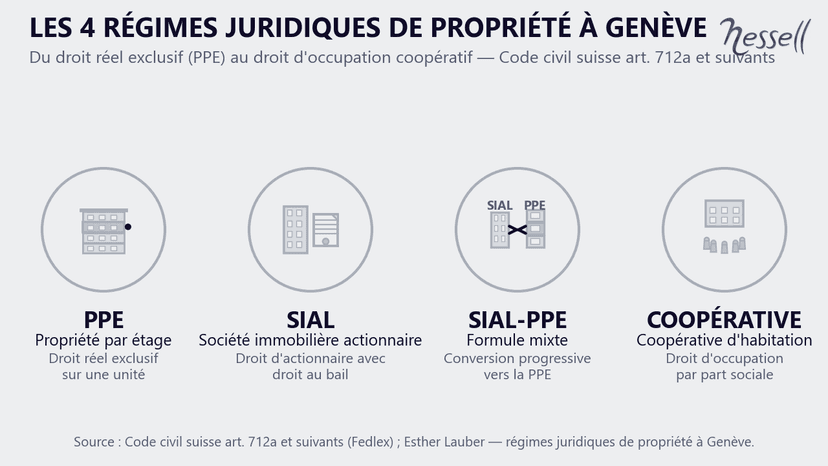
The canton of Geneva indeed recognises four main legal regimes of real estate ownership: condominium ownership (PPE), the tenant-shareholder property company (SIAL), the mixed SIAL-PPE formula and the housing cooperative. Unlike condominium (PPE), which grants the owner a real right of ownership over a unit recorded in the land register, SIAL grants a shareholder's right with a right to lease; the cooperative grants an occupancy right linked to a share. The regimes differ in the taxation applicable to them, their mode of transfer and their financing arrangements. Provided for under articles 712a et seq. of the Swiss Civil Code, condominium (PPE) represents the particular form of co-ownership most widespread in Switzerland.
This diagram summarises the four legal ownership regimes recognised in Geneva.
What is condominium (PPE) in Geneva?
Condominium (PPE) in Geneva is a floor-based co-ownership of a building, in which each co-owner has an exclusive right of use and interior fitting-out over a given "floor unit" of the building. In accordance with article 712a of the Swiss Civil Code, each floor unit is a co-ownership share to which an exclusive right of use is attached, and which is recorded in the land register under a dedicated sheet. Condominium (PPE) is the predominant legal regime for new apartments sold in the canton.
What is a SIAL in Geneva?
A SIAL in Geneva is a tenant-shareholder property company in which the acquisition of shares grants a right to lease over a floor unit of a building held by the company. SIAL constitutes a historical specificity of the Geneva market, still present in older buildings in the city centre. The SIAL regime is progressively giving way to condominium (PPE) for new construction in the canton.
What is a housing cooperative in Geneva?
The housing cooperative in Geneva is a non-profit company that owns a property portfolio and grants its members an occupancy right in exchange for a share. The cooperative remains the owner of the building, which is why the member is not an owner but nonetheless benefits from a moderate rent for life. The State of Geneva fully integrates the cooperative model into its housing policy. The housing cooperative fact sheet details the conditions of access, the obligations and the list of Geneva cooperatives.
How are property types distributed within the canton?
Still according to the Office cantonal de la statistique, apartments make up almost the entirety of the residential stock of the canton of Geneva. Detached houses fill only a minority share of the stock, located in peri-urban municipalities. The balance between rental housing and owner-occupied housing is largely in favour of rental: only around 18 % of Geneva households are owners according to the Office fédéral de la statistique, meaning close to 82 % are tenants. The social segment (LUP, HBM) covers a significant share of the cantonal rental stock.
What types of property are found in development zones?
In Geneva, development zones build three types of property: condominium (PPE) in a development zone (ZD-PPE), non-subsidised rental housing (ZD-LOC) and public-interest housing (LUP). In accordance with the Loi générale sur les zones de développement (LGZD) amended in 2020 and 2022, sale prices and rents are controlled by the State for ten years from the arrival of the first occupants. The allocation conditions and acquisition procedure are described in the detailed fact sheet devoted to the development zone.
How to choose the property type suited to your project in Geneva?
Four main criteria structure the choice of property type from the outset: the available budget, the composition of the household, the holding horizon and the intended occupancy mode. The available budget determines access to the segments (studio, standard apartment, villa, penthouse), the composition of the household determines the required layout (number of rooms), the holding horizon guides the buy-versus-rent decision and the occupancy mode distinguishes between primary residence and rental investment. In order to buy a property suited to your project, the complete walkthrough of the buyer's methodology is covered in a fact sheet dedicated to it.
What types of property are the most sought after in Geneva?
Three types of property meeting distinct segments concentrate most of the demand in Geneva: the 3- to 4-room apartment, the penthouse and the family villa. The 3- to 4-room apartment attracts most of the residential demand from working households; the penthouse attracts that of the high-end segment, owing to the panoramic view it offers; the family villa attracts demand from senior executive households and high-income families. The cantonal market studies report explains that these three segments are under pressure due to the scarcity of supply relative to demand.
How do these property types fit into the Geneva real estate market?
Geneva property types fit into a cantonal real estate market that is tight, marked by scarcity, high prices and a specific institutional framework. Each type corresponds to a demand segment: the studio absorbs the rental demand from single-person households, the standard apartment that of families, the villa and the penthouse the high end. It is against a complete catalogue of property types in Geneva that these find their coherence, within the cantonal real estate market that structures prices, availability and acquisition dynamics.