
Letting a Property in Geneva: The Landlord's Guide
Letting a property in Geneva commits the landlord to a regulated process in which every decision made from the outset affects both the profitability of the letting and its legal security. This guide follows that process step by step: the legal framework that sets out the landlord's duties, rent-setting and the official notice specific to the canton, preparing and advertising the property, selecting the tenant, concluding the lease, and then special arrangements such as furnished or short-term letting. This guide is intended for landlords about to place their home on the Geneva rental market, whether on their own or through a property management firm, who want to secure every step before handing over the keys.
What is the letting of a property in Geneva?
Letting a property in Geneva is the process by which an owner entrusts their home to a tenant in exchange for rent, from choosing the management arrangement through to signing the lease. It falls under the Code of Obligations for the lease itself, and under Geneva cantonal law for rent-setting and the protection of the rental housing stock.
What are the landlord's obligations in Geneva?
The main duties of a landlord in Geneva are as follows (articles 256 et seq. of the Code of Obligations): deliver a property in good condition, maintain it, and guarantee the tenant against defects throughout the lease.
- deliver the property in a condition suited to the agreed use
- maintain the property and cover repairs beyond minor upkeep
- guarantee the tenant against defects in the leased property
- notify the initial rent using the official form
- prepare the statement of service charges based on supporting documents
These obligations mirror what the tenant owes in turn, detailed in the tenant's guide.
What does the Code of Obligations say about the lease?
The Code of Obligations governs the residential lease in its articles 253 to 274g, applicable throughout Switzerland. The lease is a consensual contract. It is formed as soon as the parties agree on the property and the rent, with no set form required. The text sets out the reciprocal obligations of landlord and tenant, the rules for setting and challenging rent, and the conditions for termination.
What does the LDTR say about letting in Geneva?
The LDTR (law on the demolition, alteration and renovation of residential buildings; RSG L 5 20) makes work on housing located in building zones, excluding villas, subject to authorisation, and controls rent after the work is carried out. Rent is controlled for three years after renovation or alteration, extended to five years for major alterations. This is the interpretation given by the Department of Territory. The cost of the work may only be passed on to the rent within a limit set by law. A landlord who renovates before letting makes sure their property falls outside this scope.
How is rent set in Geneva?
The rent for a property let in Geneva is set on two bases.
- the permissible yield of the building
- comparable rents charged in the neighbourhood for similar properties
How do you estimate a fair rent?
Estimating a fair rent relies on comparable rents in the neighbourhood and on the calculator provided by Statistique Genève, itself based on a sample of around 70,000 properties in the canton located in buildings of three units or more. An overpriced rent lengthens vacancy and costs several thousand francs a month without a tenant. An underpriced rent cuts into the yield for the entire lease. A property management firm or an expert can refine this estimate based on the property's condition and features.
How is the initial rent set using the official form?
The landlord in Geneva gives the tenant a notice setting the initial rent on the official form no later than thirty days after handing over the keys, stating the previous rent, the new rent and its justification, the reference rate and the price index used. Without the official form, the rent-setting itself is null and void: the lease remains valid, but the tenant may challenge the rent at any time, and the judge then sets the permissible rent based on the yield and neighbourhood rents. This cantonal requirement makes the form indispensable when concluding the lease.
What impact does the reference rate have on rent?
The reference interest rate limits how much rent can change after the lease is concluded. Published by the Federal Housing Office, it stands at 1.25% as of September 2025 and remains unchanged in 2026. A quarter-point rise lets the landlord increase the rent by 3%, while a decrease entitles the tenant to a reduction of 2.91%. The landlord states the reference rate in effect in the official notice used to set the initial rent.
How do you let a property in Geneva?
Once the rent is set, letting a property in Geneva takes place in four operational steps: preparing the property and gathering the documents, publishing the listing, organising viewings, and then selecting the tenant. Beforehand, the owner chooses whether to manage the letting directly or to appoint a property management firm.
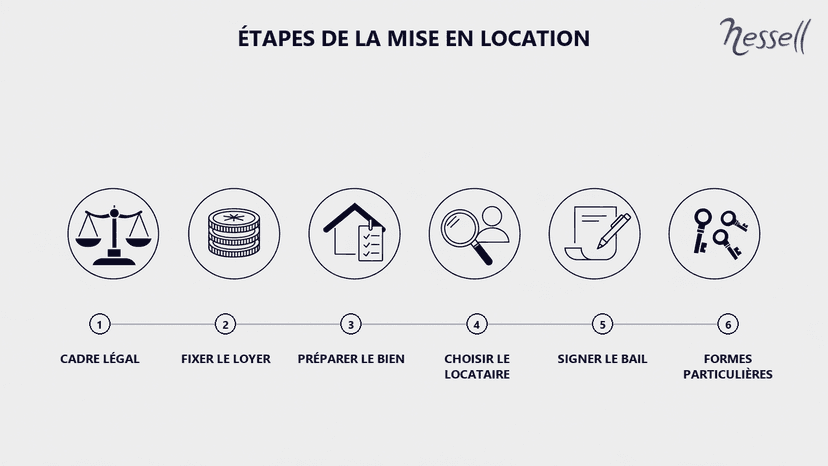
This timeline traces the six steps of letting a property in Geneva.
What documents and diagnostics should be prepared?
The documents and diagnostics to prepare before letting a property are as follows.
- the property title
- the property's floor plans
- the condominium association rules, if the property is held under PPE (condominium ownership)
- the statement of service charges
- a precise condition report of the property
- the building's energy certificate (CECB), increasingly expected on the market
The owner checks their building insurance as well as their building liability cover, and takes out unpaid-rent insurance before the tenant moves in, if needed.
Property management firm or direct management: how should you let your property?
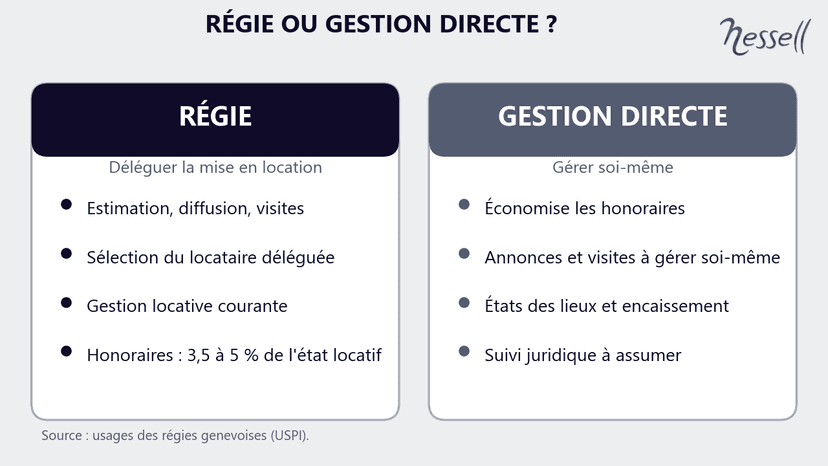
The owner chooses between appointing a property management firm or managing the letting directly. The property management firm handles the estimate, advertising, viewings, tenant selection, and then day-to-day property management, for standard fees of 3.5% to 5% of the rent roll collected. Direct management saves these fees, but the landlord must handle listings, condition reports, rent collection and legal follow-up. This choice depends on the time available and the number of units to manage.
This comparison sets property management firm oversight against direct management.
How do you choose a tenant in Geneva?
Choosing a tenant in Geneva means identifying a solvent, reliable applicant based on a complete file, using lawful selection criteria. The landlord checks financial capacity, professional stability and references, then makes a choice within legal limits. We detail below the file to request and the criteria permitted.
What documents should be requested from a prospective tenant?
The documents to request to build the applicant's rental file are those that establish their solvency.
- a valid ID or residence permit
- an employment contract
- the last three payslips
- a debt collection register extract less than three months old
- references from previous property management firms
Property management firms apply the one-third rule: rent including service charges should not exceed one third of the household's net income.
What selection criteria are permitted in Geneva?
The choice of tenant is free, but this freedom stops at the prohibition on discrimination and at compliance with data protection rules. Under the federal law on data protection, the landlord may only ask the applicant for information relevant to assessing their solvency and reliability, and may not keep the files of rejected applicants. Questions unrelated to the lease, such as origin, religion or plans to have children, fall outside the permitted scope.
What must a lease contract in Geneva contain?
The lease contract in Geneva brings together the essential elements of the letting.
- the identity of the parties
- the description of the property
- the amount of the rent and service charges
- the term and renewal
- the rent deposit
- the condition report
- the signatures
No particular form is required under the Code of Obligations, but a written lease clearly defines each party's rights and helps avoid disputes. The standard leases published by ASLOCA and the Chambre genevoise immobilière are a reliable basis.
What rent deposit can the landlord require?
The landlord may require a rent deposit of up to three months' rent for a residential property, in accordance with article 257e of the Code of Obligations. This rent deposit is placed in a blocked bank account opened in the tenant's name, with funds released only by agreement of both parties or by court order. The landlord never has free access to this sum during the lease.
How is the move-in condition report carried out in Geneva?
The move-in condition report is drawn up jointly, when the keys are handed over, in the presence of the landlord or the property management firm and the tenant. This document, detailing the condition of the property room by room when the tenant moves in, serves as the reference for the return of the property at the end of the lease. A precise, signed condition report protects the landlord from any dispute in the event of damage beyond normal wear and tear.
What special forms of letting exist in Geneva?
In Geneva, three special forms of letting follow specific rules: furnished letting, short-term letting, and letting a property held under PPE (condominium ownership). They change the landlord's obligations or the authorisations required.
How do you let a furnished property in Geneva?
Letting a furnished property in Geneva places three obligations on the landlord.
- set a higher rent that accounts for the furniture provided
- attach a detailed inventory of that furniture to the lease
- declare income from the furnished letting for income tax purposes
This arrangement suits temporary stays and an international clientele passing through Geneva.
Can you let on Airbnb in Geneva?
Yes, but under conditions. Letting an entire home remains possible for up to 90 days a year in Geneva; beyond that, the activity constitutes a change of use requiring authorisation under the LDTR. The owner checks the condominium association rules, declares the activity to their municipality and collects the tourist tax. Income must be declared to the tax authorities.
How do you let a property held under PPE in Geneva?
Letting a unit held under PPE requires compliance with the condominium association rules and the property's intended use. While the owner is free to let their unit, the tenant's rules of use are set out in the condominium association rules, and work affecting common areas falls to the owners' assembly, under articles 712a et seq. of the Civil Code. The condominium association rules should usefully be attached as an annex to the lease.
What happens once the property is let in Geneva?
Once the property is let, the relationship shifts into day-to-day property management: rent collection, statement of service charges, maintenance, rent adjustments. It ends once either party gives notice, or changes when the owner sells a let property.
Where can you get support to let your property in Geneva?
A landlord letting a property in Geneva relies on specialised players: USPI Genève and the Chambre genevoise immobilière for the professional and legal framework, and property management firms for operational management. Using a property management firm such as Nessell makes it possible to delegate the estimate, tenant selection and lease follow-up while securing every legal step.