
Geneva Real Estate Market: Pressure, Prices and Trends in 2026

In Geneva, the real estate market stands out for its structural pressure: very few vacant homes, some of the highest prices in Switzerland, and demand that supply cannot keep up with. This guide measures this pressure using public data from OCSTAT and the Federal Statistical Office, then details price formation, 2026 trends (transactions, rents, construction), the cantonal legal framework and medium-term prospects, up to the question of a bubble.
Which indicators measure a real estate market?
Reading a real estate market relies on five indicators.
- The vacancy rate: the balance between rental supply and demand.
- The price per square meter: how expensive built land is.
- Transaction volume: the market’s liquidity.
- The rent index: the cost of new leases.
- The pace of new construction: the market’s capacity to absorb demand.
All are published by OCSTAT and the Federal Statistical Office.
Why is the Geneva real estate market under pressure?
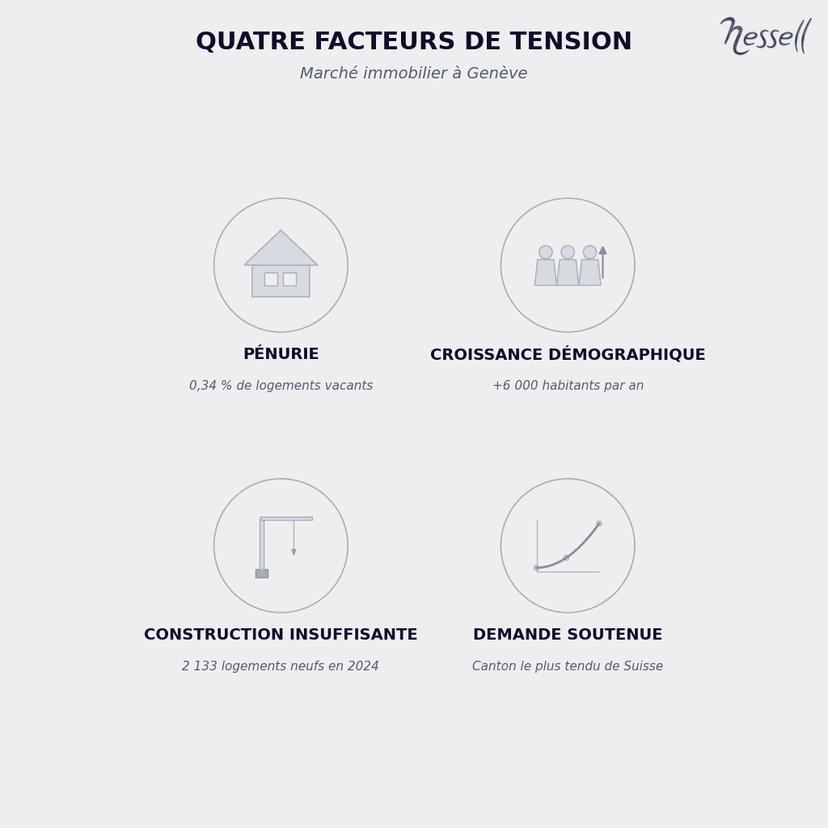
The Geneva market is under pressure because supply is not keeping up with structurally stronger demand. As of June 1, 2025, the vacant housing rate reached only 0.34% (Federal Statistical Office), compared with 1.0% for the Swiss average: the canton is nearly three times tighter than the country as a whole.
New construction is declining, with 2’133 homes delivered in 2024 (OCSTAT) against a need of 5’850 per year set by the Cantonal Master Plan, a shortfall of more than 3’700 units in that single year. Population, meanwhile, is still growing by 1.1% per year. The four subsections below detail vacancy, the housing shortfall, demographics and the role of the cross-border Greater Geneva area.
What is the vacancy rate in Geneva?
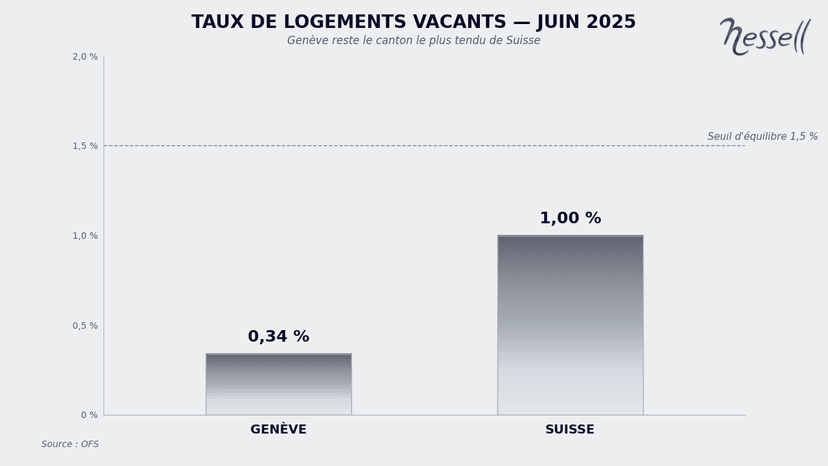
In Geneva, the vacancy rate stands at 0.34% as of June 1, 2025, its lowest level since 2012 (Federal Statistical Office). That is close to a third of the Swiss average of 1.0%, and well below the market’s theoretical equilibrium threshold, set at 1.5%.
How short of housing is the canton?
The canton must build 5’850 homes per year to meet demand, according to the Cantonal Master Plan. This need breaks down into 3’000 homes linked to economic ambitions, 2’000 for household splitting, and 850 for young people.
With only 2’133 new homes produced in 2024 (OCSTAT), the shortfall exceeds 3’700 units in that single year.
How does demographic growth fuel demand?
Demand in Geneva is driven by demographic growth that shows no sign of slowing, at around 1.1% per year. The engine? The economy of the Lake Geneva basin, which continuously attracts a working population, largely international, tied to multinational companies and international organizations. With new housing supply falling short, these arrivals feed directly into pressure on prices and rents.
What role does the Greater Geneva cross-border market play in local pressure?
Greater Geneva acts as a release valve for local pressure: with affordable housing scarce in the canton, a significant share of the workforce lives across the border in France, in the Pays de Gex and the Haute-Savoie Genevois area. More than one hundred thousand cross-border commuters cross the border every day to work in Geneva, according to the Cross-Border Statistical Observatory.
This shift of residential demand toward areas where prices are two to three times lower eases the surge on the Geneva side, but extends the pressure across the entire cross-border metropolitan area, home to nearly one million people.
How are prices formed in the Geneva market?
In the Geneva market, prices are formed by the scarcity of supply facing solvent demand, part of it international. At the macroeconomic level, three levers pull prices in the same direction: the cost of credit, measured by the reference mortgage rate, back at 1.25% as of September 1, 2025 (Federal Housing Office), inflation, and the economic appeal of the Lake Geneva basin.
At the microeconomic level, it is location, property type and condition that create the gap. The reference index is expressed in francs per square meter and varies widely from one area of the canton to another.
What factors influence real estate prices in Geneva?
Six determinants influence real estate prices in Geneva.
- The scarcity of buildable land.
- The level of the mortgage rate.
- Cantonal taxation.
- The economic appeal of the Lake Geneva basin.
- Planning constraints (protected agricultural zones, building envelopes under the construction law).
- Cross-border demographic pressure.
Land scarcity remains the main determinant: the canton covers only 282 km², about half of which is non-buildable agricultural land.
How do prices vary between Geneva’s municipalities?
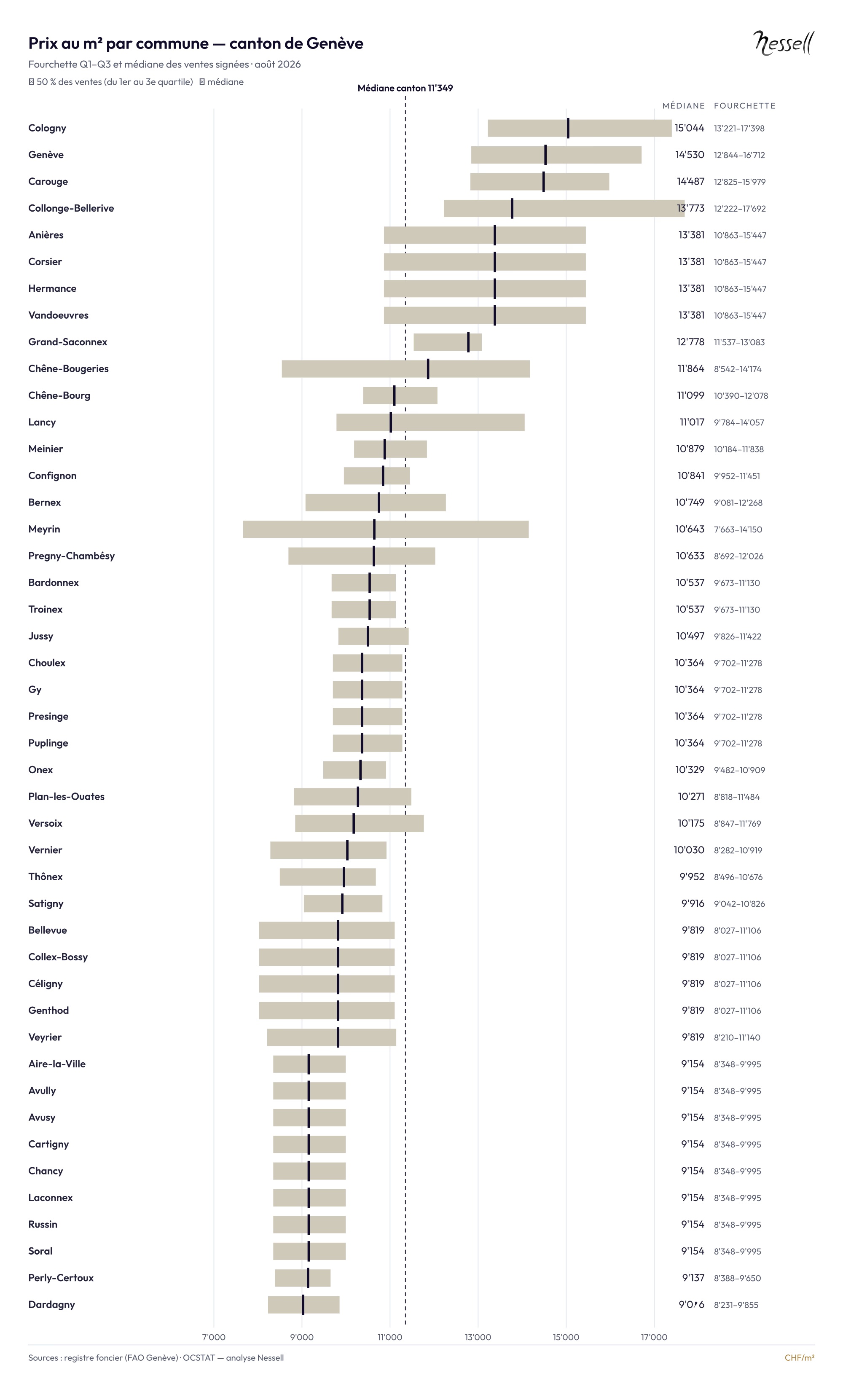
How to read it: the bar covers the middle half of each commune’s sales, the tick marks the median. Prices roughly double between the most affordable communes and Cologny at the top; the cantonal median is CHF 11'349/m² and the city of Geneva CHF 14'530/m² (August 2026).
Prices per square meter roughly double between Geneva’s municipalities. The most expensive line the left bank, along the lake, with Cologny leading at around 15'044 francs per square meter in median terms, and considerably more for exceptional properties, which exceed 35’000 francs.
The most affordable are on the outskirts, in the Champagne area and the suburban ring, such as Dardagny, at around 9'026 francs. These medians are based on sales signed in the land register (August 2026).
What trends are shaping the real estate market in 2026?
Three trends mark the Geneva market in 2026: declining transaction volumes, stabilizing rents and falling new construction. 2024 sales fell to 2’964 transactions worth 7.819 billion francs (OCSTAT), 504 fewer sales than in 2023 and the lowest level since 2019.
Rents are rising moderately, up 1.4% over 2024 (Wüest Partner). New construction dropped from 3’456 homes completed in 2023 to 2’133 in 2024. The following subsections detail transactions, then the dynamics of rents and construction.
How are transaction volumes evolving in Geneva?
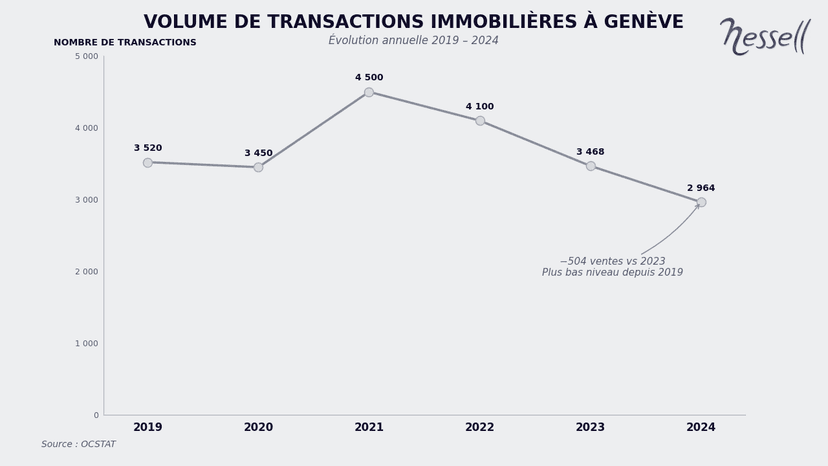
Transaction volumes are declining markedly in Geneva. There were 2’964 sales in 2024 (OCSTAT), 504 fewer than in 2023 and the lowest volume since 2019.
Their total value nonetheless reached 7.819 billion francs, close to the 2023 level: the drop in the number of sales was offset by the rise in unit prices.
What is the dynamic of rents and the pace of new construction?
The dynamics of rents and of construction point the same way, that of a constrained market. Rents are rising moderately, up 1.4% in 2024 (Wüest Partner), but this average masks two regimes: re-letting rents climb faster with each turnover, while ongoing leases, governed by tenancy law, move only marginally. The return of the reference mortgage rate to 1.25% on September 1, 2025 (Federal Housing Office) reopens the path to a rent-reduction request for affected tenants.
On the supply side, new construction fell to 2’133 homes in 2024, down from 3’456 in 2023, far short of the 5’850 targeted by the Cantonal Master Plan; 7’935 homes were still under construction at the end of 2024 and 2’496 were authorized during the year (OCSTAT).
How does the cantonal legal framework influence the market?
The cantonal legal framework filters supply and demand through three mechanisms. The General Law on Development Zones (LGZD) regulates sale prices and rents in development zones. The Lex Koller, the federal law on the acquisition of real estate by persons abroad, filters non-resident foreign demand. The Law on Demolitions, Conversions and Renovations (LDTR) protects the existing rental housing stock.
The following two subsections expand on development zones and the Lex Koller.
What role do price-controlled development zones play?
The development zone mechanism subjects new construction to sale prices and rents regulated by the State for ten years (LGZD). This regulation forms a significant share of the housing accessible to the middle class.
Article 4A, amended in 2021, splits these programs into three equal shares: public-utility housing, intermediate housing, and individually owned housing (State of Geneva).
How does the Lex Koller filter foreign demand?
The Lex Koller subjects the acquisition of real estate by non-resident foreign persons to cantonal authorization, which filters international speculative demand in the open residential segment. This federal law of December 16, 1983, in force since January 1, 1985, limits the annual authorization quotas per canton (Federal Office of Justice).
What are the prospects and long cycles for the Geneva real estate market?
The prospects for the Geneva market point to moderate price growth and stabilizing rents. UBS anticipates a contained rise in Swiss residential prices through 2026, supported by declines in the reference mortgage rate and by the structural scarcity of supply.
This trajectory extends the profile traced throughout this guide: a tight, expensive market, but without overheating. The following two subsections place this moment within the long cycles and examine the risk of a bubble.
What are the long cycles of the Geneva real estate market?
The length of a Geneva real estate cycle varies according to market and rate phases. It unfolds around an expansion phase, driven by falling rates and population growth, a plateau of high prices, then a correction phase that structural scarcity keeps limited in time.
The Geneva cycle shows an observable phase lag compared with the Swiss cycle: in the Lake Geneva region, price stabilization comes before that of the rest of the country (Wüest Partner).
Is the Geneva real estate market in a bubble?
The Geneva market is not in a bubble, according to the 2025 analysis. The UBS Swiss Real Estate Bubble Index stands at 0.29 points in the third quarter of 2025, a moderate risk, well below the high-risk threshold of 1.0 point set by UBS.
The Geneva region shows no marked imbalance, its recent price rise remaining below the Swiss average (UBS).
These cycles are a reminder that a property’s value is never fixed. A property valuation in Geneva places it in today’s market.