
Buy or Rent in Geneva: The Complete Comparison to Help You Decide
In Geneva, choosing between buying and renting a home comes down to a financial, tax and personal trade-off, made more complex by the scarcity and cost of the cantonal market. This guide sets out to compare the two statuses side by side to make the decision easier, drawing on official Swiss and Geneva bodies.
The first step is to pin down what this trade-off means in Geneva and what sets it apart from a typical Swiss trade-off.
What is the buy-versus-rent trade-off in Geneva?
The buy-versus-rent trade-off in Geneva is the economic and personal comparison between owner-occupier status and tenant status, for the same housing need. This trade-off is assessed along three lines: the total cost measured against the holding period, the taxation attached to each status (including the imputed rental value taxed on owners), and personal flexibility, covering mobility and savings capacity. According to federal housing statistics, the canton is an exception: Geneva has the lowest home-ownership rate in Switzerland, at close to 19 % of households.
Should you buy or rent your home in Geneva?
It depends: in Geneva, buying is more advantageous provided the buyer can contribute at least 20 % equity, has sufficient borrowing capacity, and a holding horizon of around ten years. Below that, or for a mobile household with little equity, renting remains the better choice.
Banking studies comparing the annual cost of buying and renting in Switzerland conclude in favour of ownership over the long term, driven by low financing rates. Renting nonetheless remains the majority status in the canton, owing to the scarcity of land and a large international population.
What financial criteria should be compared between buying and renting in Geneva?
From a financial standpoint, comparing a purchase and a rental in Geneva comes down to examining four criteria.
- Equity: the minimum personal contribution required to access mortgage credit.
- Borrowing capacity: the share of income that can be committed to repaying the debt, governed by the Swiss affordability rule.
- Monthly cost of buying: mortgage interest, amortisation, maintenance and the owner’s taxes.
- Monthly cost of renting: net rent and charges.
The first of these criteria, the personal contribution, drives all the others.
How much does buying cost per month compared with renting in Geneva?
In Geneva, the monthly instalment for a purchase is generally higher than the rent for an equivalent property. But this gap is by no means a pure extra cost: the amortisation portion of the instalment is savings that build up wealth, whereas rent is an expense with no return.
It is only over time that buying comes out ahead, driven by this forced savings effect and by the property’s appreciation, not by a lower monthly cost.
Does buying amount to forced savings compared with rent “lost” in Geneva?
Only in part. Of the loan instalment, the amortisation portion is indeed a form of forced savings in Geneva: with each instalment, the amount of debt falls and the net equity held in the property rises, whereas rent gives rise to no build-up of wealth.
Banks impose this discipline on their clients, requiring them to bring the debt down to two-thirds of the property’s value within fifteen years at most. The subtlety is that only the amortisation portion counts as savings: interest, maintenance and taxes remain, like rent, money spent with no return.
What annual maintenance cost does the owner bear (the 1 % rule)?
Around 1 % of the property’s value per year. In Geneva, every year, an owner must set aside close to 1 % of their home’s price to cover routine upkeep and future renovations, such as the roof, heating or façade. A cost the tenant does not have to bear.
For a CHF 1’200’000 property, this amounts to roughly CHF 12’000 a year, or CHF 1’000 a month, to be added to the real cost of ownership. This 1 % rule gives a prudent ballpark figure, but actual costs vary with the age and condition of the property.
How much would equity earn if invested instead of used to buy?
This can amount to several thousand francs a year. As long as equity is tied up in a purchase, for example CHF 240’000 for a CHF 1’200’000 property, it is no longer working in the financial markets: this is the opportunity cost of ownership.
Invested in a diversified portfolio with an average annual return of 3 to 5 %, that CHF 240’000 would earn roughly CHF 7’000 to 12’000 a year. The trade-off therefore comes down to comparative returns, since buying only pays off if the property’s appreciation and the rent saved exceed what the capital would have earned elsewhere.
What holding period makes buying more profitable than renting in Geneva?
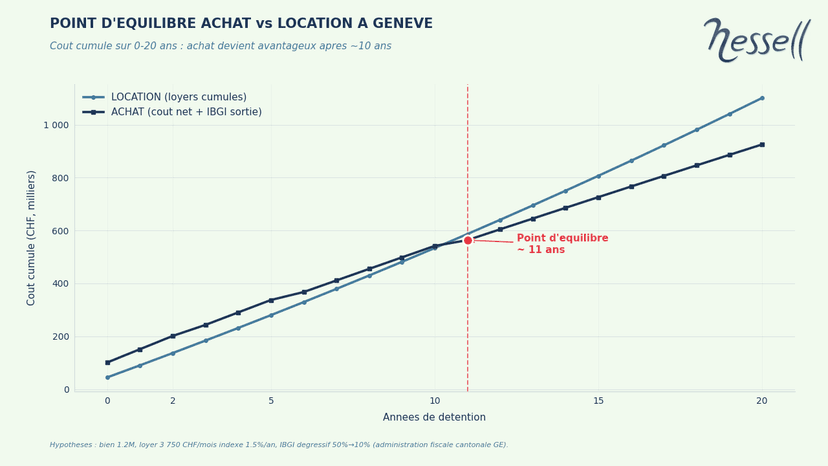
From around ten years of ownership onwards. Below that, renting remains more advantageous in Geneva; beyond it, buying yields a positive net margin against the cumulative rent avoided.
Two factors determine this threshold. First, entry costs of 4 to 5 % of the price: transfer duties, notary fees, the mortgage note and bank arrangement fees, which need to be amortised over time. Second, the declining scale of the real estate capital gains tax (IBGI), which runs from 50 % of the gain for a resale within two years down to 10 % beyond ten years, according to the Geneva cantonal tax administration.
How does the Geneva property market shape the buy-versus-rent trade-off?
The Geneva market sharpens both sides of the trade-off through its extreme scarcity and prices among the highest in Switzerland. The vacancy rate reaches only 0,34 % as of 1 June 2025, the lowest in the country and the lowest since 2012, while the average price of a condominium (PPE) apartment stood at CHF 13’548 per square metre in 2024 (Cantonal Statistical Office).
This scarcity cuts both ways: it favours buying through the scarcity premium expected on resale, but pushes people to stay tenants for lack of property to buy. Cantonal regulation, through the LDTR (law on the demolition, conversion and renovation of housing) and development zones, keeps a controlled supply with capped rents.
How does the tax impact differ between owner and tenant status in Geneva?
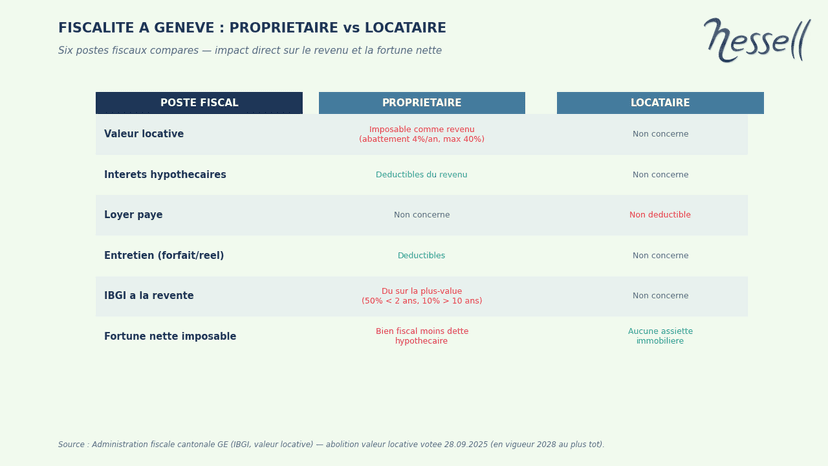
The tax impact clearly sets the two statuses apart. Each year, the owner declares the imputed rental value of their home as taxable income (this is set by the cantonal tax administration and reduced by an allowance of 4 % per year of continuous occupancy, up to a limit of 40 %), and in return deducts mortgage interest as well as maintenance costs, either at a flat rate or on an actual-cost basis.
The tenant declares no notional income but cannot deduct rent either. On resale, the owner pays the real estate capital gains tax under the declining IBGI scale, and their taxable wealth includes the property’s tax value less the mortgage debt.
On 28 September 2025, however, the Swiss people voted 57,7 % in favour of abolishing the imputed rental value, though it cannot come into force before 2028.
What role does personal mobility play in the choice between buying and renting in Geneva?
Decisive. An early resale destroys the profitability of a purchase in Geneva. An owner who sells within four to six years suffers three penalties: entry costs not yet amortised, a high real estate capital gains tax under the declining IBGI scale (50 % of the gain for a holding period under two years, 40 % between two and four years), and the risk of a capital loss if the sale falls at a low point in the cycle.
Renting therefore remains rational for people exposed to international job relocation, common in a city of multinational headquarters and international organisations, even when its direct monthly cost appears higher.
Buy or rent in Geneva: comparison table of costs, risks and advantages
The table below summarises the costs, risks and advantages of each status in Geneva.
| Criterion | Buying in Geneva | Renting in Geneva |
|---|---|---|
| Equity required | 20% minimum (240’000 CHF on 1,2 MCHF) | Rent guarantee (max 3 months) |
| Monthly cost (4-room) | 4’000 to 5’500 CHF including charges and tax | 1'744 CHF excluding charges, free-market rent (OCSTAT, May 2025 survey) |
| Taxation | Imputed rental value taxed + interest and maintenance deductions | No notional income, no rent deduction |
| Flexibility | Low, costly resale under 10 years | High, 3-month notice period |
| Capital built up | Yes, amortisation and potential capital gain | No |
| Market downturn risk | Borne by the owner | None |
| Entry costs | 4% to 5% of the price (notary, transfer, mortgage note) | Security deposit |
| Exit costs | Declining IBGI (50% to 10% depending on duration) | None |
The choice depends on personal timing, covered in the next section.
What alternatives exist between outright buying and standard renting in Geneva?
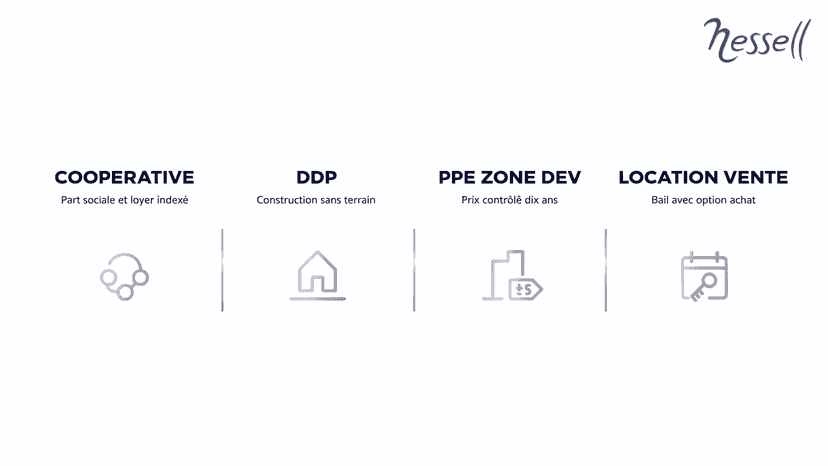
In Geneva, three intermediate statuses sit between outright buying and standard renting. The housing cooperative is a hybrid status: members hold a share in the capital and pay a cost-indexed rent, with no individual capital gain on resale.
The right of superficies (building right, DDP) allows buyers to purchase only the building, in exchange for ground rent paid to an institutional landowner, which reduces the initial contribution. Condominium (PPE) ownership in a development zone gives access to property at a controlled price, in exchange for a ten-year occupancy commitment. Each one shifts the balance between flexibility, capital built up and taxation.
Is it better to buy in Geneva or rent and invest elsewhere?
This trade-off is decided on the basis of comparative returns and the opportunity cost of capital. In Geneva, the average gross rental yield on a property stands at between 2 and 3 %, against 4 to 6 % for investment properties in German-speaking Switzerland, according to cantonal banks’ market bulletins.
A Geneva household therefore has a rational interest in remaining a tenant and investing its equity in an income property outside the canton, a listed real estate fund, or a diversified portfolio, in order to capture a higher return than that of a primary residence in the city centre.